
A long call means you buy a call option and gain the right to buy the underlying later at a fixed price. We will look at what this position solves, where the breakeven sits, and what time and volatility do to it.
What we are solving
You have a bullish view on a stock, but you don't want to put the full purchase price into it and you don't want an ordinary decline to bring you a large loss. Buying a call option solves this problem only partially: you pay a known amount up front and, in the option position itself, you cannot lose more than that amount (after exercise or a large gap, however, you already hold a different, stock exposure) — and you pay for this advantage with expiration and time.
So we address three practical questions: how much the stock must rise for the trade to pay off at all, how long you have for that, and what happens when you get the direction right but the move is small or comes late. Those answers determine whether a long call is a suitable tool for your thesis — not the direction itself.
What options you have
You can express a bullish thesis in several ways, and each one has a different profile:
- Buying stock — full exposure, full capital, dividends, no expiration.
- Long call — limited loss and leverage, but you pay the option premium and time.
- Bull call spread — cheaper than a standalone call, but the profit is capped.
- Risk reversal — a call financed by selling a put, but with downside risk.
- ZEBRA — two long call options and one short call; otherwise a technically composite, stock-like exposure with balanced time value. It is not automatically better — just a different trade-off between capital, exposure, and management.
The question is not which variant is “better”, but which one matches the size of the expected move and the time for which you want to be in the position.
Why long call specifically
A long call is useful when you want a defined maximum loss and at the same time leverage for a limited period. One contract controls exposure to 100 shares (the multiplier of 100 is an example for equity options, not a universal constant) and you risk only the premium paid. Compared with buying the stock outright, the loss is known in advance and capped.
The price for that is time: you need a move, not just the right direction. A modest rise above the strike price may not be enough, because it must first cover the premium paid.
How it is constructed
A long call is a single leg: you buy a call option, pay the premium, and gain the right (not the obligation) to buy the underlying at strike K by expiration. You do not have to use the right — if it is unfavorable at expiration, you let the option expire.
| Leg | Position | Strike | Quantity | Expiration |
|---|---|---|---|---|
| 1 | Long call | K (chosen) | 1 contract | chosen |
For equity options the multiplier is usually 100, so a premium of 3.00 per share means 300 per contract. For index options, settlement is usually cash; with American-style equity options you can, as the holder of the right, exercise the option at any time, which requires capital to buy the shares.
How it behaves
The price of an option consists of intrinsic value and extrinsic value / time value. For a call, intrinsic value is max(S − K, 0), i.e. only the amount by which the underlying is above the strike. Everything else is time value — compensation to the seller for risk and for the time the right grants.
When you buy a long call, you are buying primarily time value, and that disappears as expiration approaches. That is why a long call needs a move, not just an opinion: the underlying must rise enough to cover the premium and the costs.
Compared with the stock
The difference from the stock is best seen in numbers. A hypothetical stock at 100 and a call with a strike of 105 for a premium of 3.00:
| Attribute | 100 shares | Long call (1 contract) |
|---|---|---|
| Capital to enter | 10 000 | 300 |
| Maximum loss | theoretically the entire value of the stock | 300 (premium paid) |
| Rise of the underlying (at expiration) | 1:1 with the stock | rises from 105 (slope 1:1 per share) |
| Dividends | yes | no |
| Expiration | none | yes |
Beware a common confusion: one call contract is not the same as 100 shares unless the delta is 1. Its exposure is approximately delta × 100 shares and changes as the price moves (delta and gamma). Before expiration the price of the call can increase even below the strike (for example, when IV rises or as expiration approaches for an ITM option), so the local delta is not the same as the slope of the payoff at expiration.
When it makes sense and when it does not
A long call makes sense when: (a) you expect a move large enough to cover the premium; (b) you are willing to accept a complete loss of the price paid; (c) you have a view on time and volatility as well, not just on direction; (d) you understand that a cheap out-of-the-money option has a low delta and needs a pronounced move.
Conversely, it is not suitable when you want to hold the position long term without expiration, when you need dividends, or when your thesis is only “slightly higher” — there a spread or the stock tends to be more appropriate.
What can go wrong
The direction can be right and the trade can still lose money:
- Time and a fall in volatility. You hold negative theta and positive vega; after an event, implied volatility can drop sharply and wipe out the profit even with the right direction.
- Breakeven above the strike. Being right on direction does not yet mean earning; in the example the breakeven is 108, not 105.
- Liquidity and the spread. At distant strikes the bid–ask spread is wide and the costs of entry and exit can exceed the expected profit.
- Multiplier and settlement. Both the multiplier and the style of the option differ across different underlyings.
Greeks and exposure
Under ordinary conditions a long call has positive delta (0 to 1 per share), positive gamma, positive vega, and negative theta. These are local sensitivities of the model, not guaranteed changes in P/L:
- Delta ∂V/∂S — how the value of the option moves with the price of the underlying. For a call with dividend yield q, delta = e−qT·N(d₁); it is not the probability that the option finishes in the money (that, under risk-neutral measures, corresponds to N(d₂)).
- Gamma ∂Δ/∂S — how quickly delta changes; it is usually highest near ATM and close to expiration. In P/L the second order shows up approximately as ½·Γ·ΔS².
- Theta ∂V/∂t — erosion of time value, which accelerates in the final weeks for ATM options.
- Vega ∂V/∂σ — sensitivity of the value to σ expressed in decimal terms; the value “per 1 percentage point” is 0.01× this derivative, so the units must not be confused.
- Rho ∂V/∂r — sensitivity to rates; it is usually small, but for longer expirations and higher rates or carry it plays a role.
The Greeks apply to a given moment, price, IV, and time; in a large jump or a change in the shape of the volatility skew they describe reality only partially.
Practical example
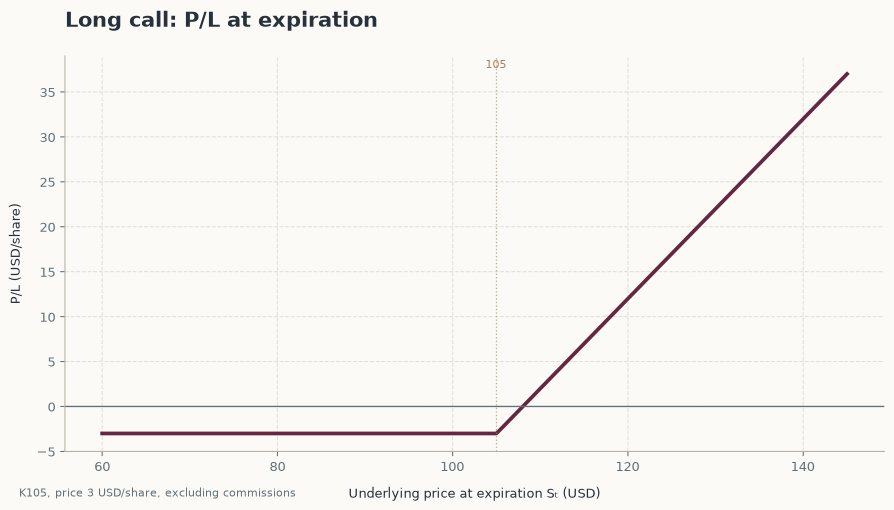
The hypothetical underlying trades at 100. You buy a call with a strike of 105 for a premium of 3.00 per share, one contract = 100 units, expiration in 60 days; for illustrative purposes we ignore commissions and slippage.
- Payoff at expiration per share: max(ST − 105, 0)
- P/L at expiration per share: max(ST − 105, 0) − 3.00
- Breakeven: ST = 105 + 3.00 = 108.00
- Maximum loss: 3.00 per share, i.e. 300 per contract
| Underlying price at expiration | Option value per share | P/L per share | P/L per 1 contract |
|---|---|---|---|
| 90 | 0.00 | −3.00 | −300 |
| 100 | 0.00 | −3.00 | −300 |
| 105 | 0.00 | −3.00 | −300 |
| 108 | 3.00 | 0.00 | 0 |
| 115 | 10.00 | +7.00 | +700 |
| 130 | 25.00 | +22.00 | +2 200 |
Between 100 and 105 the option is worthless at expiration; above 105 the payoff grows linearly with a slope of 1.00 per share. The payoff function at expiration is not the same as the value of the position today — before expiration the option is priced by the market and its price depends also on time, IV, rates, and dividends.
Checklist before use in practice
For an experienced options trader, these two checks are especially important before deciding:
- Compare the required move to expiration with the price of the option and with the alternative of a call spread.
- Allow for the fact that the right direction, with unsuitable IV and timing, can end in a loss.
Key takeaways
A long call exchanges full exposure to the stock for leverage with limited loss, but in doing so you buy yourself expiration and the need for a move. Decide based on the breakeven and on the time you give the underlying — not on the fact that the option is “cheap”.
Sources
- Long Calllegs, terminal risk/profit, and the practical risks of a long call position
- Options Basicsright versus obligation, the basic mechanics of equity options
- Understanding Options GreeksGreeks as local sensitivities and model inputs (without claiming an exact N(d1)/N(d2) distinction)
- The Black-Scholes Model — Martin Haugh, Columbia UniversityN(d1) delta versus N(d2) risk-neutral probability of ITM and the parity relationships in the Black–Scholes model