
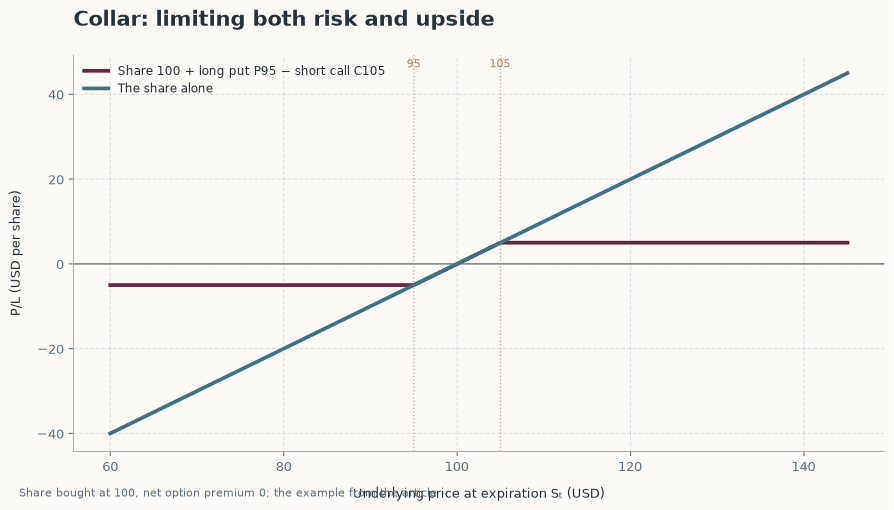
A collar is a strategy that adds a protective put to shares you hold and finances it by selling a covered call. We will look at how it is built, what zero-cost means and why a zero payment is not zero risk.
What we are addressing
You hold shares — for dividends, taxes or a long-term thesis — and you want to limit short-term downside risk without selling the shares. Buying a protective put solves that problem, but it costs premium. A collar finances it by selling a covered call: you get paid for giving up gains above the chosen strike.
This addresses the question of how much protection you can afford and what you pay for it — and why a "zero-cost" collar is not the same thing as free protection.
What options you have
- Sell the shares — the risk disappears, but you realize a tax liability and give up dividends and further gains.
- Buy only a put — it does not limit gains, but it is more expensive because you are not selling anything.
- Put spread — cheaper protection, but it does not protect you below the lower strike.
- Collar — shares + long put + short call; protection in exchange for capped gains.
Why the collar specifically
A collar holds shares, buys a put as insurance and sells a call to finance it. The resulting profile has two boundaries: at the bottom the put protects you, at the top the short call limits you. It is not hedging without cost — the cost is the forgone upside and the risk that the short call takes the shares away from you sooner than you expect.
Compared with a standalone put, a collar lowers the cost of protection. Compared with selling the shares, it preserves exposure and dividends for as long as you hold the shares.
How it is built
| Leg | Position | Type | Strike | Role |
|---|---|---|---|---|
| 1 | Long shares | underlying | — | core exposure and dividends |
| 2 | Long put | put | Kp (lower) | lower protection |
| 3 | Short call | call | Kc (higher) | financing of the put, covered call |
The expiration payoff per share is (S − S0) + max(Kp − S, 0) − max(S − Kc, 0) + net payment. Below Kp the P/L is constant (the put protects), between the strikes it moves with the share, above Kc it is again constant (the call limits gains). That is why a collar is sometimes described as a "synthetic long call spread on the stock".
How it behaves
The protection is conditional on the strike and the expiration: it covers only a decline below Kp and only until expiration. Between the current price and Kp you bear the loss yourself — that is your "deductible". Above Kc, by contrast, you do not participate in the gains.
How much protection you get depends on how close to the share price you place the put, and how much upside you give up depends on how low the call strike sits. You cannot have strong protection, full upside and a zero payment at the same time — that would contradict option pricing itself.
Versus the stock and a short position
A collar contains actual shares, so it is compared directly with holding shares:
| Characteristic | 100 shares | Collar (shares + put + short call) |
|---|---|---|
| Protection on the downside | none | down to the put strike, until expiration |
| Upside | unlimited | capped at Kc |
| Dividends | you receive them | you receive them as long as you hold the shares |
| Cost | none | forgone upside, fees, possibly a debit |
| Assignment risk | — | the short call can take your shares away |
Against short selling shares, a collar is the exact opposite: a short position bets on a decline and carries unlimited risk to the upside, while a collar stays long and has its upside risk capped (by the forgone gains). Against a risk reversal, the difference is fundamental: a risk reversal contains no shares, so its short put does not hedge any existing exposure.
When it makes sense and when it does not
A collar makes sense when you want to keep the shares and at the same time limit short-term risk and you are willing to give up gains above the call strike. It suits liquid shares and options.
It is not suitable if you need the full upside, if the options are illiquid and the costs exceed the benefit of the protection, or if there is a risk of assignment of the short call at a moment when you do not want to lose the shares.
What can go wrong
- Protection is neither complete nor permanent. It covers only a decline below Kp and only until expiration.
- The upside is capped. Above Kc you do not participate in gains, even if the thesis plays out strongly.
- Early assignment of the short call. Typically before the ex-dividend date, if the call is in the money and the remaining time value is less than the dividend. You must deliver the shares and the collar falls apart — cash and the long put remain, but not the shares.
- Settlement at expiration. Above Kc the shares are delivered at Kc; below Kp they are sold at Kp. With index variants the mechanics differ.
- Dividends, margin and corporate actions. On assignment you can lose the dividend; after assignment the hedge disappears and the margin changes. Splits and mergers can change the strike or the deliverable.
- Fees and slippage. Three legs mean more costs; with less liquid options the execution can be worse than the model shows.
Greeks and exposure
- Delta: between the strikes, delta ≈ 1 + Δ(put) − Δ(call), so it can be well below +1 because both options have a non-zero delta; it declines towards the strikes — to zero at the bottom (the put starts to take effect), to zero at the top (the call limits gains).
- Gamma: a long put has positive gamma, a short call negative; the net gamma depends on which option is closer to the money and on time — it is not determined by the number of legs alone.
- Vega: long put vega is positive, short call vega is negative. In markets with a skew, OTM puts tend to have relatively higher IV (this is not a higher absolute premium, but a relative valuation of volatility), so the net vega need not be zero.
- Theta: the long put loses time value, the short call gains it; the net theta is usually small and changes with the position of the price.
The Greeks are local sensitivities of the model. With a collar, the mechanics matter more than the Greeks themselves: the protection is conditional on the strike and the expiration, and the short call can change the structure through assignment.
Practical example
The share is at 100. You buy a 95 put for 3.00 and sell a 105 call for 3.00. The net payment = 0.00 — a zero-cost collar; we assume 100 shares, prices per share.
- Below 95: P/L = 95 − 100 = −5.00 per share (−500 for 100 shares)
- Between 95 and 105: P/L = ST − 100
- Above 105: P/L = 105 − 100 = +5.00 per share (+500 for 100 shares)
| Share price at expiration | P/L per share | P/L on 100 shares |
|---|---|---|
| 80 | −5.00 | −500 |
| 95 | −5.00 | −500 |
| 100 | 0.00 | 0 |
| 105 | +5.00 | +500 |
| 120 | +5.00 | +500 |
"Zero-cost" means only a zero initial payment, not zero risk. The maximum loss is 5.00 per share and the maximum gain is also 5.00 per share. If the share jumped to 150, with the collar you would still earn only 5.00 — the forgone upside is the real economic cost of the protection.
Checklist before using it in practice
For an experienced options trader, the following two checks are particularly important before deciding:
- When calculating the protection band, include the purchase price of the shares held and the net premium of both options.
- Check the ex-dividend date on the short call and the state of the underlying in the event of possible delivery.
Key takeaways
A collar exchanges part of the upside for downside protection and is built on actual shares. It suits holders who want to limit short-term risk and are willing to pay for it with forgone upside; the "zero-cost" form does not mean zero risk or zero cost.
Sources
- Collar Protective Collar | Options Educationlegs of the protective collar and the terminal risk/reward
- Long Putmechanics of the long put as lower protection
- Understanding Options Greekslocal sensitivities and the limits of the model