
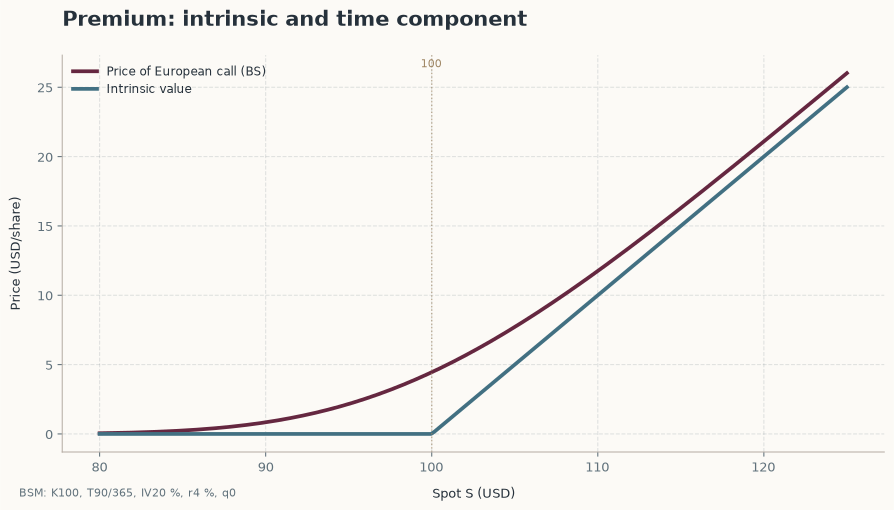
The premium is the price you pay for an option when you buy it, or that you receive when you sell it. A premium received is not, by itself, profit. In the article you will learn what the option price is made up of, what changes it and how to also take costs into account when assessing the result of a trade.
What we are addressing
With a stock you pay one price and you know it. With an option you pay a premium, which consists of intrinsic value and a time component — and each of them behaves differently. Moreover, the premium is not the same as the price you actually pay: bid–ask spread, fees and slippage come into play.
The practical problem is: how to tell whether an option is expensive, and how much value an option can still have when closed early and what part of the premium can decay by expiration.
Intuition
Imagine a stock price that consists of two parts. The first is what you would receive upon immediate exercise — intrinsic value. The second is the price of the possibility that something will happen by expiration — extrinsic value / time value. For an ATM option the first component is zero and the entire premium is time value.
The premium is the price of risk and of a right, not an exchange fee. Just like a stock, it has two sides: the bid, at which it can be sold, and the ask, at which it can be bought.
A simple example
Model valuation of European call options in the Black–Scholes model: S = 100, IV = 20 % per year, r = 4 % per year, q = 0, T = 90/365 of a year. All prices are per share, without fees.
- Call K = 100 with 90 days: price approximately 4.45; intrinsic value 0.00, the entire premium is time value.
- Call K = 90 with 90 days: price approximately 11.45; intrinsic value 10.00 and time value 1.45.
- One call contract K = 100 with a multiplier of 100: price 4.45 × 100 ≈ 445 (rounded to whole dollars).
For the call K = 100 the same model has an initial vega of approximately 0.196 per share per one percentage point of IV. A shift in IV from 20 % to 21 % raises the price, by exact repricing, from approximately 4.451 to 4.647, i.e. by 0.196 per share, or approximately 4.4 % of the original premium. This is a local sensitivity; confusing a percentage point of IV with a percentage change in price is a mistake.
Why it matters
You pay the premium for a right, not for certainty. That is why it is important to know how much of it is intrinsic value and how much is time value: intrinsic value moves with the price of the underlying, while time value evaporates as expiration approaches. This distinction determines how much the position behaves like a stock and how much like a bet on movement and volatility.
How it shows up in the position
The size of the premium is determined by five inputs: the price of the underlying, the strike price, the time to expiration, implied volatility and interest rates together with dividends.
| Input | Call | Put |
|---|---|---|
| Underlying price rises | price rises | price falls |
| Strike rises | price falls | price rises |
| Time to expiration rises | usually rises | usually rises |
| IV rises | price rises | price rises |
| Rates rise | usually rises | usually falls |
| Dividend yield rises | usually falls | usually rises |
The table describes typical directions in a European model with the other parameters held fixed, not the magnitude of the move. A negative starting rate does not by itself flip the sign of rho for a European vanilla call/put option. For American options, changes in dividend expectations or simultaneous market moves, the actual repricing may differ.
A common mistake
The most common mistakes include confusing the price per share with the price per contract, the assumption that the premium is always at least the intrinsic value, and judging expensiveness by absolute price regardless of IV and exposure. With European options the price may be lower than the intrinsic value, because the right cannot be exercised earlier.
For advanced readers
In an arbitrage-free risk-neutral valuation, with a correct model price, the premium paid equals the discounted expected payoff under the risk-neutral measure; the discounted expected net result of the purchase is then zero before costs. This is not a statement about the actual expected return under the real probability measure; the real world adds a risk premium that can be positive or negative depending on realized volatility. Therefore it is not true that selling options is systematically profitable and buying them systematically loss-making.
The Greeks are local: they apply to small changes in inputs around a given point. Valuation moreover depends on the model and on how IV, the rate and the dividend yield are specified, so the same option may be valued slightly differently in different models. The difference between implied and subsequently realized volatility is the most common explanation for why the long-term averages of buyers and sellers differ.
In practice
The premium paid may not come back, even if the investor was right about the direction. If the stock rises by less than the premium plus the costs, the long option loses money. Likewise, the move may arrive too late or be outweighed by a fall in IV. The premium must therefore be read together with the expiration and with how large a move is needed for it to be paid for.
Check before using in practice
For an experienced options trader, these two checks in particular are essential before a decision:
- At entry, separate the market price, the premium collected and the actual exposures after the multiplier.
- Premium received on short options is not realized profit until the position is closed or expires.
Key takeaways
- Premium is the market price of a right, not an exchange fee.
- It consists of intrinsic and time value; for an ATM option it is entirely time value.
- The real cost includes the spread, fees and slippage.
- The premium paid is the entry price of a long option, not an initial realized loss. If the option has market value when closed early, it can be realized by selling; the loss of the entire premium paid occurs at a worthless expiration (without counting fees); the application is discussed by long call and long put.
Sources
- Understanding Options Greeksvaluation inputs and local sensitivities of an option
- Volatility & the Greeksthe relationship between volatility and the option price, historical versus implied volatility
- Characteristics and Risks of Standardized Options — OCCofficial document on the risks of standardized options; kept as a reference, full text not verified in this run