
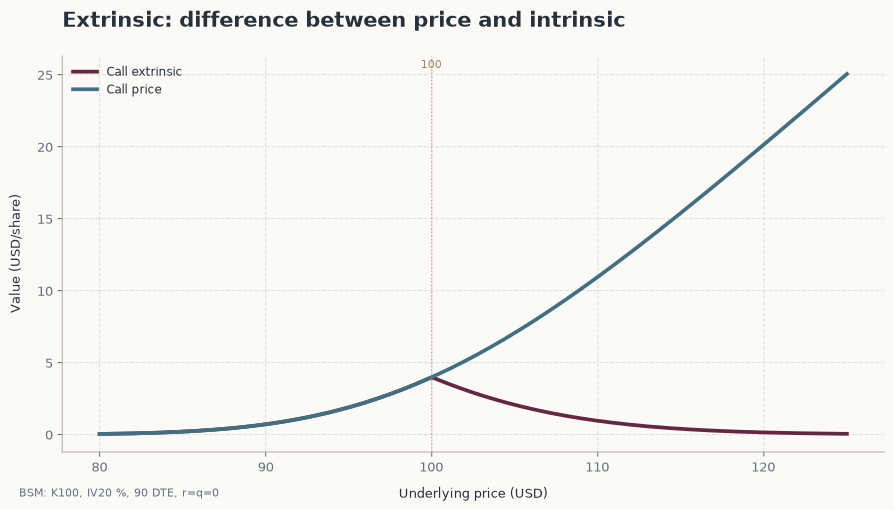
Time value is the part of an option's price you pay above intrinsic value, for time and uncertainty until expiration. We will look at how this part evaporates and why you can get the direction right and still lose money.
What we are addressing
For a share you pay a price that corresponds to its value. For an option, however, you also pay something extra: the price of the possibility that the stock moves before expiration. The part of the premium that exceeds intrinsic value is called time (extrinsic) value.
The practical question is: how much am I paying for time and uncertainty, how does that portion disappear when the market does not move, and why can I get the direction right and still lose money.
Intuition
Imagine that you buy an option today and the stock does not move at all before expiration. Intrinsic value stays the same, but time value shrinks, because less time remains in which something can happen. This decline is called time decay, and it is measured by theta.
Time value is largest around ATM, where there is the most uncertainty about the future direction, and it declines toward the wings. It is not an overpayment that always comes back — it is the market price of uncertainty.
A simple example
Model decomposition of European call options in the Black–Scholes model with S = 100, T = 0.5 years, IV = 20 % per year and r = q = 0; with no transaction costs.
| Option | Strike price | Premium | Intrinsic | Time |
|---|---|---|---|---|
| Call | 90 | 11.77 | 10.00 | 1.77 |
| Call | 100 | 5.64 | 0.00 | 5.64 |
| Call | 115 | 1.29 | 0.00 | 1.29 |
In this model the ATM call has the highest time value, while the ITM and OTM variants have lower values. If you choose a more distant OTM strike price, the premium paid usually decreases, but the probability of expiring worthless increases. A more distant ITM strike price has a different profile: it contains higher intrinsic value, a high delta and generally a lower risk of expiring worthless. Distance from ATM alone therefore does not determine the same risk on both sides.
Why it matters
For the option holder, time value is a cost that can melt to zero. For the seller it is income, but in exchange for an obligation and negative gamma. The decision to buy an expensive ATM option versus a cheap OTM option is in fact a decision about how much time value you want to pay and what exposure you get for it.
How it shows up in a position
Time value is not distributed evenly. For a given expiration and IV, it peaks around ATM and declines toward the wings. For a given strike price it grows with a longer expiration, but unevenly: four times the time to expiration does not mean four times the time value. During a sharp drop in IV, typically after an expected event, it can fall very quickly even if the underlying price does not move — this is called IV crush.
A common mistake
Common mistakes: treating time value as an overpayment that always comes back, assuming that it is positive for every option, and interpreting a fall in the option's price as proof of a wrong direction even though it was a drop in IV or time decay.
For advanced readers
For American options, in an ideal model without frictions and arbitrage, a lower bound holds: the price is at least at the level of intrinsic value, because the option can be exercised at any time. If it were lower, arbitrage would close it immediately. At the optimal early-exercise boundary, time value falls to zero, not below zero. The negative value you occasionally see in a quote usually reflects stale or unexecutable quotes, the spread and the costs of the trade, not the true model value below immediate exercise. For European options, the premium minus intrinsic value can be negative even in the model, because the right to earlier exercise does not exist.
The total time value paid for a position is the sum of the relevant premium components of all legs, with signs according to long and short. For structures sold as zero extrinsic, this number is the first check of whether the claim roughly matches reality — it is always an approximation that depends on the model and on market quotes.
In practice
An option's outcome depends on the path, not only on the final price. You can correctly estimate that the stock will rise, but if the move comes late, is too small, or IV falls in the meantime, time value evaporates before intrinsic value has a chance to rise. That is why, with an option, it does not pay to evaluate only the direction, but also time, the size of the move and the costs.
Check before using it in practice
For an experienced options trader, the following two checks are particularly important before deciding:
- Distinguish intrinsic and extrinsic on a genuinely tradable quote; for illiquid options, do not use the last trade uncritically.
- Before the ex-dividend date, for American calls assess the price of the remaining extrinsic against the dividend motive.
Key takeaways
- Time value is the part of the premium above intrinsic value.
- It is the price of time and uncertainty, not an overpayment.
- It is usually largest around ATM and grows with expiration.
- It disappears to zero or falls sharply when IV drops; theta and implied volatility discuss the connections.
Sources
- Thetatime decay of an option and its uneven course
- Understanding Options Greekslocal sensitivities including vega and the effect of volatility on the premium
- Characteristics and Risks of Standardized Options — OCCofficial document on the risks of standardized options; retained as a reference, full text not verified in this run