
A call option is the right, not the obligation, to buy a stock at a pre-agreed price by a certain date, paid for with a premium. We will look at when it makes sense to pay for the right instead of the stock, what it does to capital and risk, and how it differs from buying the stock directly.
What We Are Addressing
You buy the stock, pay its full price, and from the first day you bear the entire risk and the entire return. The call option offers a different path to upside: you pay only the premium and gain the right to buy the stock at a pre-agreed strike price by a certain date. The rest of your capital remains available to you.
This page addresses a practical question for the stock investor: when it makes sense to pay for the right instead of for the stock, what I gain from it and what I lose from it. The mechanics of the contract matter, but they come only after it is clear what problem the call actually solves and what horizon it has.
Intuition
Imagine you want a stock at 100, but you don't want to tie up the full 10 000 for one hundred shares. You pay a smaller amount and gain the right to buy it within three months at 105. When the stock rises to 120, your right has value and you earn on the move much like a stockholder — only with less capital. When it falls to 90, the right expires and you lose only the amount you paid, not the entire value of the stock.
On the other side stands the seller. They collect the premium immediately, but commit to deliver the stock at 105 when the counterparty calls on them. This is called assignment and it is the price for the risk you did not want to bear. A call is therefore an agreement about the transfer of risk, not about its disappearance.
A Simple Example
Hypothetical example: the stock XYZ is at 100.00. You buy one call with a strike of 105.00 and an expiration in three months for a premium of 3.00 per share. One contract corresponds to 100 shares; the multiplier 100 is chosen here as an example and is not universal.
- Cost: 3.00 × 100 = 300 before fees.
- Breakeven point at expiration: 105 + 3 = 108.00.
- Stock at 120: intrinsic value 15.00, i.e. 1 500; gross profit 1 200.
- Stock at 90: the right expires worthless, loss of 300.
For comparison: 100 shares would cost 10 000. At 120 they would bring in 2 000, at 90 they would lose 1 000. The call earns less in absolute numbers, but ties up far less capital and its loss is bounded in advance. Conversely, you forgo the dividend and the voting right, and you must resolve the entire position by the expiration date.
Why It Matters
For the stock investor, the call is interesting for two things: capital savings and a maximum loss known in advance. When you pay 300 for a position instead of 10 000, you can use the freed-up capital elsewhere or hold it in cash. That is a different distribution of risk, not automatically a better position.
The other side of the coin is extrinsic value / time value: part of the premium you pay for time and uncertainty. It shrinks as expiration approaches, which is what theta describes. That is why you can be right about the direction and still lose money — if the move arrives late, is too small, or implied volatility falls.
How It Shows Up in the Position
Under ordinary conditions a long call behaves as follows: it rises with the price of the underlying (positive delta), it accelerates on a move (positive gamma), it reacts to volatility (positive vega) and it loses over time (negative theta). The exact values depend on the strike, the price, the time and the IV.
| Aspect | Stock | Long call |
|---|---|---|
| Capital outlay | 10 000 | 300 |
| Maximum loss | the entire value of the stock | the premium paid |
| Dividend and voting | yes | no |
| Horizon | unlimited | until expiration |
| Sensitivity to time and IV | none | significant |
A practical rule follows from the table: a call suits situations where you want to limit risk and conserve capital, and it is a drawback where you want to hold the position for a long time and collect dividends.
A Common Mistake
The most common mistake is treating a call as a stock at a discount. A call is not an equity stake but a right with an expiration date; if the move does not come, the right can expire worthless. The second mistake is reading delta as the probability that the option will finish in the money — delta is a local sensitivity to price, not a promise of an outcome.
For Advanced Readers
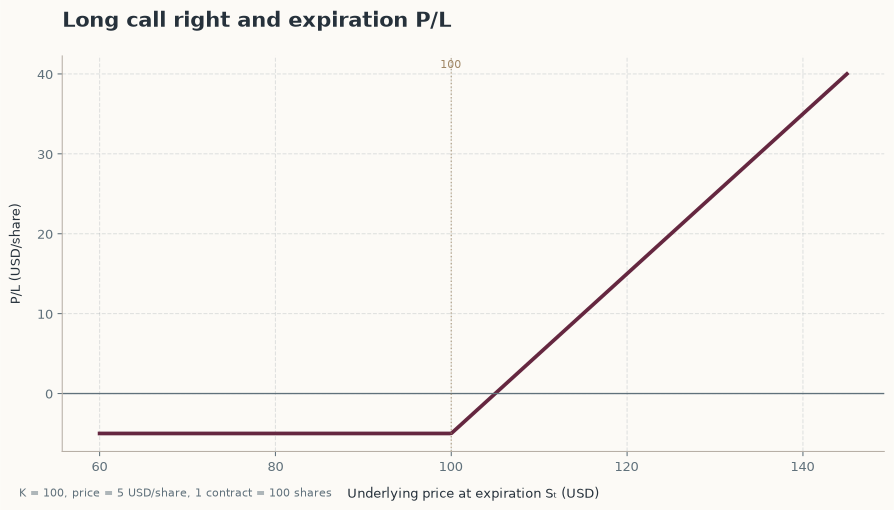
Formally, the payoff of a long call at expiration is max(S − K, 0) and the breakeven point is K + premium. Before expiration, the market valuation applies, into which time, IV, rates and dividends enter; that is why mark-to-market can differ from intrinsic value.
In the American style, the option can be exercised at any time, which in an ITM call before a dividend creates the risk of early exercise. In European index options, exercise is possible only at expiration. The difference between physical and cash settlement changes the cash flow as well as position management, and the costs of entering and exiting include the bid–ask spread.
In Practice
You can be right about the direction and still lose money. The stock rises from 100 to 104, i.e. by 4 %, but a call with a strike of 105 bought for a premium of 3 has a breakeven point of 108, so the right expires worthless and you lose the entire 300. Similarly, the move may come late, be too small, or be swallowed by a fall in IV. With a stock, the direction alone is enough; with an option, the move must be large enough and timely.
Check Before Using in Practice
For an experienced options trader, the following two checks in particular are essential before deciding:
- Before trading, establish whether it is a stock/ETF or an index call option and what the exercise style and settlement are.
- Separate the holder's right, the writer's obligation and the risk of a long vs. short position.
Key Takeaways
- In a standard American stock call, the holder has the right to buy the underlying at the strike until expiration and the writer bears the delivery obligation. European, cash-settled index calls (for example SPX), by contrast, are not exercised before expiration and do not deliver shares.
- A limited loss and lower capital are paid for with time, IV and the absence of dividends.
- Direction is not enough — time, volatility and costs also decide.
- First clarify what problem you are solving; the specific application is discussed in long call.
Sources
- Options Basicsthe right of the long side and the obligation of the short side in a call option, basic mechanics
- Exercising Optionsexercise and settlement for equity options
- Characteristics and Risks of Standardized Options — OCCofficial document on the risks of standardized options; retained as a link, the full text not verified in this run
- Cboe SPX Weeklys Specificationsexternal primary source for expert supplementation; verified 2026-10-11