
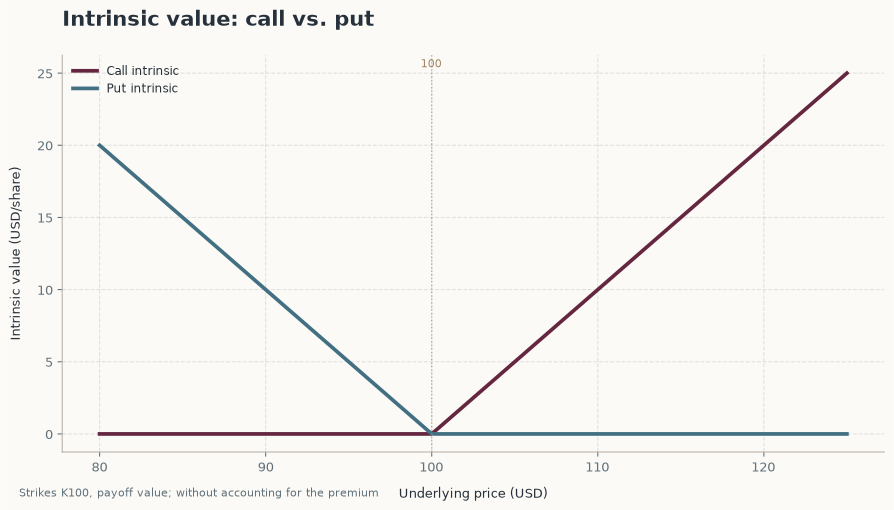
Intrinsic value is the part of an option's price that represents the real difference between the stock price and the agreed price. We will look at why it is not profit and when it pays to exercise an option.
What we're addressing
When you own a stock, its market quote is just the price at which it is trading right now — it is not a guarantee of the company's fundamental fair value. With an option, it is useful to know how much of its price is the real difference and how much is the price of uncertainty. The former is called intrinsic value. It is the value of immediate exercise: how much the option would deliver if you exercised it right now. It is not an estimate of the company's fundamental value, nor is it the profit of the position.
The practical question is: does it pay to exercise the option, or is it better to sell it on the market? And what is the difference between intrinsic value and profit from the option premium? How intrinsic value is calculated for a call option and a put option is shown in the example below.
Intuition
Intrinsic value tells you how deep in the money the option is. But it is not profit. An option with an intrinsic value of 10.00 for which you paid 11.50 loses 1.50 on immediate exercise — but you do not buy it in order to exercise it immediately; you buy it because you expect movement.
The portion of the price above intrinsic value is extrinsic value (time value). The greater the intrinsic value, the smaller the extrinsic component usually is, and the more the option behaves like a direct stock position — with the difference that expiration still exists.
Simple example
| Option | S | K | Intrinsic value |
|---|---|---|---|
| Call | 110 | 100 | max(110 − 100, 0) = 10.00 |
| Call | 95 | 100 | max(95 − 100, 0) = 0.00 |
| Put | 90 | 100 | max(100 − 90, 0) = 10.00 |
| Put | 105 | 100 | max(100 − 105, 0) = 0.00 |
For a call with K = 100 at S = 110, the intrinsic value is 10.00 per share, i.e. 1 000 per contract at a multiplier of 100. But that is not profit: if you paid 11.50 for the option, on immediate exercise you are at a gross loss of 1.50 per share. In general, the intrinsic value of a call is max(S − K, 0) and of a put is max(K − S, 0).
Why it matters
Intrinsic value helps you quickly assess moneyness, estimate extrinsic value as the difference from the premium, and decide on exercise. It also shows that different strikes carry a different share of the real and time components, and thus different behavior when price, time and volatility move.
How it shows up in the position
A deep ITM option with high intrinsic value has a delta close to 1 and a small extrinsic component, so it behaves almost like a direct position. An OTM option has zero intrinsic value and its entire price is extrinsic, which brings greater sensitivity to time decay and to a decline in IV, but lower capital requirements. The choice of strike price is thus always a choice between the intrinsic and extrinsic components.
Common mistake
The most common mistake is confusing intrinsic value with the profit of the position. The second is the universal claim that the premium is always at least intrinsic value — for European options that is not true. The third is ignoring the multiplier and the number of shares in the contract.
For advanced readers
For American options it holds that the price is usually at least at the level of intrinsic value, because the right can be exercised at any time; otherwise arbitrage would exist. For European options that is not true, because the right can be exercised only at expiration, and therefore the option may trade even below intrinsic value. The option style, rates and dividends decide.
In multi-leg structures, the intrinsic values of the legs partially offset each other. In a debit call spread, the resulting intrinsic value at expiration is limited to the difference of the strikes, which helps with a quick estimate of the maximum but says nothing about the ongoing mark-to-market or about the risk of time and volatility.
In practice
There are two practical uses. When deciding on an exit, compare the intrinsic value with the option's market price: if the market price is higher, it is better to sell the option than to exercise it. And when planning taxes and cash, be aware that exercise may realize a result differently than simply closing the position. Intrinsic value is a state, not a final profit.
Check before putting it to practical use
For an experienced options trader, the following two checks are especially important before deciding:
- Calculate the intrinsic against the relevant underlying, strike and settlement rules of the given series.
- Do not be confused by the trading price outside the spread: market price, intrinsic and realizable liquidation value are not the same thing.
Key takeaways
- Intrinsic value is the immediate value of the difference, not profit.
- Before expiration, extrinsic value (time value) is added to it.
- With European options, the price may be lower than intrinsic value.
- What decides is the premium paid, expiration and costs; the application is discussed by long call and vertical spread.
Sources
- Options Glossarydefinition of intrinsic value and moneyness
- Understanding Options Greeksrelationship between moneyness and local sensitivities
- Characteristics and Risks of Standardized Options — OCCofficial document on the risks of standardized options; kept as a reference, full text not verified in this run