
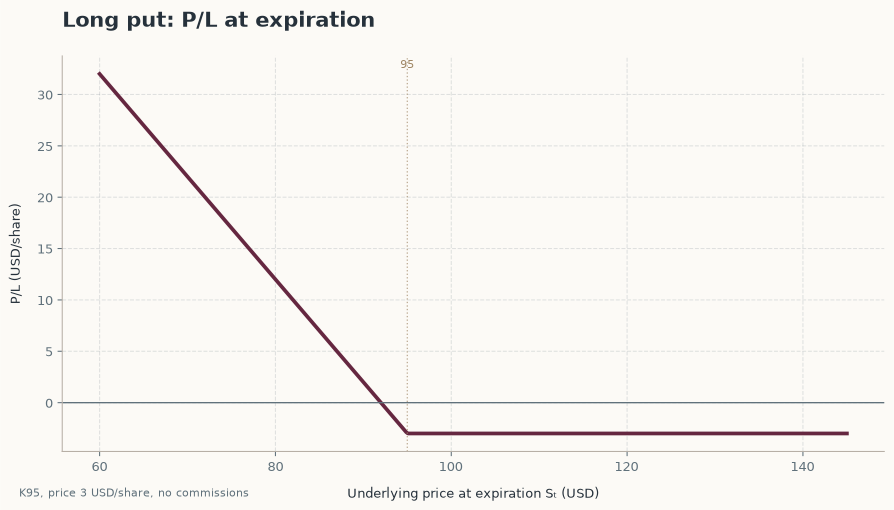
A long put is a bought put option that gives you the right to sell the underlying at a fixed price for a known premium. We will look at where the breakeven lies, why the profit is capped from above, and how this differs from short selling stock.
What We're Addressing
You hold stocks and are afraid of a decline, or you simply expect a decline and want to profit from it without unlimited risk. Buying a put option addresses both: you pay a known amount and gain the right to sell the underlying at strike K until expiration. The loss is limited to the premium, but both the protection and the profit have limits that you need to know before entering.
There are two key questions: how far must the price fall for the trade to pay off, and how much of the decline will the put actually pay you. The answer depends on the strike, on the premium paid, and on the time to expiration.
What Options You Have
Protection or bearish exposure can be obtained in several ways:
- Sell the stock — the risk disappears immediately, but you realize any gain or tax and give up the dividends and future growth.
- Hedge yourself with a long put — the downside risk is capped, but you pay the premium and time.
- Put spread — cheaper, but the protection ends below the lower strike and the profit is smaller.
- Short selling stock — a bet on a decline without a premium, but the upside risk is unlimited and you pay for the borrow.
The long put is therefore a compromise: a known maximum loss in exchange for limited profit and the cost of the premium.
Why the Long Put Specifically
The long put is the only basic position that gives a defined loss and a defined profit at the same time. You pay the premium and you cannot lose more; on the other hand, you know that even if the price falls to zero you will earn at most the strike minus the premium. This symmetry of a “known boundary below and above” is both its main advantage and its main limitation.
Compared with short selling stock, it has a fundamental advantage: you do not have to borrow anything, you do not pay borrow fees, and you do not lose without limit when the price rises.
How It Is Built
The long put is one leg. You buy a put option and for the premium you gain the right (not the obligation) to sell the underlying at strike K until expiration. Its value at expiration on a stock is max(K − ST, 0).
| Leg | Position | Strike | Quantity | Expiration |
|---|---|---|---|---|
| 1 | Long put | K (chosen) | 1 contract | chosen |
For equity options the put is settled physically (delivery of shares), for index options usually in cash. American options can be exercised at any time, European ones only at expiration. A multiplier of 100 is a common example for equity options, not a universal constant.
How It Behaves
A put works like insurance: you pay a known amount and gain the right to sell at a predetermined price. The lower the strike and the shorter the time, the cheaper the insurance — and the smaller the portion of the risk it covers. The difference between the current price and the put's strike is your “deductible”: you bear the loss within that band yourself.
For speculation on a decline the same logic applies as for a call: the price must fall below breakeven, not merely below the strike. With a put, moreover, the maximum profit is limited by the size of the strike, because the price of the underlying cannot fall below zero.
Compared with Short Selling and Stock Protection
The most common mistake is to confuse a long put with “the same as short selling stock with less risk.” It is not the same:
| Property | Short 100 shares | Long put (1 contract) |
|---|---|---|
| Capital / collateral | margin and stock borrow | premium (e.g. 300) |
| Risk if the price rises | unlimited, grows with the price | limited to the premium |
| Profit if the price falls | grows down to a price of 0 | cap K − premium |
| Dividends | you pay them on the position | you do not pay them |
| Borrow | availability, fees, recall | not an issue |
Short selling stock moreover requires that the shares be available to borrow at all, carries a borrow fee, recall risk and the obligation to pay dividends. A long put avoids all of that, but pays for it with limited profit and time decay.
When hedging a portfolio, an index put is often used instead of individual stocks — it is cheaper and more liquid, but it creates basis risk: the index and your stocks need not move in the same way.
When It Makes Sense and When It Does Not
The long put has two main uses: controlled hedging of an existing long position at a known price and bearish speculation with a defined loss. It is suitable when you expect a decline deep enough to cover the premium, and when you do not want to bear the unlimited risk of short selling.
It is less suitable when your thesis is only “moderately down” — then the premium reduces the protection so much that the trade does not pay off. It will not serve as long-term hedging without an expiration; after expiration it must be renewed, and that is already under new conditions.
What Can Go Wrong
- Time erodes the premium. You hold a negative theta; if the price does not fall, the value of the put is lost, and for ATM options faster and faster.
- A drop in volatility. After the market calms down or after an event, implied volatility falls and the put gets cheaper even without any price movement.
- Limited profit. Even if the price falls to zero the maximum is the strike minus the premium; the long put is therefore not an “unlimited bet on a crash.”
- Exercise and delivery. With an American ITM put you can be called for exercise earlier; exercise means delivering the shares, or buying them first.
- Liquidity. For far-away strikes the spread is wide and both entry and exit are more expensive.
Greeks and Exposure
A long put usually has negative delta (between −1 and 0 per share), positive gamma, negative theta and positive vega; rho is usually negative for a put; it is usually small, but for longer expirations and higher rates or carry it plays a role. Again, these are local model sensitivities, not a guaranteed P/L.
- Delta ∂V/∂S — negative; in absolute value it grows with moneyness (an ITM put approaches −1).
- Gamma ∂Δ/∂S — positive, highest near ATM and near expiration; the second-order term in P/L is approximately ½·Γ·ΔS².
- Theta ∂V/∂t — negative, time value disappears.
- Vega ∂V/∂σ — positive; for puts the volatility skew is important: OTM puts are relatively more expensive because the market prices in the risk of a sharp decline.
Practical Example
Hypothetical underlying at 100; you buy a put with a strike of 95 for a premium of 3.00 per share, one contract = 100 units, expiration in 60 days; we ignore commissions.
- Payoff at expiration per share: max(95 − ST, 0)
- P/L at expiration per share: max(95 − ST, 0) − 3.00
- Breakeven: ST = 95 − 3.00 = 92.00
- Maximum loss: 3.00 per share (300 per contract)
- Maximum profit: 95 − 3.00 = 92.00 per share (9 200 per contract) at an underlying price of 0
| Underlying price at expiration | Option value per share | P/L per share | P/L per 1 contract |
|---|---|---|---|
| 110 | 0.00 | −3.00 | −300 |
| 100 | 0.00 | −3.00 | −300 |
| 95 | 0.00 | −3.00 | −300 |
| 92 | 3.00 | 0.00 | 0 |
| 85 | 10.00 | +7.00 | +700 |
| 70 | 25.00 | +22.00 | +2 200 |
| 0 | 95.00 | +92.00 | +9 200 |
Below the strike of 95 the payoff grows linearly with a slope of −1 per share. The cap of 92.00 per share arises because the price of the underlying cannot fall below zero; for instruments whose price can be negative, this reasoning would not hold. Before expiration the value is governed by market pricing, not by this fixed shape.
Checklist Before Using It in Practice
For an experienced options trader, the following two checks are particularly important before making a decision:
- Separate the insurance of existing shares from a standalone speculation on a decline.
- When hedging, compare the price of the put with the coverage interval and the size of the protected position.
Key Takeaways
A long put is insurance and a bet in one: a known loss below, but also a known cap above and costs in the form of premium and time. It is not a “short stock without risk”; it is a right to sell that you must pay for and that has an expiration.
Sources
- Long Putlegs, terminal risk/profit and practical risks of a long put position
- Options Basicsright versus obligation and the basic mechanics of equity options
- Understanding Options Greekslocal sensitivities and the limits of the model