
Theta describes how time changes the value of an option, and for long options it is usually a cost. We will look at what waiting costs, when the decline speeds up and why a short position can be vulnerable.
What we're addressing
A stock has no contractual expiration or theta — you can hold it until your thesis plays out. Even there, waiting is not entirely free: financing, opportunity cost, dividends and changes in fundamentals all have an effect. With an option there is also contractual time: as expiration approaches, time value declines. This decline is called theta and it measures the change in the option price per day elapsed.
The practical question is: how much does waiting cost me, when is the decline fastest, and why can a short position earn overnight even when the market doesn't move.
Intuition
Imagine an option as a ticket with an expiry date. Every day the window in which something can happen gets shorter, so the ticket loses value. The option holder therefore pays for time; the seller collects it in exchange for an obligation and for negative gamma.
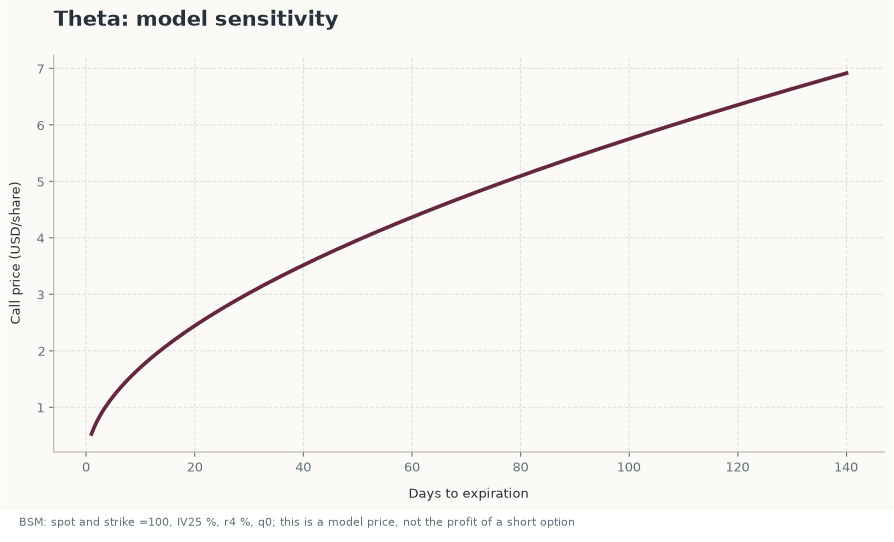
The decline is not uniform. With the underlying price unchanged and IV unchanged, most of the time value disappears in the final weeks, when theta is at its largest in absolute terms. That is why holding an option for a month at the start is not the same as holding it for a month before expiration.
A simple example
A hypothetical ATM call with a theta of −0.033 per calendar day and a multiplier of 100 as an example.
- For one day: −0.033 × 100 = −3.30 per contract.
- For 30 days linearly: −0.99 per share, i.e. −99 per contract. In this frozen ATM model, however, theta grows in absolute terms, so the actual decline tends to be larger — it therefore cannot be mechanically extrapolated with a fixed theta.
- If time value falls from 3.40 to 2.30 over 60 days, the average theta is approximately −0.0183 per day; with unchanged inputs it accelerates towards the end and can exceed −0.05.
The rule that follows: do not treat theta as a constant, but as a changing sensitivity whose path depends on the underlying price and IV.
Why it matters
Theta helps estimate how much time a position can hold without movement and to compare structures. In a portfolio, thetas add up, but you must watch the units and the fact that theta changes as soon as the underlying or IV moves. Theta is not a return, it is compensation for risk taken on — with short options it can quickly be outweighed by the loss from a sharp move.
How it shows up in a position
Theta differs by the type of position and by the time to expiration. Long vanilla options usually have negative theta, short positions positive. For vertical spreads the net theta is the difference between the two legs. For a calendar spread the short leg dominates, because its theta is largest in the final weeks, so the net theta of the position changes over its life and can flip sign.
| Days to expiration | Time value | Theta per day |
|---|---|---|
| 90 | 3.40 | −0.018 |
| 60 | 2.90 | −0.024 |
| 30 | 2.30 | −0.033 |
| 7 | 1.10 | −0.060 |
| 2 | 0.45 | −0.110 |
A common mistake
Typical mistakes: treating theta as a constant, confusing it with a return, and ignoring that with short positions it grows together with gamma risk. Moreover, the sign is not universal — for a deep ITM European put at high rates theta can be positive.
For advanced readers
Conventions differ: theta defined with respect to calendar time points forward and for a long option is usually negative; theta defined with respect to time to expiration has the opposite sign. Both descriptions are correct, but they cannot be mixed. The unit is typically one calendar day; in the approximation ΔV ≈ Δ·ΔS + ½·Γ·ΔS² + ν·Δσ + Θ·Δt, Δt must be in the same unit as theta.
The sign is also not universal: for a deep ITM European put at high rates theta can be positive, because shortening the time to maturity increases the value of the discounted payoff — this is a financing and carry effect, not early exercise, which a European option does not allow. In practice the result is measured against realized volatility — a short position collects theta, but a sharp move can wipe out the theta collected.
In practice
With short positions theta is collected, but at the same time gamma risk grows. A hypothetically short ATM straddle collects total theta of around 0.066 per day. Five quiet days bring approximately 0.33, but a single 3 % move can wipe out those days. That is why the result is not measured by the number of days to profit, but against what volatility is actually realized.
Check before using in practice
For an experienced options trader, these two checks are particularly important before deciding:
- Verify whether the platform reports theta per calendar day or per year and according to which time convention.
- Do not treat the high positive theta of a short position as an expected daily profit without a price and gamma scenario.
Key takeaways
- Theta is the price of time; for long options it is usually negative.
- The decline is not linear and accelerates in the final weeks.
- It is not a return, but compensation for gamma risk.
- Watch theta relative to gamma and vega; the connections are discussed in theta exposure and extrinsic value.
Sources
- Thetaintuition of time decay and the usual signs
- The Black-Scholes Model — Martin Haugh, Columbia UniversityBlack-Scholes as the basis for theta and its relationship to gamma and volatility
- Quantitative Finance, Lecture 6 — E. W. Farkas, ETH Zurichthe Black-Scholes PDE and the solution of the sensitivities; modelling assumptions of numerical valuation