
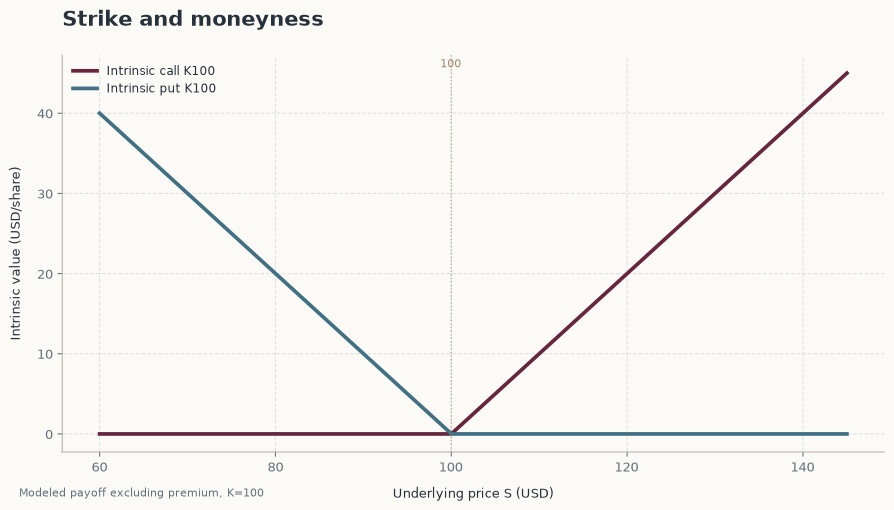
The strike is the fixed price at which an option holder can buy or sell the underlying until expiration. We will look at how this choice changes the option's price, its behaviour and the risk of the position.
What this covers
With a stock, you choose the price you enter at according to the market. With an option, you choose it yourself — and that choice is called the strike. It is the fixed price at which the holder can buy (call) or sell (put) the underlying. It determines whether the option is in the money, how much intrinsic value it has and how strongly it behaves like a stock.
The practical question for a stock investor is: how close to or how far from today's price should I choose the strike, so that I get the exposure I want without paying unnecessarily much for time value?
Intuition
Imagine a sell order with a limit. If you want to buy a stock at no more than 95, you place a limit of 95. A strike is a similar preset level, except that it is built into the contract and applies until the expiration date. The further from today's price you choose it, the cheaper the right is — and the smaller its chance of being exercised.
The relationship between the underlying price and the strike is called moneyness: in-the-money, at-the-money and out-of-the-money. It is a state at a given moment, not a forecast.
A simple example
Stock XYZ trades at 100.00 and you are comparing three calls with the same expiration in three months. The premiums and deltas are hypothetical.
| Strike | Moneyness | Premium | Delta | Breakeven point |
|---|---|---|---|---|
| 90 | ITM | 11.50 | 0.85 | 101.50 |
| 100 | ATM | 3.40 | 0.52 | 103.40 |
| 110 | OTM | 0.90 | 0.25 | 110.90 |
The ITM option at 11.50 contains 10.00 of intrinsic value and only 1.50 of time value, so it behaves partly like a stock. The ATM option at 3.40 is entirely time value and has the highest gamma. The OTM option at 0.90 is the cheapest, but it needs a move all the way to 110.90 to make a profit and it more often expires worthless.
Why it matters
Choosing a strike is in fact a choice between two extremes. A close strike means a higher price, a higher delta and stock-like behaviour. A distant strike means a lower price and less capital, but also a smaller chance and greater relative sensitivity to time decay. There is no strike that is best for every situation.
How it shows up in the position
The strike affects all the sensitivities. A deeply ITM option has a delta close to 1 for a call and −1 for a put, and only a small time component. Gamma tends to be largest around ATM and grows as expiration approaches. Vega is highest for longer-dated ATM options. These rules are tendencies, not universal laws — the exact values depend on the model, rates, dividends and skew.
A common mistake
The most common mistake is choosing a strike by the absolute price of the premium. A cheap OTM option does not look expensive, but in relative terms it can be more expensive and it more often expires worthless. The second mistake is confusing moneyness with the probability of profit — being in the money is not a forecast of the outcome.
For advanced readers
Strikes are not continuous; the exchange offers a discrete series that differs according to the price of the underlying. For more expensive stocks the intervals tend to be wider, so the choice is coarser than the intention would warrant. After a split, a special dividend or a spin-off, adjusted contracts arise in which both the strike and the deliverable quantity change; such series no longer correspond to the standard and tend to have worse liquidity and more complex settlement.
Liquidity across strikes is not uniform: it is usually highest at ATM and at a few neighbouring strikes. A distant wing may have a wide bid–ask spread, which is a real cost that must be factored into the decision.
In practice
In practice you do not choose a strike from an infinite series, but from what the exchange offers. For more expensive stocks the intervals are wider, so the planned exposure may end up between two available strikes. Distant wings also tend to have worse liquidity, and even if the premium is low, the real cost of entry and exit may be disproportionate. Moreover, the price on the screen is only the last trade, not a guaranteed quote.
Check before using in practice
For an experienced options trader, the following two checks are especially important before deciding:
- Verify the strike spacing, the multiplier and any corporate action adjustment of the contract.
- Compare the risk of the strike distance not only in points, but against IV and the time to expiration.
Key takeaways
- The strike is the price at which the option exercises its right; together with expiration it determines the payoff profile.
- The further from the underlying price, the lower the price and the smaller the chance, but the greater the relative risk.
- Moneyness is a state, not a probability.
- Choose the strike according to exposure and costs; the application is discussed in vertical spread.
Sources
- Options Glossarydefinitions of strike, moneyness and related terminology
- Understanding Options Greeksthe effect of moneyness on the local sensitivities of an option
- Characteristics and Risks of Standardized Options — OCCofficial document on the risks of standardized options; kept as a reference, full text not verified in this run