
ZEBRA is an options construction that tries to mimic stock ownership with less capital. We will look at how it is built, how it behaves, and why it is not a risk-free or zero-theta trade.
What we are addressing
You want stock-like exposure but do not want to tie up the full purchase price. At the same time, you do not want to buy the expensive extrinsic value of two separate call options. ZEBRA addresses both problems at once: two long deep-in-the-money (ITM) call options carry stock-like exposure and one short near-the-money (near-ATM) call option returns part of the paid extrinsic value. The key is to calibrate the long legs so that the sum of their extrinsic value (2× extrinsic_long) approximately equals the extrinsic value of the short leg (extrinsic_short) — it is not enough to take the “deepest” ITM strike, because even a deep ITM option does not automatically have a delta of exactly 1 and zero extrinsic value.
We are thereby addressing the question of how much capital and how much extrinsic value stock-like exposure costs — and what this approximation costs.
What choices you have
- Buying shares — full exposure, dividends, no expiration, but full capital and full downside risk.
- Long call — defined loss, but high extrinsic value paid and the need for movement.
- Call spread — cheap, but above the upper strike the profit stops growing.
- ZEBRA — stock-like exposure, lower capital, but its own risks from the short leg and from the approximation.
Why ZEBRA in particular
ZEBRA rests on two ideas. First: a long ITM call option has a high delta (approaching 1) and therefore behaves much like a stock — but a deeper strike by itself guarantees neither a delta of exactly 1 nor zero extrinsic value. Second: by selling a call option near the money I get back part of the extrinsic value paid, hence the name “zero extrinsic back ratio”; the long legs must be chosen so that the sum of their extrinsic value roughly matches the extrinsic value of the short leg.
Both ideas are approximations, not risk-free properties. The delta of an ITM option is not exactly 1 and changes as the price moves, and the extrinsic value can never be offset exactly. ZEBRA is therefore not a zero-theta or zero-risk construction.
How it is built
ZEBRA is a ratio construction built on call options: 2 long call contracts with a lower (ITM) strike and 1 short call contract with a higher, approximately ATM strike, all with the same expiration. It is opened for a net debit.
| Leg | Position | Strike | Quantity | Expiration |
|---|---|---|---|---|
| 1 | Long call | K1 — ITM (lower) | 2 contracts | same |
| 2 | Short call | K2 — near-ATM (higher) | 1 contract | same |
Beware of confusion: ZEBRA is not a backspread. A backspread buys two options with a higher strike and sells one with a lower strike; ZEBRA buys two with a lower strike and sells one with a higher strike. Swapping the legs changes the profile completely.
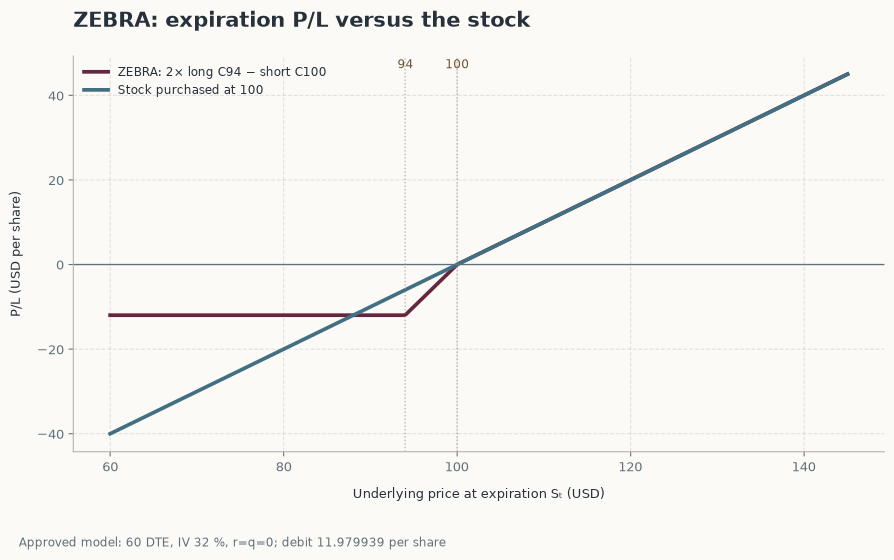
The expiration payoff function is 2·max(ST − K1, 0) − max(ST − K2, 0). The slope is 0 below K1, between K1 and K2 it rises to 2, and above K2 it falls to 1 (this is the slope of the gross payoff at expiration) — above the upper strike the profile keeps rising, but with a slope of 1×, that is, more slowly than two separate long call options (and the same as 100 shares).
How it behaves
As long as the price is above the lower strike, ZEBRA behaves approximately like a stock with leverage: between K1 and K2 it rises with a slope of 2×, so it reacts faster than the stock itself. Above K2 the slope drops to 1×, because the short call takes away part of the move. That is the main difference from two separate call options — those would continue to rise above K2 with a slope of 2×.
The short leg adds risks that do not appear with a stock: the possibility of assignment (with American options typically before a dividend) and the need to actively manage the position.
Compared with the stock
ZEBRA is marketed as a “stock with less capital”. It shares with the stock the fact that it profits from rising prices, but many things differ:
| Characteristic | 100 shares | ZEBRA (2 long ITM, 1 short ATM) |
|---|---|---|
| Exposure to upside | 1:1 throughout | accelerated between the strikes, 1:1 above K2 |
| Capital | full share price | net debit (often lower, but not universally much lower — it depends on the strikes, the premium and the target delta) |
| Maximum loss | for 100 shares bought at 100, up to 10 000 (non-negative unleveraged price, excluding fees) | The maximum loss at expiration equals the net debit for the entire construction × 100; the construction consists of 2 long and 1 short call, each contract having a multiplier of 100. |
| Dividends | you receive them | you do not receive them |
| Extrinsic value | does not exist | partly paid through the long options |
| Management | no expiration and no obligation to deliver shares | requires a plan for the short leg, expiration and possible assignment |
Compared with buying shares, the loss on the downside is capped at the debit paid, but the upside potential above K2 is slower than with two separate long call options (the 1:1 slope is the same as for 100 shares) and it lacks dividends as well as ownership rights.
When it makes sense and when it does not
ZEBRA makes sense when you want bullish, stock-like exposure with less capital (though the capital saving is not automatic) and you understand that it is an approximation involving a short option. It fits liquid underlyings where both ITM and near-ATM call options are tradable at reasonable spreads.
It is not suitable when you want exposure without assignment risk and without active management, when you need the full slope of two long call options above K2, when the underlying is shortly before a dividend, or when the options are illiquid.
What can go wrong
- “Zero extrinsic” is an approximation. The balancing of extrinsic value is not exact and changes over time.
- Assignment of the short call. With American options it may be assigned, typically before the ex-dividend date; an obligation to deliver shares arises and the position must be managed.
- Possibly negative net gamma near K2. When the price approaches K2, the gamma of the short option may outweigh twice the gamma of the long one.
- Sensitivity to volatility. A rise in IV makes the long options more expensive, but also the buyback of the short one; the net effect depends on the skew between K1 and K2.
- No guaranteed outcome. A defined risk at expiration does not mean that the position will be profitable; moreover, above K2 the profile grows only with a slope of 1×.
Greeks and exposure
The net delta of ZEBRA is usually positive (the short call has a higher strike than both long positions), but lower than the sum of the deltas of the two long calls. Both Γ and both vegas are taken as the sensitivities of one long vanilla call with the same T and with signs corresponding to the quantities (+2 for K1, −1 for K2). The net gamma is therefore 2·Γ_call(K1) − Γ_call(K2) and the net vega 2·Vega_call(K1) − Vega_call(K2); the sign depends on the strikes, the spot, IV and time. Theta is ambiguous — it may be slightly positive, close to zero, or negative.
- Delta ∂V/∂S — positive, but it changes as the price rises; in ratio structures it is not constant.
- Gamma ∂Δ/∂S — 2·Γ_call(K1) − Γ_call(K2); usually negative where the gamma of the short option outweighs, typically near K2.
- Theta — balancing two long options and one short one is an approximation, not a rule; the theta of the short option increases as expiration approaches and may outweigh.
- Vega — 2·Vega_call(K1) − Vega_call(K2); the sign depends on the strikes and on the volatility skew between K1 and K2.
We derive the profile in this example from the payoff functions of vanilla calls; the sources cited explain these fundamentals, not a named strategy. The concepts of IV Rank and IV Percentile are not the same and must not be confused.
A practical example
Consider a hypothetical underlying at 100 and a construction with two long calls (strike K1) and one short call (strike K2 > K1) with the same expiration, opened for a net debit D per share. The values below are net P/L at expiration, that is, the gross payoff function minus the debit D paid. To determine the net P/L at expiration, all that is needed are the strikes, the underlying price at expiration ST, the net debit D and the number of contracts with the multiplier (and costs); the remaining time, IV and rates do not enter the value at expiration — they matter only before expiration.
| Scenario | Net P/L at expiration |
|---|---|
| A strong decline to ST ≤ K1 | The net P/L is exactly −D (excluding costs); a deeper decline no longer makes it worse. |
| A moderate decline above K1 | The net P/L is 2·(ST − K1) − D; part of the debit is offset by the intrinsic value of the long options. |
| Stagnation between K1 and K2 (at expiration) | The net P/L is 2·(ST − K1) − D, where D is the net entry debit per share. |
| A rise toward K2 | The net P/L rises steeply (slope 2×) — the strongest phase of growth. |
| A rise above K2 (at expiration) | The net P/L is 2·(ST − K1) − (ST − K2) − D = ST − 2·K1 + K2 − D. It keeps rising, but with a slope of 1×. |
The formulas describe the net P/L at expiration excluding fees and with the same expiration for all options. Before expiration the position is marked to market and its value also depends on the remaining time, IV and rates — it is not the same as the value at expiration. The maximum loss (exactly −D for ST ≤ K1, excluding costs) is limited by the debit paid, and that is because the short call has a higher strike than both long ones, not because it would be a risk-free position.
Checks before putting it into practice
For an experienced options trader, the following two checks are particularly important before deciding:
- For the 2× long ITM call – 1× short near-ATM call variant, recalculate the net extrinsic, delta and break-even.
- Do not mistake “zero extrinsic back ratio” for a guarantee of zero theta or the absence of early assignment on stock options.
Key takeaways
ZEBRA is an approximation of stock-like exposure with less capital: two long ITM call options and one short near-ATM one. It is not a zero-theta or zero-risk trade — the balancing of extrinsic value is approximate and the short leg carries assignment and management risk.
Sources
- Long Callmechanics and risks of the long call option from which ZEBRA derives
- Understanding Options Greekslocal sensitivities and the limits of the model for deriving net Greeks
- All Strategiesgeneral overview of ratio constructions; the academic and vanilla derivations apply to payoff functions and Greeks
- ZEBRA Stock Replacement Strategy — tastylivea verified named industry source for the name ZEBRA and the typical leg composition (two long ITM calls, one short near-ATM); it is not academic proof of valuation nor a confirmation of performance