
The bid-ask spread is the difference between the price at which you sell an option and the price at which you buy it. We will show how to tell whether a series is liquid enough and how to calculate the cost of a trade before placing it.
What we are addressing
With a liquid stock you buy and immediately sell again at almost the same price. With an option that need not be the case: between the price at which you sell and the price at which you buy there is the bid-ask spread. If you cross the quote immediately, the spread shows up in the price; with a limit order the actual cost may be smaller, but the order may not be filled.
The practical question is: how do I tell whether a series is liquid enough, and how do I calculate what a trade will really cost me before I place it.
Intuition
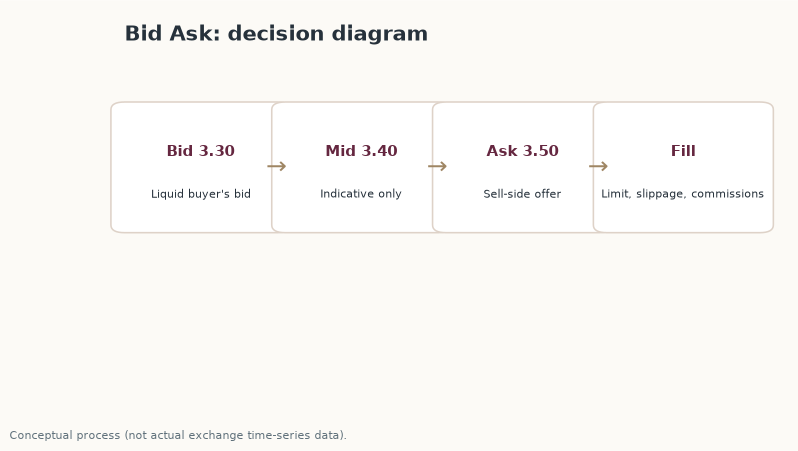
Imagine you see an option price of 3.40. That is only the midpoint. If you want to buy right away, you pay the ask, say 3.50; if you want to sell right away, you receive the bid, say 3.30. The mid of 3.40 is no guarantee that a trade will occur there — it is merely the arithmetic midpoint.
The spread is the market maker's compensation for holding the other side for you and bearing the risk that the price moves before it closes the position. A narrower spread usually means a more liquid series, but not always a cheaper trade.
A simple example
Hypothetical quote for one call: bid 3.30, ask 3.50. You buy at the ask and would immediately sell at the bid without the underlying price or IV moving.
- Cost of one round turn at a multiplier of 100: 0.20 × 100 = 20.
- Relative to the premium of 3.50: 0.20 / 3.50 ≈ 5.7 % of the option price.
- With ten contracts and a single entry and exit: 10 × 20 = 200 on the spread alone, excluding commissions and slippage.
The spread is compared relative to the premium: the same 0.20 on a cheap OTM option at 0.30 is two thirds of the price, whereas on an expensive ITM option it is only a fraction.
Why it matters
The spread enters into every trade, and in multi-leg structures it adds up across all legs. A position that looks profitable on paper can have a negative expected value once the spread and commissions are taken into account. That is why it pays to calculate costs in advance, not only after the trade.
How it shows up in a position
Liquidity is not uniform: ATM options and a few nearby strikes tend to have a narrower spread, while far wings and little-traded expirations have a wider one. Before events and just before expiration the spread widens, because uncertainty rises and the willingness to make a market falls. In multi-leg structures there is also legging risk — the risk that one leg fills and the other does not, so that you temporarily carry unwanted exposure.
| Item | Calculation | Cost |
|---|---|---|
| One leg – entry and exit combined | 0.10 × 100 | 10 |
| Four legs – complete round turn | 4 × 10 | 40 |
| Ten sets – complete round turn | 10 × 40 | 400 |
With a simultaneous four-leg limit order, the actual fill may be closer to the midpoint and the realized cost lower, or a non-fill may occur. The table does not state a guaranteed transaction cost.
A common mistake
Typical mistakes: planning based on the mid without a buffer for the spread, ignoring the spread in multi-leg structures where costs add up, and comparing options by absolute price regardless of the relative spread. Moreover, the last trade shown on the screen may not be a current quote.
For advanced readers
In practice, limit orders are used instead of market orders, the combined price of the structure is tracked as a net debit or net credit, and it is assessed whether it is executable as a whole. Historical backtests built on mid prices usually understate actual costs, because the mid may not be executable. The width of the spread depends on time, implied volatility and liquidity; a model price is therefore theoretical, not an executable quote.
In practice
Compare the spread with the expected move, not just with the premium. If you expect the option to move by 0.30 and the spread is 0.20, entry and exit will consume most of the gain. With far strikes and approaching expiration, the spread tends to be widest, because the absolute option price is small and liquidity is weak. That is why for small and illiquid series it pays to calculate costs before placing the order.
Check before putting it into practice
For an experienced options trader, the following two checks are especially important before deciding:
- Compare the theoretical price with the available executable limit price of the entire structure.
- Add commissions, slippage, changes in quotes and the possibility of a partial fill to the backtest.
Key takeaways
- Bid and ask are the available quotes for selling and buying at the stated size; the width of the spread is an indicator of potential execution disadvantage, not a guaranteed cost of every fill.
- The mid is no guarantee of execution.
- In multi-leg structures, execution costs show up in the price of the whole combination; when a complex limit order is placed, it need not equal the sum of the full individual spreads.
- Calculate the spread relative to the premium; the related topics are discussed in premium and open interest.
Sources
- Options Glossarydefinitions of bid, ask, spread and related terminology
- Characteristics and Risks of Standardized Options — OCCofficial document on the risks of standardized options; retained as a reference, the full text was not verified in this run