
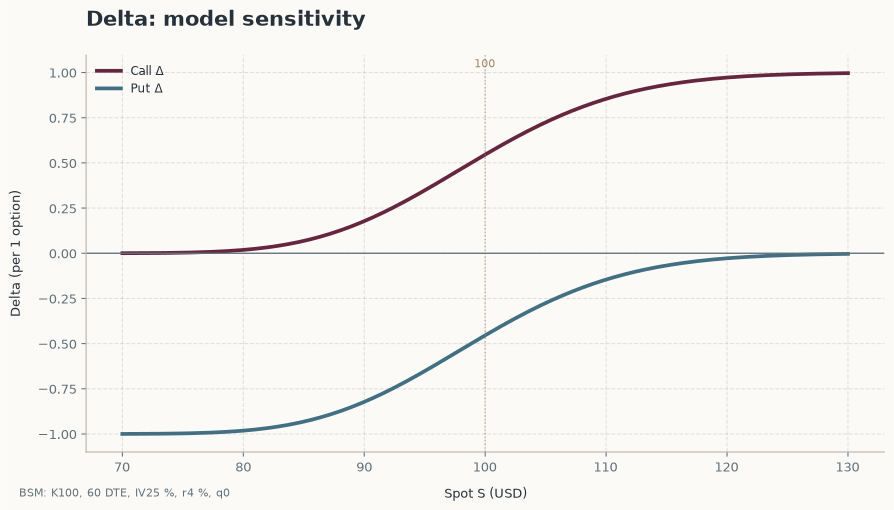
Delta shows how much an option's price changes approximately when the underlying moves a little. We will look at how many shares an option replaces, why this number changes over time, and why delta is not a probability.
What we are addressing
When you hold a stock, you know what you are exposed to: one share, one unit of risk. With an option, that is not so clear. How much stock risk do you actually carry when you hold one call option? The answer is given by delta: the approximate change in the option's price for a small change in the price of the underlying.
The practical question is: how to compare an option with a stock, how many shares an option replaces, and why this number changes over time.
Intuition
A call delta of 0.50 means that when the stock moves by 1, the option moves by approximately 0.50. One contract on 100 shares therefore behaves roughly like 50 shares. The delta of a put is negative: a value of −0.50 means the option rises when the stock falls.
That is why delta is used as a converter between options and stocks. It is not the probability that the option finishes in the money, even though the number 0.50 resembles that idea. It is a sensitivity, that is, exposure.
A simple example
Hypothetical example: long 10 call contracts, delta 0.52, contract multiplier 100 as an example.
- Stock-risk equivalent: 0.52 × 10 × 100 = 520 shares.
- Underlying move +1.00: estimated change in value approximately 0.52 × 1.00 × 10 × 100 = +520.
- For a short position the sign is reversed; the same delta then means exposure to a decline.
Watch the units. A delta of 0.52 is the sensitivity to one unit of the underlying (one share). For a single contract with delta 0.52 and a multiplier of 100 that makes 52 shares; only multiplying by the number of contracts produces the total exposure. The delta of one contract expressed in shares (52) and the delta of one unit of the underlying (0.52) are two different quantities.
Why it matters
Delta is the foundation for measuring directional exposure. For positions on the same underlying, in the same currency and with the same multiplier, the deltas are converted to a share equivalent and added together; the sum then says how much the portfolio depends on the direction of the market. For different underlyings, deltas do not add mechanically — that requires conversion to notional, beta weighting or separate views by underlying, as discussed in the article on portfolio greeks. A delta-neutral position has a sum close to zero, but that does not mean it carries no risk — gamma, vega, theta and gap risk remain.
How it shows up in a position
Delta is not constant. As the price of the underlying changes, delta changes too, and this is described by gamma. Delta itself holds only for small moves — it is a linear estimate that diverges from reality for a larger move, because curvature (gamma) and other sensitivities come into play.
Example with the same inputs: delta 0.52 and gamma 0.03. For a move of +2.00, delta shifts roughly to 0.52 + 0.03 × 2 = 0.58 and the second-order correction is ½ × 0.03 × 2.00² × 100 = +6 per contract, so the actual change is greater than a purely linear estimate. We will go through the exact composition of this approximation in the For advanced readers section.
A common mistake
The most common mistake is to interpret delta as the probability that the option finishes in the money. Delta holds only locally, for small moves, and its exact value depends on the model, interest rates and dividends. Another mistake is to forget the multiplier and the number of contracts, or to assume that delta-neutral means risk-free.
For advanced readers
Formally, delta is the first derivative of the option price with respect to the price of the underlying, Δ = ∂V / ∂S. For a European call with rate r and dividend yield q, Δ_call = e^(−qT) N(d1) holds, and for a put Δ_put = −e^(−qT) N(−d1). Subtracting gives the exact relationship Δ_call − Δ_put = e^(−qT); with a zero dividend yield, Δ_put = Δ_call − 1 holds exactly and for any rate r. It is therefore not an approximation valid only at r = 0.
For small changes, the option price can be expanded in a Taylor series ΔV ≈ Δ·ΔS + ½·Γ·ΔS² + ν·Δσ + Θ·Δt, where Δ = ∂V/∂S, Γ = ∂²V/∂S², ν = ∂V/∂σ and Θ = ∂V/∂t. Delta is only the first term; for a larger move in the underlying or in volatility, the linear estimate therefore fails and gamma, vega and theta decide.
Delta is also not to be confused with the probability of finishing in the money. In a risk-neutral world this probability is N(d2), whereas the delta of a call is e^(−qT) N(d1). The difference holds even at a zero rate and without dividends, because d1 − d2 = σ√T: N(d1) and N(d2) are two different numbers and their distance depends on volatility, time to expiration and moneyness. Illustratively, for an ATM option with r = q = 0, σ = 0.20 and T = 1, we get N(0.10) ≈ 0.5398 for delta and N(−0.10) ≈ 0.4602 for the risk-neutral probability of ITM. Delta therefore measures exposure, not probability.
Delta also changes with time (charm) and with volatility (vanna). For spreads and ratio structures, net delta is the sum of the legs with their signs and can change sign depending on the price of the underlying; it is never estimated from the number of long and short legs.
In practice
In a portfolio, deltas are added together after conversion to a share equivalent — but only for positions on the same underlying, in the same currency and with the same multiplier. Hypothetically, everything on one stock at 100: long 10 calls with delta 0.52 at a multiplier of 100 represents +520 shares of the same underlying, short 200 shares of the same underlying represents −200, the net delta is +320 shares. You obtain a delta-neutral position by selling 320 shares of the same underlying. Deltas of different underlyings are not added this way; they need conversion to notional or beta weighting, as portfolio greeks explains. As soon as the underlying moves, delta drifts apart according to gamma and the hedge needs to be adjusted; more frequent adjustments track exposure better but cost in spread and commissions.
Checklist before putting it to use in practice
For an experienced options trader, these two checks are especially important before making a decision:
- Add the same underlyings only after conversion through the multiplier, the sign and, where applicable, the currency.
- For a larger move, do not insist on a constant delta; use a fresh calculation of the Greeks including gamma.
Key takeaways
- Delta converts an option into a share equivalent and measures directional exposure.
- It is neither a probability nor a constant.
- One contract with delta 0.52 corresponds to 52 shares, not 100.
- For larger moves, allow for gamma; the connections are discussed in delta exposure and hedging basics.
Sources
- Options Deltalocal sensitivity to the price of the underlying, the signs of long and short positions, and the share equivalent
- The Black-Scholes Model — Martin Haugh, Columbia UniversityBlack-Scholes (Haugh): explicitly delta e^(−qT) N(d1) versus the risk-neutral probability of ITM N(d2) and the difference d1 − d2 = σ√T
- Characteristics and Risks of Standardized Options — OCCofficial document on the risks of standardized options; kept as a reference, the full text was not verified in this run