
A vertical spread combines buying one option and selling another on the same underlying: both are calls, or both are puts, they have the same expiry and different exercise prices (strikes). In the basic calculation at expiry, its maximum profit and loss are limited; the actual result is also influenced by costs, any assignment and the settlement method. In the article you will learn how the debit and credit variants differ, how to calculate their result and which risks to watch out for.
What we are solving
You have a directional view, but you don't want to pay the full price of a long call or a long put, and you don't want a drop in volatility or the passage of time to strip you of the entire premium. A vertical spread solves this problem: you sell an option farther from the market, which lowers your entry cost, and in exchange you cap your profit.
This way we solve two things at once — how much you pay for the position (or receive) and how much risk you carry. Both figures are known in advance, which is the main difference from a stand-alone option.
What choices you have
A directional thesis can be expressed in different ways:
- Buying shares — full exposure and no expiration, but full capital and full risk.
- A stand-alone option — unlimited potential, but a more expensive premium and full sensitivity to time and implied volatility.
- Vertical spread — lower cost and a defined profit and loss, but the profit is capped.
- Selling an option — collecting premium, but with a naked short call the risk on a rise is unlimited, and with a short put it is large, limited from below by zero; a spread bounds the risk with the long leg.
Why precisely a vertical spread
A vertical spread does two things here: it lowers the entry cost (in the debit version) and it precisely bounds both risk and reward. Both legs share the same expiration, so the spread's terminal gross payoff is driven by the underlying's price at expiry/settlement, not by the strike distance alone. That is what produces the predictable "hockey-stick" profile with two payoff kink points (at the two strikes) for the nondegenerate structures shown.
You pay for the defined boundaries with forgone upside: above the upper strike the spread no longer earns from further movement. The strike width bounds the magnitude of the terminal gross spread payoff for the positions shown, while the net premium together with the terminal underlying price sets the realized profit or loss and where the position breaks even. Maximum loss and maximum profit are bounded and known at entry under a simplified expiration model that ignores transaction costs, early assignment and product-specific settlement risks, so the realized expiration P/L is not predetermined.
How it is built
A vertical spread combines two options of the same type (both calls, or both puts) with the same expiration and different strikes; one leg is long, the other short. The sign of the net payment decides:
| Name | Legs | Direction | Max. profit | Max. loss | Breakeven |
|---|---|---|---|---|---|
| Bull call spread (debit) | long call lower K, short call higher K | bullish | width − debit | debit | lower K + debit |
| Bear put spread (debit) | long put higher K, short put lower K | bearish | width − debit | debit | higher K − debit |
| Bull put spread (credit) | short put higher K, long put lower K | bullish | credit | width − credit | higher K − credit |
| Bear call spread (credit) | short call lower K, long call higher K | bearish | credit | width − credit | lower K + credit |
In credit spreads the long leg is farther out of the money and serves as protection against a further increase in the loss of the short leg — that is why the risk is defined, but not zero.
How it behaves
At expiration a spread has only two extreme values: the maximum loss on one side and the maximum profit on the other, with a transition along a straight line between them. You pay for a debit spread in advance and its maximum loss is that debit. A credit spread receives a premium, but its risk is the strike width minus the credit — not merely the size of the payment received.
The difference lies in capital, margin and what you need: a debit spread wants movement, a credit spread wants the market to move little or to stay in a range.
Compared with a stock and a short
Against a direct stock position, a spread has narrower and more knowable boundaries:
| Feature | 100 shares (or short) | Vertical spread |
|---|---|---|
| Capital / collateral | full price, or margin and borrowing | debit, or margin on the width minus the credit |
| Maximum loss | large; for a short, unlimited to the upside | known in advance (debit or width − credit) |
| Maximum profit | unlimited (long stock) | capped (width − debit, or credit) |
| Time | plays no role | expiration and time decay play a role |
A credit spread is sometimes confused with "waiting in cash": both earn when nothing major happens, but a spread has a known maximum loss and margin, whereas cash carries no risk. A debit spread, in turn, does not pay off as a substitute for a stock, because above the upper strike it no longer earns.
Caution: a credit spread is not automatically better just because you receive money. The high indicative "probability" according to delta is bought at the price of an unfavourable ratio of risk to reward.
When it makes sense and when it does not
A spread makes sense when you expect movement within a certain range and want both risk and reward under control. A debit spread fits a mildly directional thesis with a limited target; a credit spread fits a neutral or mildly counter-directional thesis within a range.
A spread is not suitable when you expect a truly large move — there the capped profit deprives you of most of the potential. Nor is it suitable when you have no time to manage the position or when both wings are illiquid.
What can go wrong
- A defined risk is not zero. The width minus the credit is a real loss that you can suffer in full.
- Assignment of the short leg. With American options the short call may be assigned (a short stock position arises) or the short put may be assigned (a long stock position arises).
- Pin risk. If the underlying finishes exactly at the strike at expiration, one leg may be exercised and the other not.
- Margin and buying power. A credit spread holds collateral against the risk, not against the credit received.
- Continuous mark-to-market. The hockey-stick profile applies only at expiration; before it the value depends on IV, time and movement.
Greeks and exposure
The net delta of a spread is the difference of the deltas of the two legs, with sign. The direction is not determined by the payment but by the structure of the legs. But net gamma and vega are not determined by the number of legs nor by the type (debit/credit) — they depend on the strikes, the spot, time and the slope of volatility.
- A debit bull call spread usually has positive delta; gamma and vega may be either positive or negative depending on which leg is closer to the money.
- A credit bear call spread has negative delta and often negative vega, because the short leg near ATM has higher vega than the farther long leg — it is a rule about circumstances, not a law.
- Theta tends to be positive in credit spreads and negative in debit spreads, again under typical conditions.
So a spread is not "delta-neutral" or "vega-neutral" merely because it has two legs. Greeks are local sensitivities, not probabilities.
A practical example
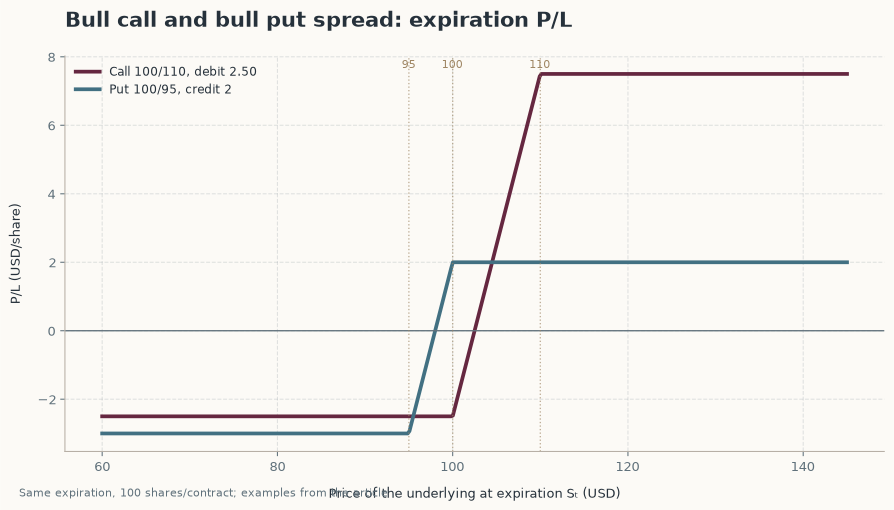
The debit version. Underlying at 100; you buy a call with a strike of 100 for 4.00 and sell a call with a strike of 110 for 1.50. Net debit = 2.50 per share (250 USD for one complete structure; 2 option contracts, each with a multiplier of 100), width 10.00.
- Maximum loss = 2.50 per share (250), at ST ≤ 100
- Maximum profit = 10.00 − 2.50 = 7.50 per share (750), at ST ≥ 110
- Breakeven = 100 + 2.50 = 102.50
| Price of the underlying at expiration | Spread value per share | P/L per share | P/L of the whole structure (USD) |
|---|---|---|---|
| 90 | 0.00 | −2.50 | −250 |
| 100 | 0.00 | −2.50 | −250 |
| 102.50 | 2.50 | 0.00 | 0 |
| 105 | 5.00 | +2.50 | +250 |
| 110 | 10.00 | +7.50 | +750 |
| 125 | 10.00 | +7.50 | +750 |
Above the strike of 110 the payoff no longer changes: the short call offsets the long one one-for-one. Compared with a long call on its own, the spread lowers the cost, but you give up the rise above the upper strike.
The credit version. You sell a put with a strike of 100 for 4.00 and buy a put with a strike of 95 for 2.00. Net credit 2.00 per share (200), width 5.00.
- Maximum profit = 2.00 per share (200), at ST ≥ 100
- Maximum loss = 5.00 − 2.00 = 3.00 per share (300), at ST ≤ 95
- Breakeven = 100 − 2.00 = 98.00
| Price of the underlying at expiration | Value of the obligation per share | P/L per share | P/L of the whole structure (USD) |
|---|---|---|---|
| 110 | 0.00 | +2.00 | +200 |
| 100 | 0.00 | +2.00 | +200 |
| 98 | 2.00 | 0.00 | 0 |
| 95 | 5.00 | −3.00 | −300 |
| 85 | 5.00 | −3.00 | −300 |
The credit received, 2.00, is not free profit: in exchange for it you bear a risk of 3.00 (300 USD for one complete structure; 2 option contracts, each with a multiplier of 100).
Checks before using it in practice
For an experienced options trader, the following two checks are particularly important before deciding:
- Check the 1:1 ratio, the same expiration and the strike width when calculating the maximum loss.
- For American equity options, add the assignment and pin risk of the short leg to the plan.
Key takeaways
A vertical spread trades unlimited potential for known boundaries of profit and loss and for a lower cost. Decide according to the width and the ratio of risk to reward, not according to whether you pay a debit or receive a credit.
Sources
- Bull Call Spread (Debit Call Spread)debit call spread: legs and terminal risk/profit
- All Strategiesoverview of structures and a note that the long/short ratio nomenclature differs
- Understanding Options Greeksnet Greeks as a function of strikes/spot and the limitations of the model
- The Black-Scholes Model — Martin Haugh, Columbia UniversityN(d1) delta versus N(d2) probability in the Black–Scholes model for the delta-based probabilities cited