
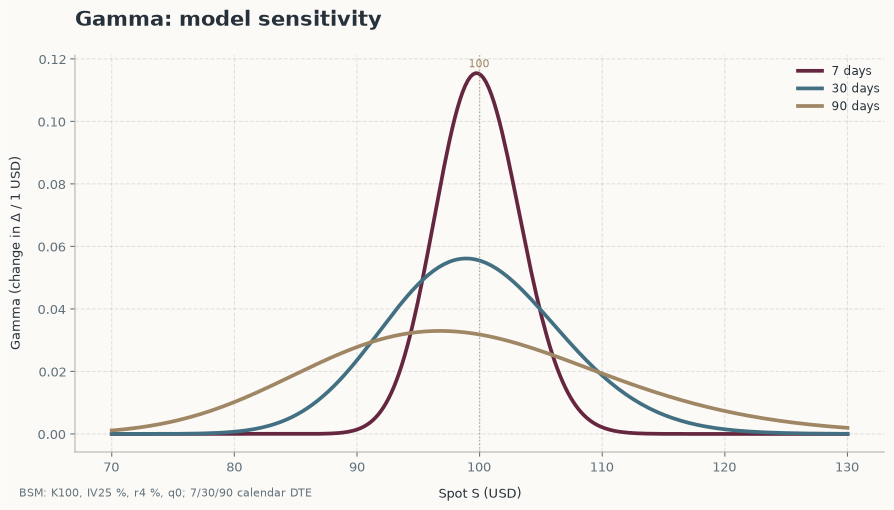
Gamma describes how fast an option's delta changes when the underlying moves a little. We will look at why a long option accelerates as the stock moves, where this convexity is most noticeable, and how it is paid for with theta.
What we are addressing
Delta tells you how many shares the option currently replaces. But it does not tell you what happens when the stock moves more. That is what gamma describes: how fast delta changes. For a stock investor, it is the difference between a position that behaves linearly and a position that accelerates as it moves.
The practical question is: why a long option increases its exposure when the stock rises and reduces it when the stock falls, and where this convexity is most noticeable.
Intuition
Imagine you hold a stock: no matter where it moves, the exposure stays the same. With an option, it changes. When the stock moves up, the call's delta rises, so the position behaves like more and more shares. When it moves down, delta falls and the exposure shrinks. This shape is advantageous for the holder, and it is described by positive gamma.
But it is not free. The option holder pays theta, that is, the price for time. A short position has negative gamma, collects theta, but in a sharp move it loses faster than it has accumulated.
A simple example
Hypothetical values: long 1 call, delta 0.52, gamma 0.03 per share, contract multiplier 100 as an example.
- Move of +1.00: new delta approximately 0.55, and the gamma contribution to value ½ × 0.03 × 1.00² × 100 = +1.50.
- Move of +5.00: gamma contribution ½ × 0.03 × 25 × 100 = +37.50, i.e. twenty-five times the contribution for a move of 1.00, because it grows with the square.
For a short position the signs are reversed: the same move subtracts value and delta moves against you.
Why it matters
Gamma matters for managing delta-neutral positions, for understanding the risk of short options, and for structures that bet on convexity. It determines how often and how large hedging adjustments will be needed: higher gamma means more trading of the underlying and greater sensitivity of the result to the volatility actually realized.
How it shows up in the position
Gamma is usually largest for options near ATM and rises as expiration approaches. For options further from the underlying's price it falls. Higher IV flattens the gamma peak around ATM, because the distribution of future prices is wider. Short positions just before expiration can therefore have a very unpleasant negative gamma.
A common mistake
Typical mistakes: treating positive gamma as unambiguously good, ignoring how it changes as expiration approaches, and inferring the sign of a structure's gamma from the number of long and short legs. With spreads, what matters is the specific strikes, the spot price and time.
For advanced readers
Gamma is the second derivative of the option price with respect to the underlying price, Γ = ∂²V / ∂S² = ∂Δ / ∂S, and its contribution to the result is second-order: ½ · Γ · ΔS². For small moves it is almost invisible, for larger moves it is significant, and in a gap the approximation fails.
A useful question is how large a move gamma needs in order to outweigh the cost of theta: approximately ΔS ≈ √(2·|Θ| / Γ). Hypothetically, for an ATM call with gamma 0.03 and theta −0.033 per day, the required daily move works out to √(2 × 0.033 / 0.03) ≈ 1.48 points. With S = 100 that is 1.48 % per day; under the calendar convention (365 days) this annualizes to approximately 1.48 × √365 ≈ 28.3 %. Theta here is quoted per calendar day, which is why the same calendar convention is used; annualizing over 252 trading days would mix theta and gamma in different units.
This comparison is a local attribution, not a guaranteed rule for when gamma “earns”. It assumes the other inputs and carry are frozen and ignores the costs of rehedging and the spread. Repeatedly adjusting delta (rehedging or scalping) is not a source of certain profit merely because realized volatility exceeds implied: the cash flows can sum to a loss and depend on the path, not only on the final price.
In practice
In structures, net gamma is calculated from all legs and changes with the underlying price. Hypothetically, long 1 ATM call with gamma 0.03 and short 2 OTM calls with gamma 0.01 give a net gamma of +0.01. At a different price, however, the gammas of the individual legs change differently and the sign can flip. What also matters is where the gamma is concentrated: a position with large gamma at ATM behaves differently from a position with a similar total spread across the wings.
Check before using it in practice
For an experienced options trader, the following two checks are especially important before deciding:
- Gamma is a local derivative and its value will change with a larger move or a change in time.
- With a short expiration, watch gamma, liquidity and the structure's maximum loss at the same time.
Key takeaways
- Gamma measures the change in delta, and thereby the convexity of the position.
- Long vanilla options have positive gamma, short ones negative; it is paid for with theta.
- It is usually largest at ATM and near expiration.
- In structures, net gamma is calculated from strikes and time, not from the number of legs; the connections are discussed in gamma exposure and scenario analysis.
Sources
- Gammathe meaning of gamma, its signs for vanilla positions, and its dependence on moneyness and time
- Options Gamma – The Greeks - CME Groupthe analogy of acceleration and changing delta in futures options; the units differ from stocks
- The Black-Scholes Model — Martin Haugh, Columbia UniversityBlack-Scholes as the basis for second derivatives; the Taylor expansion is an original derivation from this model
- Cboe 0DTE Trading Resourcesexternal primary source for expert supplementation; verified 2026-10-11