
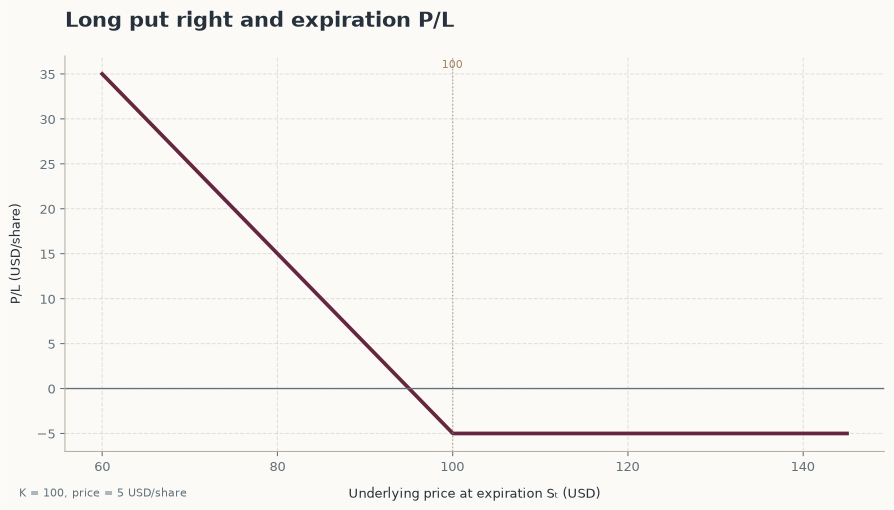
A put option is the right to sell the underlying at a predetermined price by a certain date, paid for with a premium. We will look at how it can limit the loss on a held stock and why this insurance is neither free nor permanent.
What we are solving
You hold a stock that has made you money and you do not want to sell it because of taxes or a long-term thesis — you are just afraid of a deep decline. Or, conversely, you expect a decline and do not want to short the stock with unlimited upside loss. A put option solves both problems with a single instrument: it gives the right to sell the underlying at a predetermined price by a certain date.
This right costs a premium. It is not free insurance nor a bet on a crash — it is a transfer of risk with a clear price and expiration date.
Intuition
You can think of a put as insurance on a stock. You pay a premium and gain the right to sell the stock at the strike, even if its price falls deeply. Unlike classic insurance, however, a put has an expiration and its price changes daily: the coverage is not permanent and you have to renew it.
On the other side is the put seller. That party collects the premium and undertakes to buy the stock at the strike when the counterparty calls on it. Economically, the seller thereby takes on the downside risk in exchange for the premium; this consequence of exercise is called assignment and it is not a risk-free return.
A simple example
Hypothetical example: stock XYZ trades at 100.00 and you hold 100 shares. You buy one put with a strike of 95.00 and an expiration in three months for a premium of 2.50 per share, that is 250 per contract at a multiplier of 100 as an example.
- Breakeven of the put itself: 95 − 2.50 = 92.50.
- Worst case above the strike: (100 − 95) + 2.50 = 7.50 per share, i.e. 750 on 100 shares.
- S = 85: stock −1 500, put +1 000, premium −250, net −750.
- S = 110: put expires worthless (−250), stock +1 000, net +750.
Without the put, a fall to 85 would mean a loss of 1 500. The insurance reduced it to 750 but did not eliminate it — and in the rising scenario it shaved 250 off the return.
Why it matters
A put makes it possible to separate two decisions: whether to hold the stock and whether to bear the full downside risk. Instead of selling the stock you can buy protection and keep both your long-term position and your tax deferral. At the same time, repeated insurance can in a calm period cost more than a one-off loss — the price of extrinsic value accumulates.
How it shows up in the position
A long put has negative delta, positive gamma and positive vega; theta is usually negative. The signs mirror those of a call, but a long put is not the same as a short call — the second derivative and other risks differ.
| Aspect | Selling the stock | Protective put |
|---|---|---|
| Rise above the strike | none | preserved |
| Cost | transactional | premium paid |
| Tax on the sale | immediate | deferred depending on jurisdiction |
| Protection | unlimited | only until expiration |
A short put has the opposite profile: limited profit and a large loss on a decline all the way to zero. The maximum loss at expiration is roughly (strike − premium) × 100, but margin and buying power are something different from the maximum loss.
A common mistake
A common mistake is to confuse the maximum loss at expiration with the risk during the life of the position and with margin requirements. The second is the assumption that a put always rises when the stock falls — during a decline in implied volatility or a rapid decay of time this need not happen.
For advanced readers
The expiration payoff of a long put is max(K − S, 0) for non-negative S, so the maximum profit is K − premium and occurs at S = 0. For European options the price may be below intrinsic value because the right cannot be exercised earlier. Early exercise of an American put tends to be advantageous mainly for deep ITM options at high rates, when the released cash earns interest.
For a short put it is necessary to distinguish the maximum loss, margin and the cash needed upon assignment: early assignment of a short put creates a long stock position and consumes capital. For index options the settlement tends to be cash, which changes both the cash flow and the risk.
In practice
Repeated insurance has its cost. If you bought the put for 250 every three months and the stock rose for a year, you would pay 1 000 without the protection having brought you anything. An alternative is insurance with index options, which has lower single-stock risk but does not bind perfectly to your portfolio — basis risk arises. Neither approach removes risk, it only transfers it and changes its form.
Checks before using it in practice
For an experienced options trader, the following two checks are especially important before deciding:
- Clarify whether you hold the put for stock protection or for a standalone short directional view.
- For a short put, calculate the possible taking on of shares upon assignment and the overall risk budget.
Key takeaways
- With a standard American equity put, the holder has the right to sell the underlying at the strike and the writer has the obligation to buy it upon assignment. With European cash-settled index puts (for example SPX), at expiration the cash difference is settled, not delivery of shares.
- A protective put limits the loss but does not eliminate it — you pay a premium and the coverage has a date.
- A short put is not a risk-free return; its profit is limited and its loss large.
- The investment application is discussed by long put and the combination with the stock by collar.
Sources
- Options Basicsthe right to sell the underlying and the obligation of the short side in a put option
- Long Putpayoff logic and practical risk of a long put
- Characteristics and Risks of Standardized Options — OCCofficial document on the risks of standardized options; retained as a link, full text not verified in this run
- Cboe SPX Weeklys Specificationsexternal primary source for expert supplementation; verified 2026-10-11