
Exercise is using the right granted by an option, choosing between selling the option and obtaining a position in the underlying at a pre-agreed price. We will look at when exercise makes sense, what is lost by it, and how physical settlement differs from cash settlement.
What we're dealing with
You hold a call, the stock has risen and the option is in the money. You can sell it in the market, or exercise it and become the owner of the stock at a pre-agreed price. Exercise is the use of a right granted by an option. It can occur on the holder's instruction or at expiration through the administrative procedure known as "exercise by exception", if no contrary instructions have been given.
The practical question is: when does exercise make sense, and when does it destroy value that you would have received on top by selling? And what is the difference between exercising and simply closing the position?
Intuition
Exercise converts the option into stock. The option ceases to exist, and with it its extrinsic value. If the option is deep ITM and has almost zero extrinsic value, exercise is almost equivalent to selling — only instead of cash you receive the stock. But if the extrinsic value is still worth something, destroying it costs you money.
Think of it as the right to buy the stock at an old price. You do not have to use it now; if the extrinsic value is positive, the market will pay you for giving up the right.
A simple example
Hypothetical example: a long call with a strike of 95, an underlying price of 120 and an option market price of 25.50. Intrinsic value is 25.00 and extrinsic value 0.50.
- Exercise: you pay 95 for the stock and hold it at a value of 120; gross benefit of 25.00 per share, but unrealized until you sell the stock.
- Selling the option: you receive 25.50 per share, i.e. 0.50 more, and you are left with no position in the underlying.
Early exercise usually destroys 0.50 of extrinsic value. The exception is a situation where something else brings you more — typically a dividend on a call or interest on the cash released in the case of a put.
Why it matters
Exercise matters because it changes both the position and the costs. After exercise you bear the full market risk of the stock, you pay settlement fees, and the tax outcome may change. With physically settled contracts it is an actual transfer of shares, while with cash-settled contracts it is only a cash difference.
How it shows up in the position
Exercise pays off mainly when the option is ITM and has almost no extrinsic value. With a call before a dividend, exercise may be advantageous if the dividend exceeds the remaining extrinsic value. With a deep ITM put, early exercise can release cash that earns interest. And with wide spreads, exercise may be cheaper than closing in the market, especially for small positions.
A common mistake
The most common mistake is exercising an option with significant extrinsic value early and destroying that value. The second is confusing exercise with selling the option — the two have different costs, cash flow and tax consequences. The third is forgetting that after physical exercise you bear the full risk of the underlying.
For advanced readers
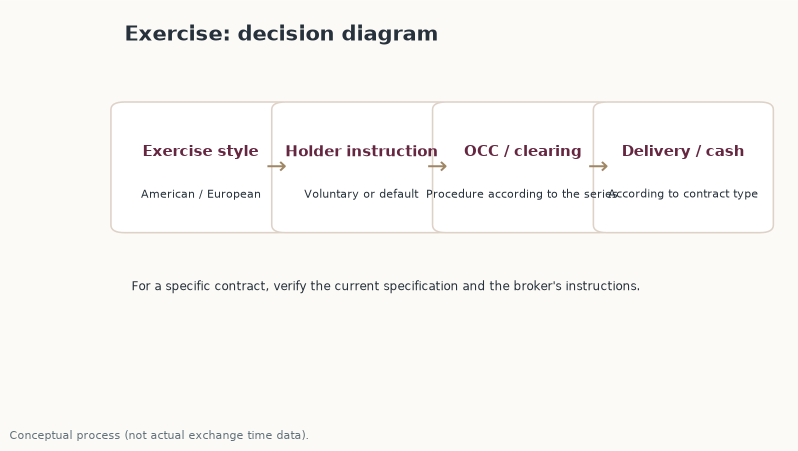
With American options the holder may exercise at any time during the life of the contract; the decision is usually reported to the broker by the end of the day and settlement takes place according to exchange rules. With European options, exercise is possible only at expiration; the specific clearing procedure, the right to submit a different instruction and its time limits vary by product. With both American and European standardized options, do not assume that exercise always requires an active instruction from the customer. The difference is fundamental for position management: with a European option you have no choice of timing, with an American option you do, and with it also the risk of error.
The golden rule is: do not exercise an option that has non-negligible extrinsic value unless you have a specific reason to do so. However, with ITM options with minimal extrinsic value and in dividend situations the balance shifts and exercise may be rational.
In practice
The decision rests on comparing the remaining extrinsic value with the intrinsic value and with the costs. Before exercising, go through four things: the remaining extrinsic value, the reason that outweighs it, the cost of exercising compared with closing in the market, and the tax consequence. With physical settlement you also acquire a full position in the stock, so from that moment you bear its market risk.
Check before using in practice
For an experienced options trader, these two checks in particular are essential before deciding:
- Exercising an option is not the same as selling it; compare the remaining extrinsic value with the economic benefit of exercise.
- Before expiration, verify with the broker the cutoff, automatic exercise, do-not-exercise instructions and the settlement method.
Key takeaways
- Exercise is the exercise of a right under an option, not the sale of an option; at expiration it can also take place without an individual customer instruction, according to clearing and broker rules.
- Exercise extinguishes extrinsic value that you could otherwise have received.
- After physical exercise you bear the full risk of the stock.
- Decide according to the remaining extrinsic value, dividends, interest and costs; the related context is discussed in assignment.
Sources
- Exercising Optionsthe right of the long side, the obligation of the short side and the mechanics of exercise
- Options Glossaryterminology of exercise and settlement
- Characteristics and Risks of Standardized Options — OCCofficial document on the risks of standardized options; kept as a link, full text not verified in this run
- OIC Options Assignment FAQexternal primary source for expert supplementation; verified 2026-10-11
- Cboe SPX Weeklys Specificationsexternal primary source for expert supplementation; verified 2026-10-11