
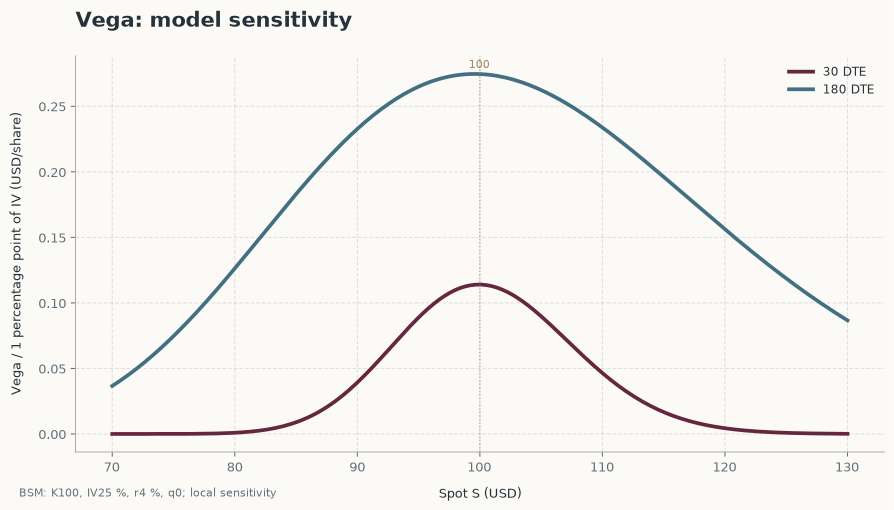
Vega measures how sensitive an option's price is to a change in implied volatility, meaning how expensively the market prices future uncertainty. We will look at why an option can move even when the stock does not, and how to read vega's units correctly.
What we are addressing
The price of a stock is driven mainly by what happens in the company and in the market. But the price of an option is also affected by something that is not directly related to the company: how expensively the market prices future uncertainty. This input is called implied volatility, and an option's sensitivity to a change in it is vega.
A practical question: why an option can move even when the stock is unchanged, and why the same change in IV does not mean the same percentage change in the option's price.
Intuition
Higher uncertainty means a wider range of possible future prices, and therefore a more expensive option — both a call and a put. Vega is thus positive for long options and negative for short ones. It tends to be largest for ATM options, because that is precisely where a change in the width of the distribution has the greatest effect; with a longer expiration, vega rises, because a longer horizon gives uncertainty more room.
A simple example
Hypothetically, an ATM call with a vega of 0.12 per one percentage point and a multiplier of 100, as an example.
- IV 20 % → 21 %: option price +0.12 per share, i.e. +12 per contract.
- IV 20 % → 22 %: linearly approximately +0.24 per share, i.e. +24 per contract; the actual change may differ, because vega changes.
- If a platform quotes vega per unit of σ, the same sensitivity corresponds to the figure 12.00.
Checking the units is critical: the same position can look like a small or a huge sensitivity depending on how vega is defined.
Why it matters
Vega is important for risk management and for structures that express a view on volatility. It depends on strikes and expirations: a spread or a calendar may have positive vega in one expiration and negative vega in another. That is why net vega is calculated as the sum of the contributions of the individual legs, not according to the number of long and short positions.
How it shows up in a position
Vega is not the same across expirations. Longer-dated options usually have higher vega. In a calendar spread with a short near-term leg and a long longer-dated leg, net vega is usually positive, even though one leg is short. In a diagonal spread it depends on the strikes and on which leg is longer-dated. Similarly, vega depends on the strike: ATM options have the largest vega, the wings smaller.
A common mistake
Typical mistakes: confusing the units of 1 percentage point of IV with 1.00 absolute unit of σ, interpreting a 1 % change in IV as a 1 % change in the option price, and simplifying all IVs into a single number. The real curve has skew and term structure, so a position can be neutral to one ATM IV and still sensitive to a change in the shape of the curve.
For advanced readers
Vega is the derivative of the option price with respect to volatility, ν = ∂V / ∂σ. Its change when volatility changes is called vomma, and its change when the underlying moves is called vanna. Distinguish between the raw derivative and the quoted vega: a figure of “vega per 1 percentage point” is ∂V/∂σ × 0.01, i.e. one hundredth of the raw sensitivity to a unit change in σ. For comparable ATM entries, longer expirations usually have higher absolute vega; a short option has a lower premium, so the same percentage change in IV can produce a relatively larger price effect on it, even though its absolute vega is smaller.
For larger changes in IV, the linear estimate fails, because vega changes continuously. That is why scenarios use a repricing of the model, not just the sum of vega. For multi-leg positions it is useful to build a vega budget by tenors and strikes, and only then assess whether the position is neutral to a parallel shift of the curve, or only to a single point.
In practice
For multi-leg positions, vega is summed across the legs. Hypothetically, long 1 ATM three-month call with a vega of 0.12 per percentage point of IV and short 1 ATM one-month call with a vega of 0.05 per percentage point of IV give a net vega of +0.07 per percentage point of IV. A rise in IV of 2 percentage points adds approximately 0.14 per share. At the same time, the position is sensitive to a change in the shape of the term structure: a rise in short-dated IV alone has a different impact than a rise in the entire curve.
Check before using in practice
For an experienced options trader, these two checks are particularly important before making a decision:
- When calculating the change in P/L, multiply the change in volatility in exactly the units in which the vega is published.
- With multiple strikes and expirations, do not assume a parallel change of the entire volatility surface.
Key takeaways
- Vega measures the sensitivity of an option's price to a change in IV.
- Watch the units: 1 percentage point of IV versus 1.00 absolute unit of σ represents a factor of 100.
- It tends to be largest ATM and for longer expirations.
- Net vega is calculated from all legs; the context is discussed in vega exposure and implied volatility.
Sources
- Vegasensitivity of the option price to implied volatility and distinguishing the level of IV from vega
- Options Vega - The Greeks - CME Groupvega of futures options and an example of the reaction to one point of IV; units and multipliers differ
- The Black-Scholes Model — Martin Haugh, Columbia UniversityBlack-Scholes as the basis for vegas and cross derivatives; higher-order Greeks are own derivations from this model