
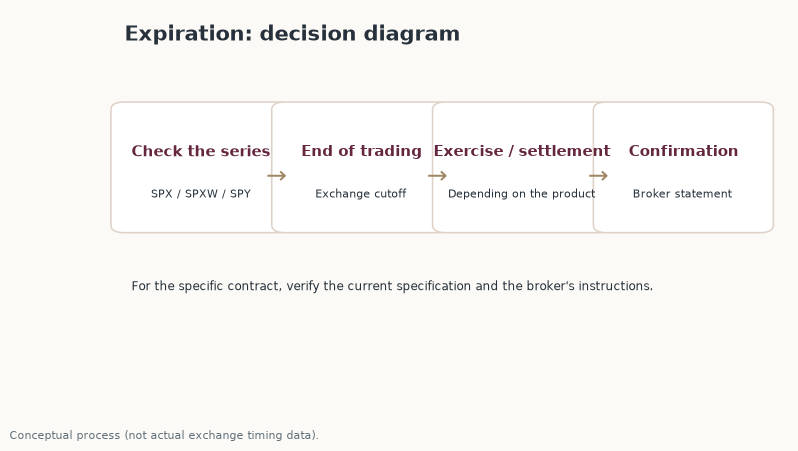
Expiration is the fixed date by which the move you are betting on with an option must actually arrive. We will look at how quickly time value disappears and what expiration means for short positions and assignment.
What we are addressing
You can hold a stock for years and wait for the thesis to play out. But an option has a fixed date by which the move must arrive — that is called expiration. After it the contract ceases to exist and only the payoff based on the underlying's price remains: for a call max(S − K, 0), for a put max(K − S, 0).
The practical problem is twofold: when the decision actually happens (the fixing moment may differ from the end of trading) and what to do with short positions that may end in assignment.
Intuition
Imagine you have limited time for your thesis. The closer expiration is, the less time remains for the stock to move. Time value therefore evaporates, usually fastest in the last weeks. For the option holder it is a cost, for the seller an income.
At the same time, the moment of decision approaches. With the American style, it can be exercised at any time; with the European style, only at expiration. Either way, the last days are different from the rest of the contract's life.
A simple example
An illustrative, not model-based, course of the time value of an ATM call with an unchanged underlying price and IV: 3.40 with 90 days, 2.90 with 60 days, 2.30 with 30 days, 1.10 with 7 days and 0.00 at expiration.
The differences are not linear: between day 90 and day 60, 0.50 disappears, but between day 7 and expiration, 1.10. The same stock move therefore lasts longer at the beginning than at the end. For a stock investor, this means that the timing of entry and exit carries a different weight than it does with a stock.
Why it matters
Expiration forces you to plan. An option does not have an unlimited horizon like a stock. If you hold a long position, you must decide whether to sell it before expiration, exercise it, or let it expire. If you hold a short position, you must reckon with the fact that exercise may occur and you will receive a stock you did not want — or you will lose it.
How it shows up in the position
Time to expiration changes the position's profile. Theta in absolute value rises, and gamma for ATM options does too, so sensitivity to the final moves and to volatility increases. Short positions just before expiration carry markedly negative gamma: a small move changes delta sharply and the hedge must be adjusted often and expensively.
| Style | When it can be exercised | Typical example |
|---|---|---|
| American | any time up to expiration | stock and ETF options |
| European | only at expiration | many index options |
A common mistake
A common mistake is to assume that expiration, the end of trading and the fixing moment are the same thing. They are often different moments, sometimes hours apart. The second mistake is leaving short positions until the last day without a plan for pin risk and assignment: a price right at the strike decides whether you end up with an unwanted stock position over the weekend.
For advanced readers
For many standard monthly stock options, expiration tends to be the third Friday of the month, but weekly and other option series have different days. The last trading moment and the settlement rules must be verified for the specific contract. Some index options settle according to the morning fixing, others according to closing prices; a contract can therefore be AM-settled or PM-settled, which changes the payoff value.
For some European index options, for example standard AM-settled SPX, trading ends before the day on which the settlement value is determined. With PM-settled SPXW, however, trading also takes place on the expiration day; the specifications of the specific series govern. The exercise of in-the-money options may take place automatically according to clearing rules and the broker's instructions. The option price also includes the passing of time during weekends and holidays. Even so, one cannot mechanically subtract three daily thetas from Friday's price: the market may already price in the effect of non-trading days in advance, and at the same time the spot, IV and liquidity may change. Rolling is therefore better planned in advance, while liquidity is still decent.
In practice
The last days before expiration have their own dynamics. Liquidity falls, the spread widens and the price can move sharply because the outcome is being decided. Rolling a position is therefore better planned in advance. Moreover, theta acts even over the weekend and holidays, so the Monday open may begin with markedly lower time value than Friday's valuation corresponded to.
Check before practical use
For an experienced option trader, these two checks are especially important before deciding:
- Verify the specific series: the last trading day, the moment at which the settlement value is determined and the AM/PM type.
- Do not rely on a European exercise style automatically meaning that trading ends the day before expiration.
Key takeaways
- Expiration is a fixed date; the thesis must play out by then.
- Time value disappears unevenly and fastest at the end.
- The moment of decision need not be the same as the end of trading.
- Short positions held until the last day carry pin risk and assignment risk; the context is discussed in term structure.
Sources
- Exercising Optionsexercise, settlement and the practical mechanics of stock options
- Thetathe decay of time value and its uneven course
- Characteristics and Risks of Standardized Options — OCCofficial document on the risks of standardized options; kept as a reference, the full text was not verified in this run
- Cboe SPX Specificationsexternal primary source for expert supplementation; verified 2026-10-11
- Cboe SPX Weeklys Specificationsexternal primary source for expert supplementation; verified 2026-10-11