
Assignment means that as the option seller you must honor the obligation you took on by selling the option; you do not decide the assignment yourself. For physically settled equity options, it means buying or delivering shares at the agreed price, depending on the option type. In the article you will learn when assignment risk increases and how it can change your position, cash and margin.
What we're dealing with
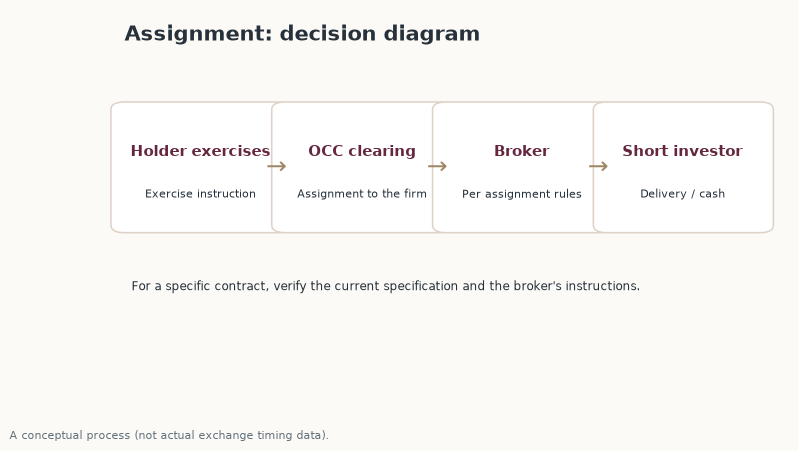
By selling an option you obtain the premium, but also an obligation. If some holder of the corresponding series exercises the option and clearing, through member firms, assigns the obligation to your short position, assignment occurs: for a short call you must deliver the stock at the strike, and for a short put you must buy it at the strike.
The practical problem: assignment is not the seller's choice and can arrive unexpectedly. The question is when it threatens, what it does to cash and margin, and what plan to have in advance.
Intuition
Every contract has two sides. When the long side exercises its right, clearing assigns the obligation to one of the short sides. The specific counterparty is not known and the selection is determined by the rules of clearing, not by your decision. You therefore cannot assume that you will be the one assigned — or that you never will be.
exercise is an active step by the holder; assignment is its counterpart on the seller's side. Economically you received the premium for the obligation, so it is not a catastrophe, but a transfer of risk with consequences for the position.
A simple example
Hypothetical examples, multiplier 100 for illustration.
- Short call K = 100, premium 3.00, price at expiration 112: you must deliver the stock at 100, whose price is 112. If you do not own the stock, a short stock position may arise after assignment; a subsequent buyback at 112 against delivery at 100 represents a loss of 12.00 per share, i.e. 1 200, reduced by the premium 300, net −900.
- Short put K = 100, premium 3.00, price 88: you must buy the stock at 100, which is worth 88; a loss of 12.00 per share, net −900. On assignment of a short put, the purchase price of the shares 100 × 100 = 10 000 is settled. The premium 300 received earlier improves the overall P/L, but does not automatically reduce the purchase amount at settlement; cash balance, margin and buying power differ by broker.
With a covered call, assignment is not a cash catastrophe, but you lose further upside: you deliver the stock at 100 even though it is worth 112.
Why it matters
Assignment changes the structure of the position, the buying power and the tax result. A short position that was merely a source of premium can turn into a long or short stock position. It is therefore sensible to have a plan before assignment arrives.
How it shows up in the position
The probability of early assignment rises for options that are ITM and have low extrinsic value / time value. For a short call, risk before the ex-dividend date is typical: if the option is ITM and the dividend exceeds the remaining extrinsic value / time value, the holder may exercise in order to capture the dividend. For a deep ITM put, a high rate can make early exercise advantageous, because it releases cash to the counterparty. Right at the strike at expiration, pin risk arises.
A common mistake
Typical mistakes: interpreting assignment as an unlikely event, underestimating the ex-dividend risk of short calls, and confusing maximum loss with margin and buying power. The assumption that a covered call is risk-free is also a mistake — it only changes the mechanism of the risk.
For advanced readers
Maximum loss at expiration and the margin requirement are two different things. A short put has a limited loss at expiration of roughly (strike − premium) × 100, but over the life of the position it ties up buying power or margin that changes with the price and implied volatility. A short call has a theoretically unlimited loss, because the stock price can rise without a ceiling, and margin requirements correspond to that.
Early assignment of a short call creates a short stock position; early assignment of a short put, conversely, a long one. For a short call it also holds that borrowing the stock for the short has its own risks: availability of the loan, fees, recall and dividends. With cash-settled contracts, only the cash difference is settled instead of shares.
In practice
A plan before assignment pays off especially before the ex-dividend date and in the last week before expiration. Find out whether you are able to deliver the stock, or whether you have the cash to buy it, how the margin will change and whether the new position matches your intent. Assignment is not the end of management, but the beginning of a new position that it may be appropriate to close or hedge immediately.
Check before using in practice
For an experienced options trader, these two checks in particular are essential before deciding:
- Before expiration, distinguish American stock/ETF options from European cash-settled index options.
- For a short stock option, calculate the possible delivery of the underlying, the cash, the ex-dividend date and the timing of the broker's notification.
Key takeaways
- Assignment is the creation of an obligation on a short option after the exercise of the corresponding long positions through clearing; the holder of the short option has no direct decision-making right with respect to a specific "counterparty".
- It is not your choice, and with American options it can arrive at any time.
- It changes the position, cash and margin; with a short call, also dividend risk.
- Prepare a plan in advance; the context is discussed by exercise and open interest.
Sources
- Exercising Optionsexercise and assignment, the obligation of the short side and settlement
- Options Glossaryterminology of assignment and transfer of position
- Characteristics and Risks of Standardized Options — OCCofficial document on the risks of standardized options; kept as a reference, full text not verified in this run
- OIC Options Assignment FAQexternal primary source for expert supplementation; verified 2026-10-11
- Cboe SPX Weeklys Specificationsexternal primary source for expert supplementation; verified 2026-10-11