
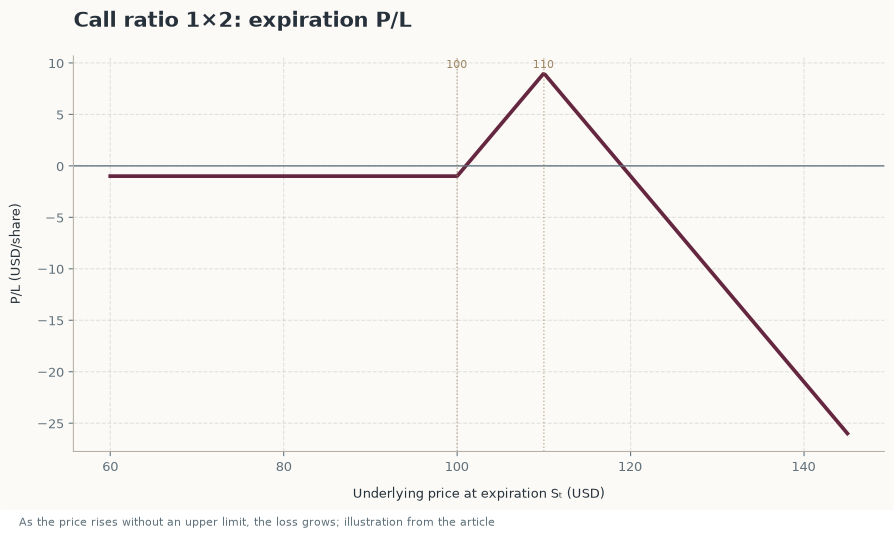
A ratio spread is an options structure that sells more options than it holds. We will show what its profile looks like, where profit is capped and why part of the short position stays unhedged.
What we are addressing
You want to express a view on the range in which the price will end, and at the same time you want to get paid for the structure or to pay less than for a plain spread. A ratio spread achieves this by selling more options than you hold. But it is precisely this ratio that creates an unhedged short position whose risk you need to know in advance.
We are thus addressing the question of what the profile looks like when one sold option has no counterpart in a long position — and why that is not the same as a defined spread.
What options you have
Ratio and defined structures are easily confused:
- Vertical spread — covers both legs, with defined risk and profit.
- Butterfly — defined risk on both sides.
- Backspread — the opposite ratio, with a loss valley in the middle.
- Ratio spread — more short than long options, with risk at the edge.
Why a ratio spread specifically
A ratio spread consists of two strike prices K1 < K2 and an unequal number of options: long 1× K1 and short 2× K2 with the same expiration. It can be opened for a debit or for a credit. Terminology differs between sources, so it is always necessary to define the specific legs, not just the name.
The key point is that one of the sold options has no counterpart. As long as the price is below K2, the structure resembles a spread; above K2 it behaves like a short option with a growing loss.
How it is constructed
| Leg | Position | Strike price | Quantity | Expiration |
|---|---|---|---|---|
| 1 | Long call | K1 (lower) | 1 contract | same |
| 2 | Short call | K2 (higher) | 2 contracts | same |
The payoff function on the stock is g(S) = max(S − K1, 0) − 2·max(S − K2, 0). Between K1 and K2 it rises with a slope of +1; above K2 it has a slope of −1. The maximum profit is at K2.
How it behaves
Below K2 the ratio behaves like an ordinary spread: the higher the price goes, the greater the profit. At K2 the profit is largest — the short position does not yet have intrinsic value and the long one is already in the money. Above K2 the picture reverses: two short options outweigh one long and the profit falls until it turns into a loss without an upper cap.
In the put variant the risk is on the downside, but limited by zero, because the price of the underlying cannot fall below zero. Even so, it can exceed the initial debit several times over, and the margin on an unhedged short put is high.
Compared with the stock and a short
In some ranges a ratio spread behaves like a long stock position and in others like a short one:
| Characteristic | 100 shares (or short) | Ratio spread |
|---|---|---|
| Delta by range | +1 (or −1) permanently | ≈ 0 / +1 / −1 depending on price |
| Maximum profit | unlimited (long stock) | at K2 (or K2 in the case of the put) |
| Maximum loss | for the short, unlimited to the upside | call: unlimited to the upside; put: large, limited on the downside |
| Capital | full price, or margin and borrowing | debit/credit plus margin on the unhedged part |
An unhedged short call above K2 means the same risk as a standalone naked short call — the long call covers only one of the sold options. A short put may be assigned when deeply ITM and will create a long stock position, while a short call creates a short position.
When it makes sense and when it does not
A ratio spread makes sense when you have a view on the range in which the price will end (in the call variant, slightly above the upper strike price), and you are willing to bear the risk of the unhedged leg and the margin on it. It is not a tool for "safe credit" nor for accounts where a margin call would mean a forced close at the wrong moment.
If you want a similar profile but with defined risk, a butterfly or an iron condor is more suitable.
What can go wrong
- An unhedged short call has theoretically unlimited risk to the upside. The long call covers only one sold option.
- Margin and buying power. The broker usually requires collateral for the unhedged part; during a sharp move the margin grows.
- Assignment of short options. A short call may be assigned before the ex-dividend date and will create a short stock position; a short put when deeply ITM creates a long stock position.
- Pin risk and expiration. If the underlying pins at K2, only part of the position may be exercised.
- Ongoing mark-to-market. The defined shape of the payoff applies only at expiration.
- Liquidity. Three legs mean more bid–ask spreads.
Greeks and exposure
- Delta: near expiration it approaches zero below both strike prices, is approximately +1 between K1 and K2, and approximately −1 above K2 (two short call options outweigh one long). Before expiration the values change; a ratio spread is therefore not a permanently directional position.
- Gamma is usually negative near K2 (two short options), which means rapid changes in delta and sensitivity to movement.
- Vega and theta depend on the position of the price, the strike prices and time. In the "tent" area around K2, theta may be positive; elsewhere the signs change. There is no universal sign based solely on the ratio of legs.
A ratio spread combines a defined loss on one side with an unhedged short option on the other; in a large jump, the Greeks cease to be a reliable estimate.
Practical example
Call variant. Underlying at 100; you buy 100 call for 5.00 and sell 2× 110 call for 2.00 each (4.00). Net debit = 1.00 per share (100 USD for one complete structure; 3 option contracts, each with a contract multiplier of 100).
- Maximum profit = (110 − 100) − 1.00 = 9.00 per share (900) at ST = 110
- Maximum loss on the downside = 1.00 per share (100) at ST ≤ 100
- Upper breakeven = 2·110 − 100 − 1.00 = 119.00; above it the loss grows without a cap
| Underlying price at expiration | g(S) per share | P/L per share | P/L of the entire structure (USD) |
|---|---|---|---|
| 90 | 0.00 | −1.00 | −100 |
| 100 | 0.00 | −1.00 | −100 |
| 105 | 5.00 | +4.00 | +400 |
| 110 | 10.00 | +9.00 | +900 |
| 115 | 5.00 | +4.00 | +400 |
| 119 | 1.00 | 0.00 | 0 |
| 125 | −5.00 | −6.00 | −600 |
| 140 | −20.00 | −21.00 | −2 100 |
Put variant. Underlying at 100, long 100 put for 4.00, short 2× 90 put for 1.50 each (3.00), net debit 1.00. The maximum profit is at S = 90: (100 − 90) − 1.00 = +9.00 per share (900 USD for one complete structure; 3 option contracts, each with a contract multiplier of 100).
| Underlying price at expiration | g(S) per share | P/L per share | P/L of the entire structure (USD) |
|---|---|---|---|
| 110 | 0.00 | −1.00 | −100 |
| 100 | 0.00 | −1.00 | −100 |
| 95 | 5.00 | +4.00 | +400 |
| 90 | 10.00 | +9.00 | +900 |
| 85 | 5.00 | +4.00 | +400 |
| 81 | 1.00 | 0.00 | 0 |
| 70 | −10.00 | −11.00 | −1 100 |
| 0 | −80.00 | −81.00 | −8 100 |
The essential difference from the call variant: the loss on the downside is very large (81.00 per share at a price of 0), but limited by zero. It is not the same unlimited risk as in the call variant. Neither variant should be judged by a single number — what matters is the entire shape of the payoff: where the maximum is, where the breakeven is, and how quickly the loss grows beyond it.
Checks before putting it into practice
For an experienced options trader, the following two checks are particularly important before deciding:
- Distinguish credit/debit and the long/short contract ratio; with uncovered short legs the risk may be unilaterally unlimited.
- When IV or the spot changes, recalculate the expiration risk and buying power.
Key takeaways
A ratio spread trades defined boundaries for higher profit within a range and for the risk of an unhedged short option. In the call variant that risk is unlimited; in the put variant it is very large but limited on the downside by zero. Always define the legs and calculate both breakevens.
Sources
- Long Ratio Call Spreadratio call structure and terminal profile
- Short Ratio Call Spreadthe opposite ratio variant; long/short ratio terminology differs between sources
- All Strategiesoverview of structures and a warning about differing terminology