
An iron condor is an options strategy for when you expect the market not to move much. We will show how it is built, how much you get paid and how large a loss you could face.
What we are solving
You have a view that in the coming weeks the stock will not move much either up or down, and you want to get paid for that thesis. Simply holding the stock may bring dividends, but it will not bring a capital gain during stagnation; selling a naked option carries risk depending on the type — for a short call, unlimited to the upside; for a short put, large but limited below by zero. The iron condor addresses both: it collects premium for a bet on a range and bounds the risk with long wings.
This addresses two practical questions: how much we get paid and how large a loss we bear if our view does not work out. Both numbers are known in advance.
What alternatives you have
A neutral thesis can be expressed in various ways:
- Hold cash — no risk, but no return from premium.
- Hold the stock — directional exposure, not a neutral position.
- Credit vertical — risk on only one side.
- Butterfly — the profit peak exactly at one strike.
- Iron condor — a flat profit range between the short strikes.
Why the iron condor in particular
The iron condor combines a bull put spread and a bear call spread. You sell options closer to the market and buy options further away as protection, usually all with the same expiration. For the structure you receive a net credit, which is the maximum profit; the maximum loss is the width of the wing minus the credit.
Compared with a plain short straddle it has defined risk, because the long wings cap the loss. That makes it popular, but at the same time prone to underestimating the risk: defined risk is still risk, and the maximum loss can be reached relatively easily.
How it is built
| Leg | Position | Type | Strike | Role |
|---|---|---|---|---|
| 1 | Long put | put | Kp1 (lower wing) | protection of the lower side |
| 2 | Short put | put | Kp2 (closer to the market) | premium collection |
| 3 | Short call | call | Kc1 (closer to the market) | premium collection |
| 4 | Long call | call | Kc2 (upper wing) | protection of the upper side |
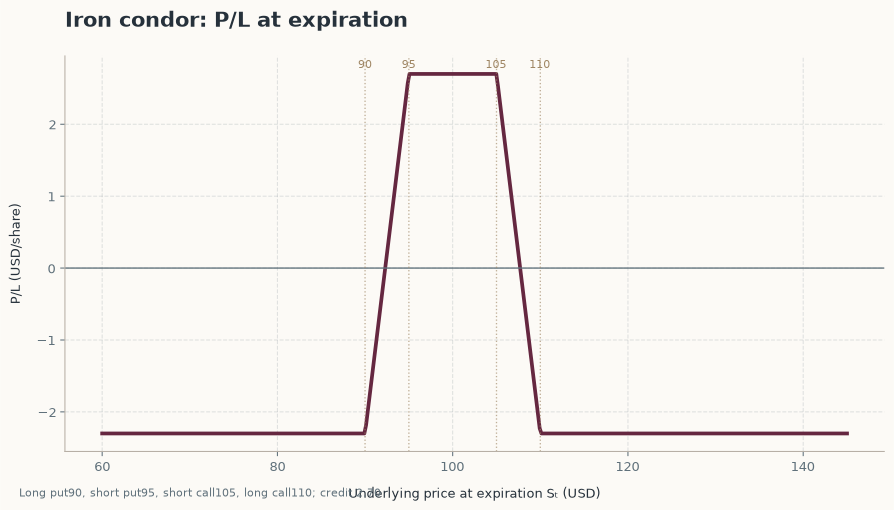
The payoff consists of two “steps”: the short put spread loses as the price falls below Kp2, the short call spread loses as it rises above Kc1. Between Kp2 and Kc1 the P/L is constant and equals the credit received; beyond the long wings the loss is capped.
How it behaves
The iron condor earns when the market does not move — the closer it stays to the middle of the range, the better. It collects the time value of the short options and benefits from a decline in volatility, but at the cost of negative gamma near the short strikes.
Unequally wide wings are common: then it holds that maximum loss = width of the wider wing − credit received and one side is significantly riskier. If the legs have different expirations, the defined risk at the shared expiration does not hold and it is no longer a classic condor.
Compared with the stock and a short position
The iron condor is a neutral position, so it is compared with the stock differently than directional structures are:
| Characteristic | 100 shares (or a short) | Iron condor |
|---|---|---|
| Directional exposure | full, 1:1 | small, close to zero |
| Source of profit | a rise (or a fall) in price | time and a decline in volatility within the range |
| Maximum loss | for a short, unlimited to the upside | known: width of the wing − credit |
| Capital | the full price, or margin and borrowing | margin on the width of the wing |
| Protection | none | the long wings cap the loss |
Against waiting in cash, the condor earns only at the cost of risk: the credit received is compensation, not “free income”. Against short selling the stock, the risk is defined, but the position is neutral, not bearish.
When it makes sense and when it does not
The iron condor makes sense in an environment where you expect the absence of a large move and relatively high IV, which increases the credit received. It suits liquid underlyings with good spreads.
It is not suitable for a strong trend view, for situations immediately before a known event (earnings, a central bank decision), or where you need a position you can exit quickly with a small number of legs.
What can go wrong
- Defined risk is not zero. The maximum loss (width − credit) is attainable, and even relatively soon if the market moves in one direction.
- Assignment of the short options. A short call may be assigned before the ex-dividend date, a short put when it is deep ITM; a short position in the stock arises.
- Pin risk. If the underlying settles (pins) at the short strike at expiration, one leg may be exercised and the other not.
- Margin and buying power. The broker usually holds collateral equal to the width of the wing, not just the credit received.
- Ongoing mark-to-market and IV. Before expiration the position can be at a loss even inside the range if IV rises or time and skew change.
- Liquidity and costs. Four legs mean four bid–ask spreads.
Greeks and exposure
- Delta is close to zero for a symmetric condor, but it changes as the price moves, and with unequal wings it has a directional tilt.
- Gamma near the short strikes is usually negative (you are short two options closer to the market); outside the range it may flip.
- Theta is usually positive: you collect the time value of the short options, but it changes with time and the spot price.
- Vega is usually negative, because the short options closer to the market have greater vega than the distant long wings — a rise in IV hurts and a decline helps, depending on the strikes and the term structure.
The signs are typical, not guaranteed. Greeks are local sensitivities; they do not describe the risk of large jumps or of assignment.
A practical example
The underlying is at 100. Lower put vertical: long 90 put for 1.00 and short 95 put for 2.50. Upper call vertical: short 105 call for 2.20 and long 110 call for 1.00. Net credit = (2.50 + 2.20) − (1.00 + 1.00) = 2.70 per share (270 USD for one complete structure; 4 option contracts, each with a multiplier of 100). Both wings have a width of 5.
- Maximum profit = 2.70 per share (270) if ST lies between 95 and 105
- Maximum loss = 5.00 − 2.70 = 2.30 per share (230), at ST ≤ 90 or ≥ 110
- Lower breakeven = 95 − 2.70 = 92.30; upper breakeven = 105 + 2.70 = 107.70
| Underlying price at expiration | P/L per share | P/L of the entire structure (USD) |
|---|---|---|
| 85 | −2.30 | −230 |
| 90 | −2.30 | −230 |
| 92.30 | 0.00 | 0 |
| 95 | +2.70 | +270 |
| 100 | +2.70 | +270 |
| 105 | +2.70 | +270 |
| 107.70 | 0.00 | 0 |
| 110 | −2.30 | −230 |
| 120 | −2.30 | −230 |
In this illustrative example the credit received is relatively high, so risk and reward almost balance out. In practice the credit tends to be lower and the risk larger, so always calculate the ratio for the specific prices. Unequal widths change the maximum loss: a 95/90 put wing (width 5), a 105/115 call wing (width 10) and a credit of 3.30 give a maximum loss of 10.00 − 3.30 = 6.70 per share on a rise above 115, with a breakeven on the call side of 105 + 3.30 = 108.30.
Checks before putting it to use in practice
For an experienced options trader, the following two checks are particularly important before deciding:
- Recalculate the width of both sides, the credit and the worst payoff; an asymmetric condor need not have the same loss on both wings.
- Distinguish between the expiration payoff of SPX and the physical settlement of SPY or equity options.
What to take away
The iron condor is a defined-risk, not a risk-free, structure. It earns on the price staying in the range and on a decline in volatility, but it carries assignment risk, margin and pin risk. Two numbers are key: the credit received and the width of the wing — and it is precisely the width minus the credit that is the real maximum loss.
Sources
- Short Condor (Iron Condor)the legs of a credit condor and defined risk
- All Strategiesclassification of the structure and terminology
- Understanding Options Greekslocal sensitivities and the limits of the model (signs of net Greeks)
- Cboe SPX Weeklys Specificationsexternal primary source for expert supplementation; verified 2026-10-11