
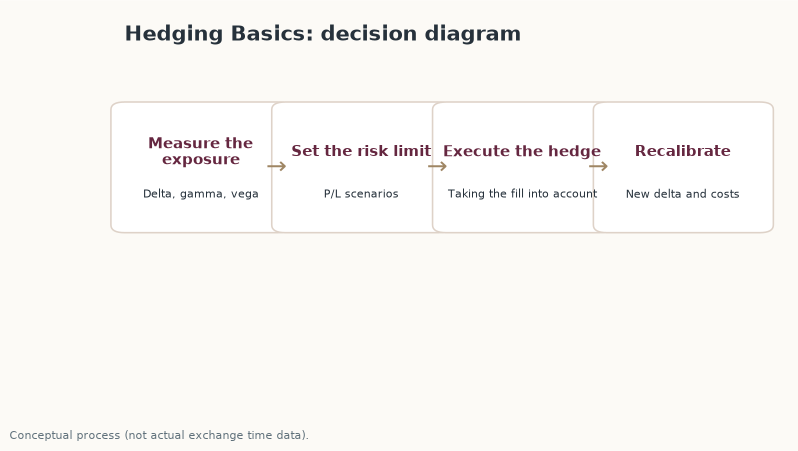
A delta hedge is adding the underlying to an option position so that the portfolio's net directional sensitivity is close to zero. We will look at how the hedge is sized, why it must be refreshed after a price move and what it does not remove.
What we are solving
You have an option position with directional exposure that you do not want to carry — perhaps because you care about time or volatility, not direction. A delta hedge suppresses this directional component by adding a position in the underlying so that the exposures offset each other. The question we are addressing is how to “make” a position neutral to small price moves.
What is key, however, is that this is not a one-off action: after a price move, the exposure of the options changes and the hedge must be refreshed. Exactly what a hedge removes and what it does not is the core of the whole topic.
Intuition
Delta tells you how much the value of a position moves for a small move in the price. When the net delta of an option position is +100, it behaves like being long 100 shares; you sell approximately 100 shares and the directional sensitivity disappears. If it is −100, you buy 100 shares.
But a hedge is local: it holds at a given moment and for a small move. With a larger move, the delta of the options changes and neutrality is lost — that is why the hedge is refreshed.
A simple example
Underlying at 100, multiplier 100. You are short 2 call options, each with a delta of 0.50. Net delta of the options = −2 × 0.50 × 100 = −100 share equivalents, so you buy 100 shares to be delta-neutral. But the delta of an option changes with the price (gamma), so the situation evolves:
| Situation | Delta of one option | Net delta of the options | Shares to hold | Action |
|---|---|---|---|---|
| Step 1: entry, price 100 | 0.50 | −100 | 100 | buy 100 |
| Step 2: price rose to 105 | 0.60 | −120 | 120 | buy 20 more (from 100 to 120; more expensive) |
| Step 3: price fell to 95 | 0.40 | −80 | 80 | sell 40 (from 120 to 80; cheaper) |
The table describes one specific path 100 → 105 → 95. In the third step you sell 40 shares because you hold 120 from the previous step; if the price had fallen directly from 100 to 95, you would have sold only 20. You see the typical consequence of negative gamma: the hedge forces you to buy more when the price rises and to sell when it falls — that is, to trade in the direction of the move.
Why it matters
Hedging is at the core of professional management of option positions: it makes it possible to separate directional exposure from the other risk factors. At the same time, it shows that neutrality is not free — every rehedge realizes costs, and with negative gamma you trade in the direction of the move.
Two traders with the same starting position can end up with different results purely based on how often and at what prices they refresh the hedge. The frequency of hedging is therefore a trade-off between neutrality and cost.
How to handle the position
The procedure is straightforward: calculate the net delta of the entire portfolio (across all legs, with signs and with the multiplier) and take its opposite value in the underlying: number of shares to trade ≈ −(net delta in share equivalents).
The sign matters: positive delta is hedged by selling, negative delta by buying. Because fractions of shares cannot be traded, the hedge is rounded and a small residual delta remains. For index options, futures are used instead of shares and the mechanics are different.
A common mistake
- Assuming that delta neutrality means a risk-free position.
- Calculating the hedge once and not addressing the fact that delta changes with the move (gamma).
- Ignoring the costs of rehedging, financing and stock borrowing.
- Assuming that the hedge works even through a price jump (gap).
- Treating rolling as a “fix” for a loss instead of a realization and a new exposure.
- Hedging delta but ignoring vega and assignment of the short option.
For advanced readers
What a delta hedge does not remove is just as important as what it does remove:
- Gamma risk. Delta changes with price; the larger the gamma, the more often the hedge must be refreshed.
- Vega risk. A change in IV affects the value of the options regardless of the delta hedge.
- Gap risk. A price jump overnight or after an event can skip over the entire zone in which the hedge would have worked.
- Trading costs. Every rehedge has transaction costs; frequent hedging can significantly increase them.
- Assignment and exercise. A delta hedge does not address the fact that a short option can be assigned or that a long option can be exercised; a different position than you planned arises.
- Liquidity. Under stress, spreads widen and the hedge can be more expensive or impossible at the model price.
Rolling means closing the existing position and opening a new one (a different strike, a different expiration). This realizes a loss or a gain and starts a new exposure with new Greeks; rolling is therefore not a way to “erase” or “shift” a loss. The same applies to repeated rehedging: every trade realizes a result and changes future sensitivity. Delta neutrality at a single moment therefore does not mean a position that is neutral over time.
The model foundation for delta, gamma and delta hedging is provided by the Black–Scholes framework; the frequency of hedging and the costs are beyond the model itself and must be addressed as a practical decision.
Check before putting it into practice
For an experienced options trader, the following two checks are especially important before making a decision:
- Quantify the cost of rehedging, including the bid–ask spread, commissions and limited liquidity.
- Remember that zero delta does not cover jump risk, changes in IV, correlations or an overnight gap.
Key takeaways
A delta hedge can locally cancel out directional sensitivity, but it is dynamic, it costs money and it leaves gamma, vega, gap risk and assignment risk in the position. Delta neutrality is not the same thing as being risk-free.
Sources
- Portfolios and the Greeks — Rutgers Mathematical Financeportfolios, delta neutrality and dynamic hedging examples
- Understanding Options Greeksdelta as a local sensitivity and its limits
- The Black-Scholes Model — Martin Haugh, Columbia Universitythe Black–Scholes framework for delta, gamma and delta hedging