
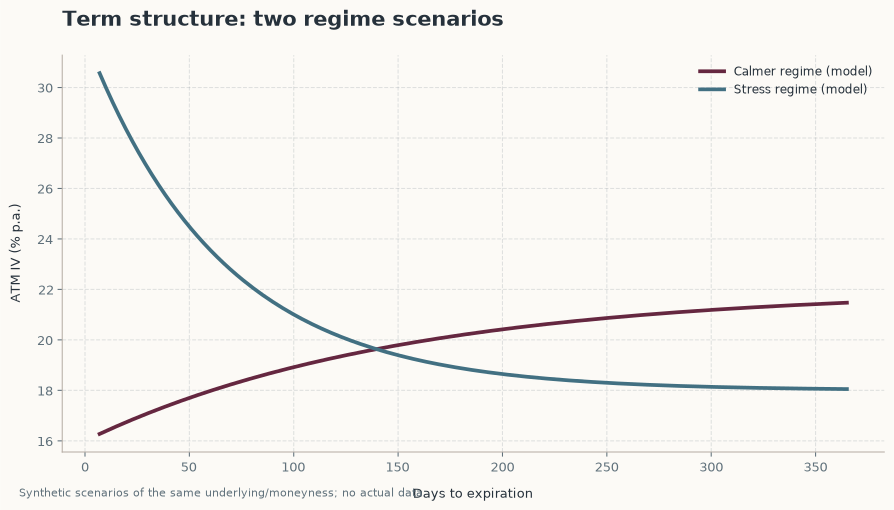
Term structure is the curve of implied volatility plotted against time to expiration at a comparable strike. We will look at why the same underlying has a different volatility for a short and a long expiration and what the slope of the curve means for calendar structures.
What we're solving
With one stock and one IV figure it does not look complicated, until you look at different expirations. The same underlying, the same strike, but a different time to maturity — and the IV differs. Term structure is the curve that captures this: implied volatility plotted against time to expiration for a comparable strike, usually ATM.
The practical question is: are short-dated options relatively expensive, or cheap, versus long-dated ones, and how does that change when an event appears? What matters is that this is a curve derived from option prices on the same underlying — it is not the same thing as volatility futures, which have their own price and their own dynamics.
Intuition
Short-dated IV often reflects upcoming events: company earnings, rate decisions, seasonal swings. Long-dated IV tends to be smoother and reflects broader uncertainty that does not change so quickly. That is why the curve can be upward sloping in a calm period (contango, long-dated IV above short-dated) and downward sloping before an event or under stress (backwardation, short-dated IV above long-dated).
The key point is that short-dated and long-dated IV do not move in the same way. An event lifts mainly the short end; the long end stays almost in place. This is exactly what the calendar spread rests on: one leg carries vega in the short tenor, the other in the long tenor, and the result depends on the difference, not on one common IV level.
A simple example
Hypothetical ATM IV of one stock by expiration. A calm period with slightly rising ATM IV: 1 month 18 %, 3 months 19 %, 6 months 20 %. Before a short-term event: 1 month 30 %, 3 months 21 %, 6 months 20 %. The slope measured as 1m minus 6m changes from −2 percentage points to +10 percentage points.
Note that the middle tenor moved only 2 percentage points, while the short one jumped 12 percentage points. If this were a parallel shift of the whole curve, such a difference would not arise. A position that is vega-neutral to a parallel shift can be very sensitive to this reversal, even if overall IV in the middle tenor looks stable. The values are hypothetical.
Where it matters
The shape of the curve matters for structures whose legs sit in different expirations: calendar and diagonal spreads, but also every position that tries to profit from a fall in short-dated IV after an event. The net vega of such a position is the difference between the vega of the short leg and that of the long leg, so a change in slope can flip the result even if total vega is close to zero.
With the so-called IV crush, it holds that after an event it is usually mainly short-dated IV that falls, but long-dated IV can fall as well, just less. One cannot count on short-dated volatility necessarily dropping, nor on the curve returning to its previous shape. The difference between holding a position and deciding on a new trade is that high short-dated IV may be compensation for event risk, not automatically an advantageous price.
Common mistakes
- Confusing the option IV curve with volatility futures. They are different instruments with a different price and different dynamics.
- Comparing different strikes or different deltas across tenors; the slope then measures something other than what you think.
- Assuming that high short-dated IV is an opportunity in itself. It may be fair compensation for an upcoming event.
- Relying on volatility falling after an event or on the curve returning to normal.
- Omitting interpolation between quoted expirations; different methods give different slope values.
For advanced readers
The slope is not measured only by the simple difference of two tenors. A common approach is comparing two fixed tenors, for example 1 month and 6 months, or regressing ATM IV on time. Short segments are more sensitive to individual events, longer ones are more stable, so when reporting it is appropriate to state which tenors are being compared and how interpolation is done.
For scenario analysis of calendars and diagonals, four cases are useful: (1) short-dated IV +5 percentage points, long-dated unchanged; (2) a parallel shift, both +5 percentage points; (3) short-dated −5 percentage points, long-dated unchanged; (4) a twist, short-dated +5 percentage points and long-dated −5 percentage points. The fourth case is not the same as the first: under a parallel shift both legs would rise equally, whereas a twist changes the slope and also affects a position that is vega-neutral to a parallel shift. For calendars and diagonals, therefore, the slope is as important as the level.
Checklist before putting it into practice
For an experienced option trader, the following two checks are especially important before deciding:
- Compare the same moneyness/forward delta definitions across different expirations and state the event date.
- Stress calendar/diagonal positions with a twist of the term structure, not only with a parallel IV shift.
Key takeaways
- Term structure is IV as a function of time to expiration at a comparable strike.
- Short-dated IV reflects events, long-dated IV broader uncertainty; the two move differently.
- The option IV curve is not the same thing as volatility futures.
- For calendars and diagonals, the difference in vega between tenors and the change in slope are decisive.
- Choose scenarios including a twist (short +5, long −5), not only a parallel shift; this links to skew and other topics.
Sources
- VIX Term Structure | CboeCboe: term structure of the option-implied volatility of the SPX index across expirations and constant-maturity indices; this is not VIX futures
- Considerations in volatility trading — Russell Investments (hosted by Cboe)Russell Investments (2014): context of term structure and of the relationship between implied and realized volatility; historical claims are not a promise of return
- The Black-Scholes Model — Martin Haugh, Columbia UniversityHaugh (Columbia): Black-Scholes assumptions and the volatility surface, including the dependence on maturity
- Volatility & the GreeksOIC: volatility and the Greeks as basic context for tenors and vega