
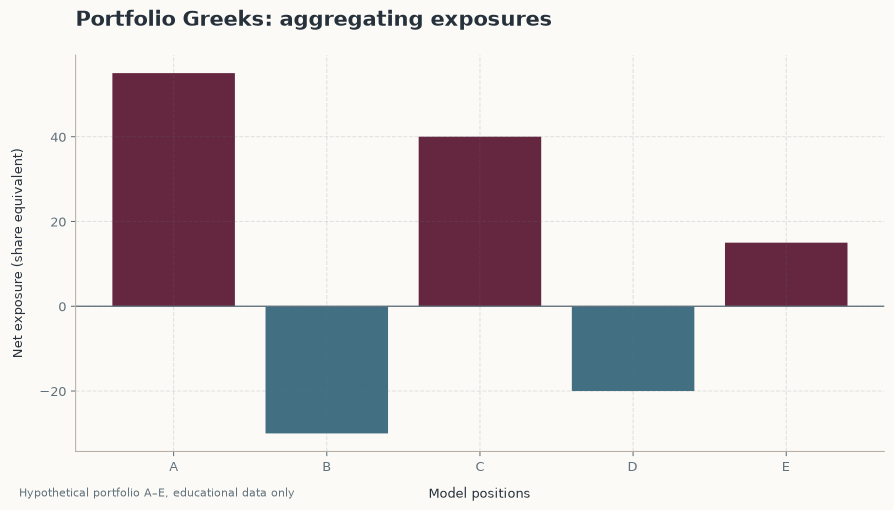
Portfolio Greeks summarize the sensitivities of several option positions into a few numbers describing the risk of the portfolio as a whole. We will look at how these sensitivities add up with their signs and the multiplier, and how to read gamma, theta and vega.
What we are solving
You have several positions and want to know what risk you carry as a whole — how much directional exposure, how quickly it changes when the price moves, how much you pay in time decay, and how sensitive you are to volatility. The individual legs will not show it; portfolio Greeks add them up into a single overview.
This addresses the question of how to turn many positions into a comprehensible picture of risk — and where that picture stops holding.
Intuition
Imagine that each position has a "share" in four questions: where it moves when the price rises (delta), how quickly that share changes (gamma), how much time takes away (theta), and how much a change in volatility adds (vega). Portfolio Greeks are the sums of these shares with their signs.
A single number then says that you are, for example, "approximately long 235 shares", but these numbers are instantaneous — after a price move they change because of gamma.
A simple example
Underlying at 100, multiplier 100. The portfolio holds 100 shares, long 2 call options (delta 0.50; gamma 0.02; theta −0.04/day; vega 0.10/pp) and short 1 put option (put delta −0.35; gamma 0.02; theta −0.04/day; vega 0.10/pp).
| Position | Delta | Gamma | Theta | Vega |
|---|---|---|---|---|
| 100 shares | +100 | 0 | 0 | 0 |
| Long 2 calls | +100 | +4 | −8 | +20 |
| Short 1 put | +35 | −2 | +4 | −10 |
| Total | +235 | +2 | −4 | +10 |
Interpretation: the portfolio is approximately long 235 shares, with slightly positive gamma (+2 means that delta rises when the price moves up), pays approximately 4 per day, and is slightly long vega (+10 per 1 percentage point increase in IV). These numbers hold only for the given moment — after a move of a few percent, both delta and gamma change.
Why it matters
Without aggregation it easily happens that a portfolio looks neutral but in reality carries concentrated risk: two positions with opposite delta "cancel out" in the sum, but may carry different gamma, vega and different assignment risk. A summary overview helps reveal such hidden exposures and plan how often the hedge will need to be refreshed.
It also contributes to event management: net vega helps estimate the impact of an IV change after earnings, and comparing structures shows whether a new position increases gamma, theta or vega risk.
How to approach the position
The procedure is mechanical: for each leg compute contribution = sign × number of contracts × Greek × multiplier and add them up — but only for positions on the same underlying, in the same currency and with the same multiplier. Shares contribute a delta of 1 per share (and zero gamma, theta and vega). For each sum, state the units and the time horizon (theta per day versus per week, vega per 1 percentage point versus per 1 %). Confusing these conventions is the most common source of error; the exact expression of the derivative and the unit conversion is in the For advanced readers section.
Use the summary as an orientational check, not as a substitute for detail: keep track by underlying as well, because a single aggregate number can mask concentration.
A common mistake
- Adding deltas of different underlyings without converting to notional or beta weighting.
- Forgetting the multiplier or the sign of a short position.
- Treating portfolio Greeks as constant across a larger move (ignoring gamma).
- Mixing units (theta per day versus per week, vega per 1 pp versus per 1 %).
- Assuming that beta weighting is exact and that correlations will stay stable.
- Confusing delta-neutrality with the absence of risk.
For advanced readers
Formally, the Greeks are partial derivatives of the position value: delta Δ = ∂V/∂S, gamma Γ = ∂²V/∂S², theta Θ = ∂V/∂t and vega ν = ∂V/∂σ. Vega is the sensitivity to σ in decimal form; the displayed vega per 1 percentage point is 0.01× this derivative. The sum across the portfolio is Greek_celkem = Σ sign · number of contracts · Greek · multiplier, valid for the same underlying, currency and multiplier.
The sum of delta is unambiguous only when all positions have the same underlying. As soon as the portfolio contains different underlyings, the aggregation options have assumptions:
- Notional. Delta × price × multiplier converts delta into a currency sensitivity; comparable in currency units, but not in the degree of common movement.
- Beta weighting. Multiplying delta by beta relative to an index creates an "index delta"; it assumes a stable beta and a single dominant factor, and beta is only an estimate.
- Separate views. It is often cleaner to look at exposures by underlying, sector or currency separately.
The same applies to vega: the vega of different underlyings adds up only under the assumption that their IVs move together. The situation is similar for gamma and theta. The link between gamma and theta is conditional: a typical short-premium trade has negative gamma and positive theta, while positive gamma under the usual assumption of zero carry means negative calendar theta. This is not a universal rule — therefore check specific positions together and do not derive a promised income from gamma and theta.
The Black–Scholes framework provides the model basis for the relationships between sensitivities and for delta hedging, including the relationships between first-order Greeks; portfolio aggregation is merely their sum with signs and multipliers.
Checks before practical use
For an experienced options trader, especially the following two checks are essential before a decision:
- Before aggregation, normalize the units of delta, gamma, vega and theta and multiply by the contract multiplier.
- Revalue the whole portfolio under stress scenarios, including simultaneous movement of prices, IV and correlations.
Key takeaways
Portfolio Greeks give a quick picture of direction, convexity, time and volatility in the portfolio, but they are local and have assumptions. Add them with signs and the multiplier, watch the units, and treat aggregation across different underlyings with caution.
Sources
- Understanding Options GreeksGreeks as local sensitivities, model inputs and limits
- Portfolios and the Greeks — Rutgers Mathematical Financeportfolios, delta neutrality and adding Greeks with signs
- The Black-Scholes Model — Martin Haugh, Columbia Universitymodel relationships between first-order Greeks and delta hedging