
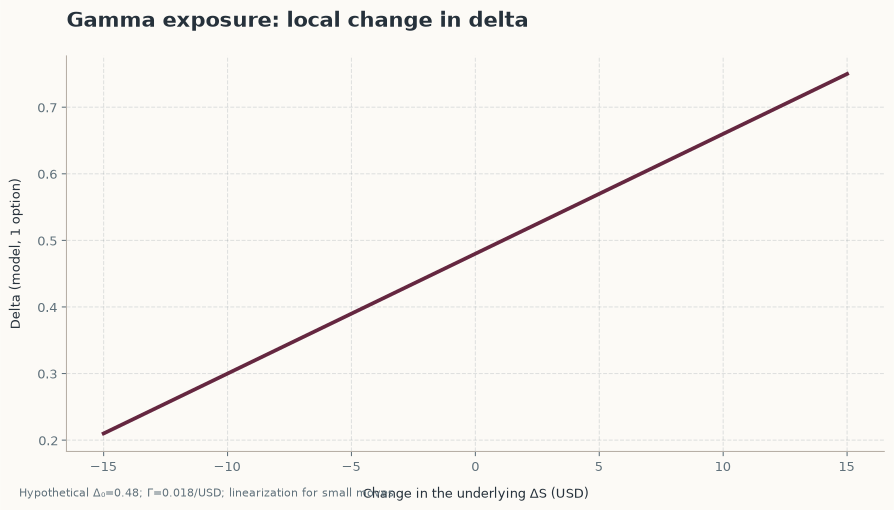
Gamma exposure shows how quickly your position's directional sensitivity changes when the stock price moves. Next you will see why positive gamma does not earn money on its own and how gamma relates to theta, hedging and scenarios.
What we are addressing
Delta exposure tells you how many shares your position currently corresponds to. But delta is not a constant: as the stock price changes, the delta of each option changes too. Gamma exposure is the aggregate rate at which the portfolio's delta changes when the underlying moves by one unit.
The practical question is: how quickly does my directional exposure drift out of line, and how often will the hedge need to be refreshed? Gamma is the second derivative of value with respect to price — the convexity of the position, which determines how nonlinearly the portfolio behaves during a larger move.
Intuition
When a position has a delta of +0.50 and a gamma of +0.03 per share, then when the underlying rises by 1 the delta increases to approximately 0.53. Positive gamma means the position accelerates in the direction of the move: delta rises when the market goes up and falls when it goes down. Negative gamma does the opposite — delta moves against you, which is typical for short options and some credit structures.
In the aggregate gamma, each leg is counted with the sign of the position, the number of contracts, the option's gamma and the multiplier. Shares have zero gamma, because their delta is a constant 1. Long vanilla options have positive gamma, short ones negative, but in spreads the signs add up and net gamma can change even with the price level.
A simple example
Hypothetical portfolio: underlying at 100, multiplier 100. You hold long 1 call with a gamma of 0.030 per share and short 2 calls with the same gamma of 0.030. Net gamma is +1 times 0.030 times 100, i.e. +3, plus −2 times 0.030 times 100, i.e. −6; in total −3.
Net gamma −3 means that when the underlying rises by 1 the portfolio's delta decreases by approximately 3, and when it falls by 1 it increases by 3. The position is short gamma: its delta moves against the move.
The second-order contribution to profit and loss is calculated as one half times gamma times the square of the move. With a move of +2 and net gamma −3, this component is 0.5 times (−3) times 4, i.e. −6, before the effect of delta, time and volatility even comes into play. That is precisely why gamma changes the result nonlinearly: it is not enough to know the delta at the start of the move.
In practice
Net gamma is most useful as an indicator of how often the delta hedge will need to be refreshed. High gamma means that delta changes quickly and every move creates a new exposure. For a short gamma position, the hedge is refreshed in the direction of the move, that is, you buy when it rises and sell when it falls, which carries transaction costs.
Gamma is highest for at-the-money options and rises as expiration approaches. Shortly before expiration, a small price move can dramatically change delta, and with it the need to hedge; for short ATM options, pin risk and assignment therefore require attention. The position-sizing plan should also include how many adjustments you are willing to pay for, see position size.
Common mistakes
- Assuming that a long option always means positive portfolio gamma; in spreads and ratio structures net gamma can be negative.
- Treating gamma as a constant. It changes with spot, time and IV and can change sign when moving through the strike.
- Confusing gamma per share with gamma per contract and forgetting the multiplier.
- Ignoring that gamma rises near expiration and for ATM strikes.
- Assuming that a delta hedge removes risk; gamma remains and the hedge must be refreshed.
- Believing that positive gamma earns money on its own. Convexity is not free and must not be measured only against the direction of the move.
For advanced readers
Positive gamma and time decay go hand in hand: a long option has positive gamma and usually negative theta, so you pay for convexity with time. A short option has negative gamma and usually positive theta, it collects time but bears the risk of acceleration against you. So the decision is not merely whether to be long or short gamma, but at what price and in what price range; in spreads gamma changes across different ranges, so a simplified statement about its sign often does not hold. For more detail see theta exposure.
Positive gamma does not mean automatic profit. For a long gamma position to earn, the realized move of the underlying must exceed the cost of time decay and the transaction costs of hedging. These costs are not a fixed daily rent and change with tenor, implied volatility and the number of adjustments; it is therefore advisable to model scenarios, see scenario analysis, instead of relying on a single number.
Check before practical use
For an experienced options trader, the following two checks are especially important before a decision:
- Convert the gammas of individual contracts to the same notional and state the units before you aggregate them.
- Do not attribute the aggregate GEX to the entire market without estimating who holds long and who holds short positions.
Key takeaways
- Gamma exposure measures how quickly a portfolio's delta changes when the underlying moves.
- Long vanilla options have positive gamma, short ones negative, but the net gamma of a spread can be either.
- The second-order profit and loss term is one half times gamma times the square of the move.
- High gamma means more frequent rehedging and higher transaction costs.
- Positive gamma does not earn money on its own; what matters is the ratio of the realized move to time decay and costs.
Sources
- GammaOIC: gamma as the change in delta, positive gamma for both long call and put, the effect of moneyness, time and volatility
- Options Gamma – The Greeks - CME GroupCME educational lesson on the gamma of futures options: changing delta, the analogy of acceleration; the underlying is futures, units differ from equities
- The Black-Scholes Model — Martin Haugh, Columbia UniversityHaugh (Columbia): Black-Scholes first and second derivatives and the model's assumptions for calculating gamma
- Quantitative Finance, Lecture 6 — E. W. Farkas, ETH ZurichETH Zurich Farkas: Greek sensitivities and numerical valuation assumptions; advanced mixed derivatives are not named as charm or vanna in the text
- Characteristics and Risks of Standardized Options — OCCofficial OCC document on the risks of standardized options; full text not verified in this run, kept as a reference
- Cboe 0DTE Trading Resourcesexternal primary source for expert supplement; verified 2026-10-11