
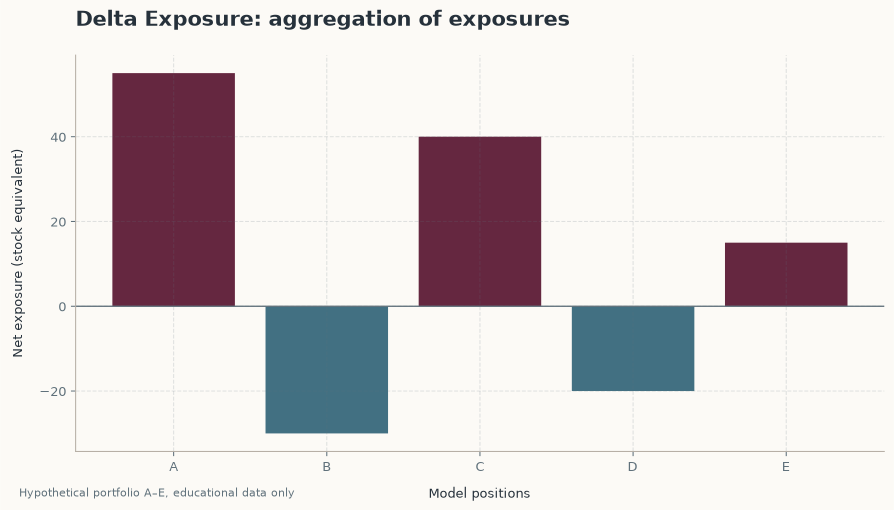
Delta exposure is the aggregate directional sensitivity of a portfolio expressed in delta. We will show how to add up the contributions of options and shares into one number and why the sign and multiplier matter.
What we are solving
A single share has a clear exposure: one unit, one slice of risk. An option on the same share adds exposure that is smaller, larger, or has the opposite sign. When you have several legs, a listing of deltas says nothing until you convert them into one common number.
The practical question is: how many shares does my position correspond to in total? The answer is given by the sum of the delta contributions across all legs, always with the correct sign and with the multiplier. That produces a directional exposure that can be compared with a stock position.
Intuition
The contribution of a single leg is calculated as the sign of the position times the number of contracts times the option delta times the multiplier. Shares have a delta of 1 per unit, so 100 shares contribute plus 100. For options the multiplier is often 100, but it is not universal and can differ across underlyings.
The result is local: at a given moment the portfolio behaves approximately like a long or short position in a certain number of shares. This holds for a small move in the underlying. As soon as the underlying moves more, the deltas of all legs change and the sum stops being exactly valid. Delta exposure is therefore a snapshot, not a constant.
A simple example
Hypothetical portfolio: underlying at 100, multiplier 100 for all options. You hold 100 shares, long 2 calls with delta 0.50, short 1 call with delta 0.30 and long 1 put with delta −0.40.
| Position | Contribution | Stock equivalent |
|---|---|---|
| 100 shares | 100 times 1 | +100 |
| Long 2 calls, delta 0.50 | +2 times 0.50 times 100 | +100 |
| Short 1 call, delta 0.30 | −1 times 0.30 times 100 | −30 |
| Long 1 put, delta −0.40 | +1 times (−0.40) times 100 | −40 |
| Total | — | +130 |
A total delta of +130 means that the portfolio behaves approximately like a long position of 130 shares. For a move of the underlying by 1, the value of the portfolio approximately increases by 130, assuming a small move and unchanged IV. After a larger move the option deltas change and the linear estimate fails.
In practice
Delta exposure serves three purposes. First, monitoring: it shows that a seemingly neutral structure actually carries a pronounced directional charge. Second, hedging: if you want to be delta-neutral, you need to know the total delta in order to buy or sell additional underlying. Third, checking overlap: several different structures may carry the same directional view and therefore the same risk, even if it does not appear so at first glance.
Hedging delta, however, does not remove the other risks. It only changes the directional exposure at a given moment; gamma, vega and jump risk remain. That is why delta exposure is an input into position sizing and risk management, not a substitute for scenario analysis.
Common mistakes
- Summing deltas of different underlyings into a single number without conversion to notional or beta weighting. The sum then has no unambiguous meaning.
- Forgetting the multiplier or the sign of a short position.
- Confusing delta with the probability that the option finishes in the money.
- Treating delta as constant across a larger move and ignoring gamma.
- Ignoring currency exposure and different methods of settlement, for example a cash-settled index.
- Assuming that beta weighting is exact; it is an approximation with unstable inputs.
For advanced readers
For positions in the same underlying the sum is unambiguous. Across different underlyings it is not so unambiguous, because a delta of 100 on a volatile stock and a delta of 100 on a broad index are not the same thing. There are two common conversions, both with assumptions.
Notional, or currency exposure, multiplies the delta by the price of the underlying and the multiplier. You obtain sensitivity in money terms, which is comparable in currency units, but it still does not say how the assets move together. Beta weighting multiplies the delta by the beta relative to a chosen index; it assumes a stable beta and a single dominant factor. Beta is an estimate that changes over time and tends to be unreliable for small or illiquid names.
For a portfolio in several currencies it is necessary to convert the exposures into a common currency, otherwise the sum has no interpretation. That is why it is advisable to calculate delta exposure first for each underlying separately and only then consider aggregation; in doing so, always acknowledge how the positions are weighted. The complete picture of risk is then assembled by portfolio Greeks together with scenario analysis.
Check before using in practice
For an experienced options trader the following two checks are especially important before deciding:
- Compare delta-dollar and beta-weighted exposures and do not confuse them with a plain sum of deltas of different tickers.
- Stress correlations, FX and the move of the underlying separately; today's hedge is not a hedge during a gap.
Key takeaways
- Delta exposure is the sum of directional contributions across legs, with sign and multiplier.
- For the same underlying the sum is unambiguous and can be expressed in stock equivalent.
- Across different underlyings deltas cannot be summed without notional or beta assumptions.
- Delta is a local snapshot; after a larger move gamma changes it.
- Hedging delta does not remove gamma, vega or jump risk.
Sources
- Options DeltaOIC: delta as a local sensitivity to the price of the underlying, the signs of long and short positions and the stock equivalent
- GammaOIC: gamma as the change of delta with a move in price, context for why delta is local
- Portfolios and the Greeks — Rutgers Mathematical FinanceRutgers Mathematical Finance: portfolios, the sum of Greek exposures and delta neutrality; model examples are not a guarantee of results
- The Black-Scholes Model — Martin Haugh, Columbia UniversityHaugh (Columbia): the Black-Scholes definition of delta as the first derivative and the assumptions of the model
- Characteristics and Risks of Standardized Options — OCCofficial OCC document on the risks of standardized options; the full text has not been verified in this run, kept as a reference