
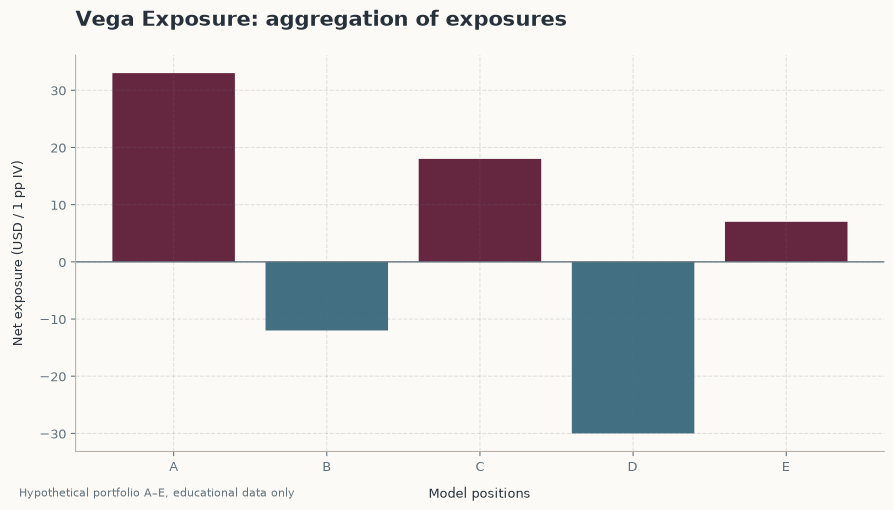
Vega exposure measures how much your position's value changes when implied volatility changes. We will look at why vega is quoted per percentage point and why a single number is not enough across expirations.
What we're addressing
The price of an option is sensitive not only to the stock price, but also to implied volatility. When IV rises, options become more expensive even if the underlying has not moved. Vega measures by how much an option's value changes when IV changes, usually by one percentage point.
The practical question is: how big an impact will a change in IV have on my position — before an event, after it, or during a general rise in uncertainty? For a portfolio, vega is summed across legs with the sign and the multiplier, so the resulting vega can be either positive or negative.
Intuition
Long options usually have positive vega: a rise in IV is favorable for them. Short options usually have negative vega. Vega is largest for options with a longer expiration and near the money; for short-term out-of-the-money options it is smaller in absolute value. That does not mean, however, that a short expiration carries less risk — short-term IV often changes sharply, typically around events, while long-term IV is more stable.
Net vega of a spread or a calendar arises from summing the contributions by strikes and expirations. That is why it can be positive, negative, or change with price; it is not a property of the structure, but the result of the specific legs.
A simple example
Hypothetical portfolio: multiplier 100, vega quoted per one percentage point. You hold long 1 call with a vega of 0.12 on the stock and short 2 calls with the same vega of 0.12.
| Position | Contribution | Vega per 1 pp |
|---|---|---|
| Long 1 call, vega 0.12 | +1 times 0.12 times 100 | +12 |
| Short 2 calls, vega 0.12 | −2 times 0.12 times 100 | −24 |
| Total | — | −12 |
Net vega −12 means that if IV rises by one percentage point, the portfolio loses approximately 12, and if it rises by five percentage points, approximately 60. This is a short vega position: a rise in volatility hurts it. The values hold locally, without any change in the underlying price and in time.
In practice
Vega exposure is used in managing events. Before earnings or other events, IV rises; after the event it often falls sharply; vega helps estimate how large the impact will be. It also serves in choosing a structure: long vega bets on a rise in IV, short vega on its decline or stagnation, and it helps to uncover hidden sensitivity in a structure that looks neutral.
For positions with multiple expirations, vega needs to be tracked by expiration, not as a single number for the whole. Term structure shows that short and long IV move differently, so a calendar or a diagonal depends on the difference in their movements. If you deliberately carry vega risk, it is advisable to have defined in advance which shift in IV you consider unfavorable, ideally in scenario analysis.
Common mistakes
- Confusing percent and percentage points. A rise from 20 % to 25 % is plus five percentage points, not plus five percent.
- Using a single IV for all expirations and strikes.
- Treating vega as constant; it changes with spot, time and IV.
- Assuming that a spread always has negative vega or that long options always have positive vega. It depends on the strikes and expirations.
- Summing the vegas of different expirations as if they were a single quantity.
- Ignoring the collapse of IV after an event and its impact on the value of the position.
For advanced readers
With units, two things need to be distinguished. Mathematically, vega is the derivative of value with respect to volatility expressed in decimal form, i.e. with respect to sigma. A rise in IV of one percentage point is a change in sigma of 0.01. The reported vega per one percentage point is therefore roughly a hundredth of the derivative with respect to sigma; the factor 100 arises precisely from converting a percentage point into a decimal number. A change in IV of one percentage point is thus not a one-percent change in the option's price, but a change in the input of 0.01.
In practice there is no single IV, but an entire surface: different strikes have different IVs, see volatility smile, and different expirations have different IVs. The vega of a single number is an approximation that assumes a parallel shift of the entire surface. In reality its parts shift differently, which is why for structures with multiple expirations it is appropriate to track vega by expiration and combine it with the other Greek exposures, see portfolio Greeks.
Checks before using it in practice
For an experienced options trader, the following two checks are particularly important before making a decision:
- Sum vega by signs, multipliers and unified units (σ vs. 1 percentage point).
- Also test the movement of individual tenors and the skew, not just one common IV.
Key takeaways
- Vega exposure measures the change in the value of a portfolio when implied volatility changes.
- Long options usually have positive vega and short options negative vega, but the net vega of a structure depends on the strikes and expirations.
- Vega is quoted per percentage point; a change of one percentage point is a shift in sigma of 0.01.
- Longer expirations and ATM options have larger vega, but short-term IV can move sharply.
- With multiple expirations, track vega by expiration, not as a single sum.
Sources
- VegaOIC: vega as sensitivity to a change in volatility and the effect of time to expiration and moneyness
- Options Vega - The Greeks - CME GroupCME educational lesson on the vega of futures options: price reaction to a one-point change in IV and examples; units and multipliers must be stated
- The Black-Scholes Model — Martin Haugh, Columbia UniversityHaugh (Columbia): the Black-Scholes derivative with respect to volatility and the model's assumptions for vega
- VIX Term Structure | CboeCboe: term structure of option-implied volatility across expirations; different expirations have different vegas; this is not about VIX futures
- Characteristics and Risks of Standardized Options — OCCOCC's official document on the risks of standardized options; the full text was not verified in this run, retained as a reference