
A backspread is an options position that bets on a pronounced move and finances part of the purchase by selling one closer option. We will show why the largest loss arises on a small move and when such a position makes sense.
What we are addressing
You expect a pronounced move (upward in the call variant) and want to profit from it with a limited loss if the move does not arrive. Buying two options is expensive; selling one closer option lowers the cost. The backspread thereby addresses how to obtain rising exposure above the upper strike while keeping the loss bounded from above.
This addresses the question of what happens when the move does not arrive in time or is only mild — and that is precisely where the largest loss arises.
What choices you have
- Long call — simpler, without a short leg and without margin on an uncovered position, but you pay the full theta.
- Vertical spread — defined profit and loss, more suitable for a milder move.
- Ratio spread — the opposite ratio, the risk is at the edge.
- Backspread — risk in the valley in the middle, unlimited potential above the upper strike.
Why the backspread specifically
The most common call variant: you sell one call option with the lower strike K1 (closer to the market) and buy two call options with the higher strike K2 (further from the market), with the same expiration. It can be opened for either a credit or a debit, and that significantly changes the shape of the payoff on the lower side.
Compared with a long call alone, above the upper strike the slope is still +1, but at a lower entry cost; in exchange you carry a loss valley in the band between the strikes and the risk of the short option.
How it is structured
| Leg | Position | Strike | Quantity | Expiration |
|---|---|---|---|---|
| 1 | Short call | K1 (lower, closer to the market) | 1 contract | the same |
| 2 | Long call | K2 (higher, further from the market) | 2 contracts | the same |
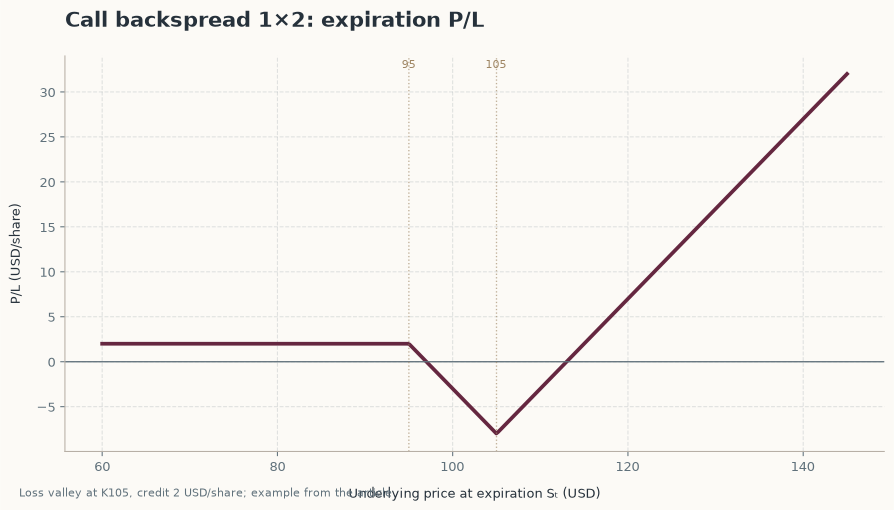
The payoff on the stock is g(S) = 2·max(S − K2, 0) − max(S − K1, 0). Below K1, g = 0 (flat bottom), between K1 and K2 g declines, above K2 g rises with a slope of +1. The loss valley lies between K1 and K2 and is deepest exactly at K2.
How it behaves
A backspread is not a position that “makes money no matter which way the market moves”. On the contrary: a mild rise straight into the band between K1 and K2 is the worst scenario, not the best. Only a pronounced move above the upper strike brings a profit, and that profit is unlimited.
The loss is limited, but it can be larger than the initial credit. “Limited risk” here therefore does not mean small risk.
Compared with stock and a short position
The backspread profile differs from both a stock position and a short position:
| Characteristic | 100 shares | Call backspread |
|---|---|---|
| Price rise | earns 1:1 | earns only above K2, then 1:1 |
| Mild rise | earns | deepest loss |
| Price decline | loses 1:1 | limited loss (lower plateau) |
| Capital | full price | debit/credit plus margin on the short leg |
Although the short leg is covered by the vertical part of the spread (short K1 / long K2 has a defined width), the second long call adds bullish exposure, not coverage. Moreover, the short option can be assigned — in the call variant this creates a short stock position.
When it makes sense and when it does not
A backspread makes sense when you expect a pronounced move (upward in the call variant), you want exposure that rises with a slope of +1 above the upper strike, and you are willing to bear a loss in the band between the strikes.
It is not suitable for neutral or mildly directional views — a mild move is precisely the worst case. Nor is it suitable where the short leg is close to the money and assignment is a threat.
What can go wrong
- Loss valley between the strikes. The worst scenario is a mild move toward the upper strike; the loss can be a multiple of the credit received.
- Assignment of the short leg. The short call can be assigned before the ex-dividend date or while ITM; this creates a short stock position that must be managed together with the two long call options.
- Time decay of the long options. Two long OTM call options can lose value while the short option is in the money — this deepens the valley.
- Defined loss ≠ small loss. It can be large relative to the account.
- Liquidity and pin risk. Three legs mean more spreads.
Greeks and exposure
- Delta: below K1 it is near zero, between K1 and K2 it is negative (the short call dominates), above K2 it is positive and rising. The backspread changes directional exposure according to the price level.
- Gamma: near K1 it tends to be negative (short option), near K2 positive (two long options).
- Vega and theta depend on the strikes, spot, time and the skew; theta can be unfavorable in the band between the strikes and favorable elsewhere.
Above the upper strike the terminal payoff is linear (slope +1), not globally convex: the long call has positive gamma, but the short leg adds negative gamma, so the resulting sign depends on the price level. Greeks are local and, during a large jump, they describe reality only partially.
Practical example
Underlying at 100. You sell the 95 call for 7.00 and buy 2× the 105 call for 2.50 each (5.00). Net credit = 2.00 per share (200 USD for one complete structure; 3 option contracts, each with a multiplier of 100).
- Lower plateau (ST ≤ 95): P/L = +2.00 per share (200)
- Deepest loss (ST = 105): (105 − 95) − 2.00 = −8.00 per share (−800)
- Upper breakeven: ST = 2·105 − 95 − 2.00 = 113.00; above it the profit rises without a cap
| Underlying price at expiration | g(S) per share | P/L per share | P/L of the entire structure (USD) |
|---|---|---|---|
| 85 | 0.00 | +2.00 | +200 |
| 95 | 0.00 | +2.00 | +200 |
| 100 | −5.00 | −3.00 | −300 |
| 105 | −10.00 | −8.00 | −800 |
| 110 | −5.00 | −3.00 | −300 |
| 113 | −2.00 | 0.00 | 0 |
| 120 | +5.00 | +7.00 | +700 |
| 140 | +25.00 | +27.00 | +2 700 |
The same strikes can be opened for either a debit or a credit, and that changes the payoff at both ends:
| Entry | Lower plateau (S ≤ K1) | Valley at K2 | Upper breakeven |
|---|---|---|---|
| Credit 2.00 | +2.00 | −8.00 | 113.00 |
| Debit 1.00 | −1.00 | −11.00 | 116.00 |
Credit reduces the risk and increases the profit on the lower side, while a debit deepens the risk — but in no case does the credit eliminate the loss valley. Derive the position size from the depth of the valley, not from the credit received.
Checklist before using it in practice
For an experienced options trader, the following two checks in particular are essential before deciding:
- Calculate both break-even levels and the maximum loss between the strikes, not just the profit in the extreme scenario.
- For a short ITM leg, check the settlement method and the risk of early assignment.
Key takeaways
A backspread bets on a pronounced move and pays for it with a loss valley when the move is small. Above the upper strike it earns without limit, but the worst scenario does not lie at the edge — it lies inside the band between the strikes, and that is why it is harder to manage than a simple spread.
Sources
- Short Ratio Call Spreadratio variant for comparing the leg ratio and risk
- All Strategiesoverview of ratio structures; long/short ratio nomenclature differs between sources
- Gammagamma behavior according to moneyness (sign depending on the price level)