
A butterfly is an options construction that bets on where the price ends at expiration, not on which direction it goes. We will show how it is built, how it behaves and what limitations it brings.
What we solve
You have a view that the stock will stay within a certain range and end at expiration close to a chosen price, but you do not want to bet on it directionally or bear the risk of selling a naked option (for a short call unlimited to the upside, for a short put large but limited from below by zero). The long butterfly solves exactly that: it creates a peaked profile that earns the most exactly at the chosen strike and outside the range loses only the debit paid.
We are thereby addressing the question "where the price will end up", not "which direction it will go" — and that is a different type of bet than a stock or a simple option offers.
What choices you have
A view on a range, or rather on a specific price at expiration, can be expressed in various ways:
- Hold the stock — bets on direction, not on a range; it cannot express a range-bound view.
- Sell an option — collects premium, but with a naked short call the risk on a rise is unlimited and with a short put it is large, limited from below by zero.
- Iron condor — leaves a flat profit range between the short strikes.
- Butterfly — a peak exactly at the middle strike and defined risk on both sides.
Why a butterfly specifically
The economic idea is simple: two short middle options collect premium where time value is highest, and two long wings limit the risk if the price moves far away. You usually pay a net debit for the construction, because the two sold middle options usually do not fully cover both wings.
The result is a position with a defined maximum loss and gain and with the maximum exactly at the middle strike. Defined boundaries, however, do not mean that the construction will make money — only that you know how much you can lose.
How it is built
A long butterfly (call variant) has three strikes K1 < K2 < K3 with equal spacing (K2 − K1 = K3 − K2) and four options: long 1× K1, short 2× K2, long 1× K3, all with the same expiration.
| Leg | Position | Strike | Quantity | Expiration |
|---|---|---|---|---|
| 1 | Long call | K1 (lower wing) | 1 contract | same |
| 2 | Short call | K2 (middle) | 2 contracts | same |
| 3 | Long call | K3 (upper wing) | 1 contract | same |
Equal spacing is important: if it is not equal, it is a broken-wing butterfly with an asymmetric risk profile. There is also a put variant (long put K3, short 2× put K2, long put K1), which has the same shape at expiration.
How it behaves
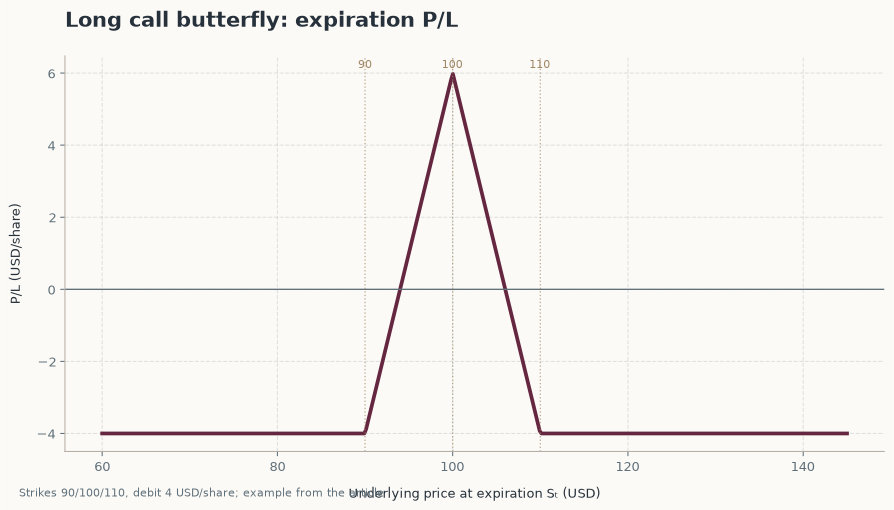
At expiration a butterfly has a triangular "tent": it rises from K1 to K2 and falls from K2 to K3, and outside the range it is constant at the level of −debit. It earns the most when the price ends exactly at K2; even a small move away from the middle quickly reduces the profit.
Before expiration, the value is driven by market pricing, not by this fixed shape — and the closer the expiration, the narrower the range in which the construction earns.
Versus stock and a short straddle
A butterfly is a different type of bet than a stock — it does not bet on direction, but on the position of the price:
| Characteristic | 100 shares | Long butterfly |
|---|---|---|
| Source of profit | price rise (direction) | position of the price at expiration (range) |
| Maximum loss | large on a decline | known: the debit paid |
| Maximum profit | unlimited | capped: spacing − debit |
| Delta | +1 permanently | small, changes sign depending on position |
| Time | plays no role | decisive; the range narrows |
Compared with waiting in cash, a butterfly makes sense only if you assign a real probability to the range; otherwise you will simply lose the debit paid. Compared with a short straddle, the risk is limited, but the profit is much smaller and concentrated at a single point.
When it makes sense and when it does not
A butterfly makes sense when you have a specific view on the price at expiration and want to bound both risk and reward in advance. The middle strike should correspond to where, according to your thesis, the price will end — not where the "highest probability" is according to delta.
It is not suitable when you expect a pronounced trend or when you need a wider profit range; there a condor or a spread is more appropriate. Do not use it either where the options are illiquid — four legs mean more spreads.
What can go wrong
- The maximum profit requires a precise hit. The price must end at expiration close to K2; even a small move quickly reduces the profit.
- Assignment of the short middle. The two short call options may be assigned (typically before the ex-dividend date or when ITM), which creates a short position in the stock; pin risk at K2 is significant.
- Costs and liquidity. Three different strikes mean more bid–ask spreads; with illiquid options, both entry and exit can be expensive.
- Ongoing mark-to-market. Before expiration, the position can be at a loss even with the price close to K2 if IV or time changes.
- Margin and settlement. Margin can change; with American options the assignment risk is real, with European and cash-settled indexes the mechanics differ.
Greeks and exposure
A butterfly is low-delta near the middle and changes sign depending on where the price is. Net gamma and net vega are not constant and their sign changes with spot, time and skew.
- Delta: below K1 positive (the long wing dominates), above K3 negative (the short middle dominates), around K2 it transitions.
- Gamma: around K2 it is usually negative, because two short ATM options have higher gamma than the two more distant long wings; on the wings the sign can reverse.
- Vega: around K2 it can be negative (two short ATM options), on the wings positive; the result depends on the specific strikes and IV.
- Theta: around K2 usually positive, outside the range it can be negative — again, it is not a fixed value.
Moreover, the payoff function is not globally convex: it is piecewise linear (constant at the extremes, slope +1 between K1 and K2, slope −1 between K2 and K3). At K2 the slope breaks downward, which corresponds to a negative second derivative exactly at the middle. The statement "a butterfly is a convex construction" is therefore incorrect without qualification.
Practical example
Underlying at 100, strikes K1 = 90, K2 = 100, K3 = 110 (spacing 10). Prices: long 90 call at 12.00; short 2× 100 call at 5.00 each (10.00 in total); long 110 call at 2.00. Net debit = 12.00 − 10.00 + 2.00 = 4.00 per share (400 USD for one complete construction; 4 option contracts, each with a multiplier of 100).
- Maximum loss = 4.00 per share (400) at ST ≤ 90 and ST ≥ 110
- Maximum profit = 10.00 − 4.00 = 6.00 per share (600) at ST = 100
- Lower breakeven = 90 + 4.00 = 94.00; upper breakeven = 110 − 4.00 = 106.00
| Underlying price at expiration | Value of the construction per share | P/L per share | P/L of the entire construction (USD) |
|---|---|---|---|
| 85 | 0.00 | −4.00 | −400 |
| 90 | 0.00 | −4.00 | −400 |
| 94 | 4.00 | 0.00 | 0 |
| 100 | 10.00 | +6.00 | +600 |
| 106 | 4.00 | 0.00 | 0 |
| 110 | 0.00 | −4.00 | −400 |
| 120 | 0.00 | −4.00 | −400 |
For the calculation: below K1 everything is worthless; between K1 and K2 the value grows according to the long K1 minus the value of the middle options; above K3 the wings cancel out and only the debit remains. A butterfly tempts you to evaluate it by the maximum profit at the middle strike — but that occurs at only a single point, so it is useful to model several scenarios, not just the best case.
Checklist before using it in practice
For an experienced option trader, the following two checks are particularly important before deciding:
- Make sure that the long and short wings match the exact 1:2:1 ratio.
- Before expiration week, assess pin risk and the difference between the maximum at the exact strike and a realistically executable exit.
Key takeaways
A butterfly is a bet on the position of the price with a defined loss and gain, but the maximum is concentrated at a single point and the range narrows as expiration approaches. It is not risk-free arbitrage or a directional position.
Sources
- Long Call Butterflybasic 1 : 2 : 1 construction and terminal risk/profit
- Gammabehaviour of gamma by moneyness and time (sign of net gamma by strikes)
- All Strategiesplacement of the construction and its variants in the overview