
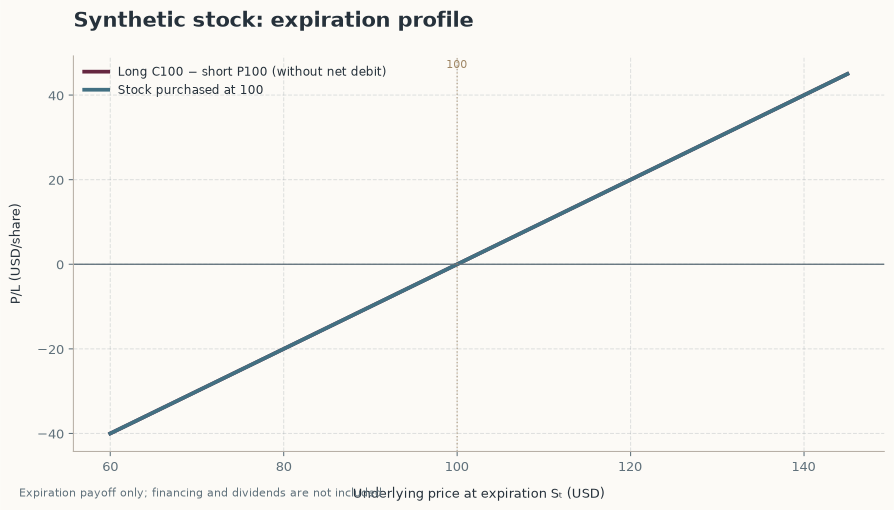
Synthetic stock is an options position that mimics holding a stock long, using a long call and a short put at the same strike. We will look at how this replica works and how it differs from actually holding the stock.
What we are addressing
You want long exposure to a stock but do not want to tie up the full purchase price, or you need to create the exposure from an options account. Synthetic stock solves this problem with a combination of a call and a put at the same strike: it replicates a long forward, and therefore the behavior of the stock.
We are thereby addressing the question of what the replica really means — and why it differs from simply holding the stock in terms of dividends, financing, margin and expiration.
What options you have
- Buying the stock — full exposure, dividends, no expiration, but full capital and full downside risk.
- Long call — defined loss, no dividends, but you pay the premium and have an expiration.
- Risk reversal — different strikes for the call and the put, a leveraged directional position.
- Synthetic stock — same strike and expiration; a replica of a long forward.
Why synthetic stock in particular
Synthetic stock replicates a long position in the underlying because, according to put-call parity, for European options with a continuous dividend yield q and a risk-free rate r the relation C − P = e−rT·(F − K) holds, where F = S·e(r−q)T is the forward price. The payoff at expiration is max(S − K, 0) − max(K − S, 0) = S − K, i.e. a linear profile with zero change in slope.
The main benefit is capital savings and the ability to create exposure from an options account. The main cost is the loss of dividends, expiration, margin on the short put, and deviations from ideal parity.
How it is constructed
| Leg | Position | Type | Strike price | Expiration |
|---|---|---|---|---|
| 1 | Long call | call | K | T |
| 2 | Short put | put | K | T |
Because both options have the same strike and expiration, for European options gamma and vega cancel out (but not, in general, theta), leaving a predominantly linear exposure to the underlying price with a delta of approximately +1. The bearish variant (synthetic short) is the mirror image of short call + long put with a payoff of K − S. If the strikes differ, it is no longer a pure synthetic underlying but a risk reversal.
How it behaves
A synthetic long rises and falls with the underlying approximately 1:1 — like the stock. But it has no dividends and no ownership rights, and it has an expiration after which the exposure ends unless you renew it. Moreover, the short put means an obligation to buy the stock at the strike if it is exercised.
The key point is that the difference C − P contains the cost of financing. The effective cost at expiration is K + D·erT: with a positive rate r > 0 it is higher than the plain K + D, with r = 0 it is the same, and with a negative rate it is lower. A synthetic long is therefore not a "stock at spot".
Compared with the stock
The replica differs from actually holding the stock in several practical respects:
| Characteristic | 100 shares | Synthetic long (long K call, short K put) |
|---|---|---|
| Exposure | 1:1 | approximately 1:1 (delta ≈ +1) |
| Capital | full price of the shares | debit/credit plus margin on the short put |
| Dividends | you receive them | you do not receive them (they are reflected in the option prices) |
| Expiration | none | yes; without rolling, the exposure ends |
| Ownership rights | yes | no |
Moreover, a synthetic short runs up against the availability of shares to borrow: with hard-to-borrow names, the price can differ significantly from theoretical parity. The short put in the long variant can be assigned and creates a long position in the stock (you are obliged to buy the shares).
When it makes sense and when it does not
Synthetic stock is useful as a building block for more complex structures or for exposure from an options account where you do not want to tie up the full price of the shares. It makes sense when you have the capital or a plan for a possible assignment of the short put and when you understand the cost of financing.
It is not suitable as a "free replacement for the stock" without differences, for cases where you need dividends or ownership rights, nor for accounts with a small margin buffer.
What can go wrong
- The downside risk is like that of the stock, but with margin. The loss grows linearly down to zero; at a price of 0 it is K plus the net debit D (for a net credit C, it is K − C). It is not a "defined small risk".
- Margin and margin call. The short put may require additional collateral on an adverse move.
- Assignment. The short put can be assigned before expiration; an obligation to buy the shares and a cash need arise.
- Expiration and rolling. Without rolling, the exposure ends; rolling out in time realizes costs and changes the forward price.
- Dividends, rates and borrowing. Changes in expected dividends and rates change the value of the position; for the synthetic short, the availability and cost of borrowing the shares are added.
- Liquidity and pin risk. Two legs mean two bid-ask spreads.
Greeks and exposure
- Delta is close to +1 for the same strike (a synthetic long position); with different strikes it is a risk reversal and delta varies according to the position of the price.
- Gamma and vega cancel out for European options with the same strike and expiration (the gamma and vega of the call and the put are identical at the same strike and time). Theta does not cancel out in general — zero applies only in the special case r = q = 0.
- The Rho of a synthetic long forward under European put-call parity and a constant dividend yield is in general neither zero nor necessarily small: roughly ∂(C−P)/∂r = K·T·e^(−rT). Its impact grows with the size of the strike, the number of contracts and the tenor exposure.
The cancellation of gamma and vega holds for European options in an ideal model; with American options, dividends and less liquid markets, deviations arise that can be economically significant. Greeks are local sensitivities and do not describe assignment or settlement.
Practical example
Underlying at 100, strike 100. You buy 100 call for 5.50 and sell 100 put for 4.50. Net debit = 1.00 per share (100 USD for one complete structure; 2 option contracts, each with a multiplier of 100). Ignoring financing, the entry (prepaid) breakeven is K + D = 101.00 — this is a simplified breakeven, not a universal forward price. The exact effective cost at expiration is K + D·erT: with r > 0 higher than 101.00, with r = 0 equal to 101.00, and with a negative rate lower.
- P/L at expiration (without financing) = ST − 100 − 1.00 = ST − 101.00
- Breakeven ≈ 101.00 (simplified, without financing)
- Maximum loss at ST = 0: −101.00 per share (−10 100 USD for one complete structure; 2 option contracts, each with a multiplier of 100), again without financing
| Underlying price at expiration | S − 100 per share | P/L per share | P/L of the whole structure (USD) |
|---|---|---|---|
| 70 | −30.00 | −31.00 | −3 100 |
| 90 | −10.00 | −11.00 | −1 100 |
| 101 | +1.00 | 0.00 | 0 |
| 110 | +10.00 | +9.00 | +900 |
| 130 | +30.00 | +29.00 | +2 900 |
You would experience the same move in the underlying by holding 100 shares, except for that 1.00 "forward" premium in this simplified view without financing (the actual premium depends on rates and expected dividends). The difference is that you did not pay 10 000 for the exposure, but 100 plus margin on the short put — and instead of shares you hold a position with an expiration.
Checks before putting it into practice
For an experienced options trader, the following two checks are particularly important before deciding:
- Separate the expiration-determined synthetic payoff from the actual cash funding and the cost of carrying the underlying.
- For the short put, check buying power and early assignment; being equivalent to the stock does not mean the same cash flows.
Key takeaways
Synthetic stock replicates a long stock from options, but it is not a free replacement: it has no dividends or ownership rights, it has an expiration and it requires margin on the short put. It is most useful as a building block for more complex structures.
Sources
- Put/Call Parityput-call parity, synthetic exposures and European relationships with rates and dividends
- The Black-Scholes Model — Martin Haugh, Columbia Universityforward price F = S·e^((r−q)T) and parity relationships in the model
- Characteristics and Risks of Standardized Options — OCCofficial link to the OCC Characteristics and Risks; the full text was not loaded in this run