
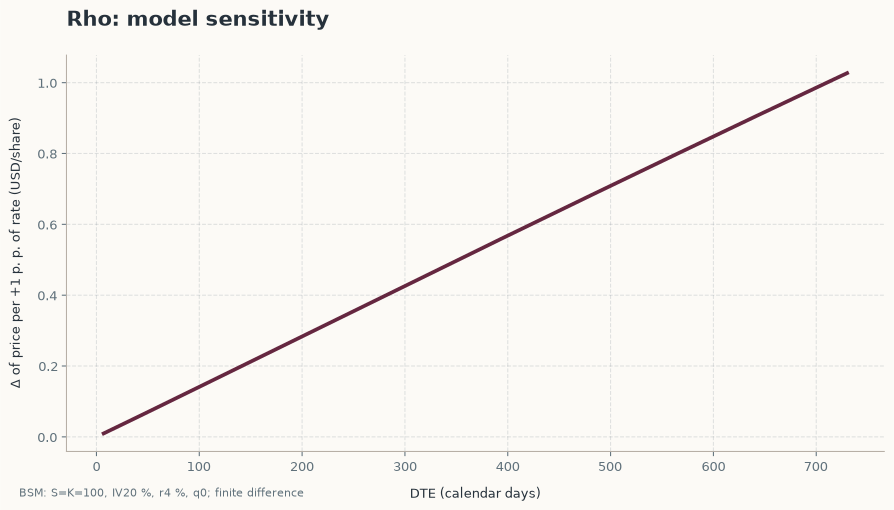
Rho measures how sensitive an option's price is to a change in interest rates. We will look at when this sensitivity matters, how calls and puts differ, and why it must not be confused with the effect of dividends.
What we are dealing with
With a short expiration the rate effect is usually smaller and often gets lost in daily noise — but that does not mean it is always zero. For a long option, for example a LEAPS with a two-year expiration, a change in rates can change the price noticeably — and many investors overlook this, because rates do not move as often as the stock price.
The practical question: when is rho relevant, how do calls and puts differ, and why must it not be confused with the effect of dividends.
Intuition
Imagine that you hold the right to buy a stock two years from now. Part of the value of that right depends on how much it costs to postpone payment — that is, on the interest rate. In the European Black–Scholes model, with a fixed dividend yield q and other inputs unchanged, a higher risk-free rate raises the price of a call and lowers the price of a put. The signs are determined by the exact derivatives, not by the general intuition about discounting itself: the rho of a call is positive and the rho of a put is negative.
For standard European vanilla options in that model, a long call has positive rho and a long put has negative rho even at negative rates, provided the other inputs remain fixed. For other products or models with variable dividends, the definition of the sensitivity and the method of repricing must be verified.
A simple example
A single model example of a European ATM call: S = K = 100 USD, T = 0.5 years, IV = 20 % p.a., r = 4 % p.a., q = 0, multiplier 100. In the Black–Scholes model the result is rho ≈ 0.2589 USD per share per 1 percentage point increase in the rate (with all other inputs fixed).
- A rate increase of 25 basis points (0.25 percentage point): local estimate of the price change ≈ 0.2589 × 0.25 = +0.0647 USD per share (about +6.47 USD per contract).
- A rate increase of 100 basis points (1 percentage point): local estimate ≈ +0.2589 USD per share (about +25.89 USD per contract).
- This is a local sensitivity: for a larger change in rates it is appropriate to perform a new full valuation rather than linearly extrapolate rho.
Why it matters
Rho matters mainly for long options. For options with a short expiration it is usually small compared with delta, gamma, theta and vega. For LEAPS, that is, long-term options such as a long-term call or a long-term put with an expiration on the order of months to years, however, a change in rates or in rate expectations can change the price substantially, especially when the rate regime shifts.
How it shows up in a position
In the European Black–Scholes model, the sign and magnitude of rho depend on the type of option, the spot, the strike, the rate and the time to expiration. The absolute rho of an otherwise comparable long option usually rises considerably with tenor, but this is not an exceptionless rule for an arbitrary portfolio. In spreads, the contributions of the individual legs may partly offset each other. Rho must therefore be quantified for the entire structure, not estimated merely from its name.
| Expiration | Rho (per 1 percentage point) | Impact of +50 bp per share |
|---|---|---|
| 1 month | 0.0425 | +0.0212 |
| 3 months | 0.1287 | +0.0643 |
| 12 months | 0.5187 | +0.2593 |
| 24 months | 1.0269 | +0.5135 |
Mind the units: 50 basis points = 0.50 percentage point; not 50 percentage points. The table is a local BSM approximation, not a market quote or a forecast.
A common mistake
Typical mistakes: ignoring rho for long options and LEAPS, confusing rho with the effect of dividends, and using one rate for all expirations regardless of the yield curve. In the European Black–Scholes model the rho of a call is positive and the rho of a put is negative even at a negative interest rate; however, the model sensitivity cannot be transferred without checking to other types of options, another carry model or other rate scenarios.
For advanced readers
Rho is the derivative of the option price with respect to the interest rate, ρ = ∂V / ∂r. As with vega, a distinction is made between the raw derivative and the figure "per 1 percentage point": the quoted rho is ∂V/∂r × 0.01. Rates enter the valuation in two ways — they change the discount factor and they change the forward price of the underlying — which is why all rate and dividend effects cannot be summed up in a single r − q difference. The forward does use the carry r − q, but discounting remains separate through e^(−rT). For European options with fixed q and σ, ρ_call = K·T·e^(−rT)·N(d2) and ρ_put = −K·T·e^(−rT)·N(−d2) apply; the sign and the magnitude therefore depend on the rate, the tenor and the moneyness. From put-call parity C − P = S·e^(−qT) − K·e^(−rT) only the difference between the rho of the call and of the put follows, not one universal sign for both sides.
For LEAPS it therefore pays to include a rate scenario in the routine repricing of the position alongside the movement of the underlying and volatility.
In practice
For comparison: a move in the underlying of 0.50 with a delta of 0.52 changes the option price by 0.26, which for an option with a short expiration is far more than the impact of a change in rates. For a two-year option, however, rho reaches the same order of magnitude and cannot be ignored. For index options, the difference between the dividend yield and the risk-free rate plays a role, so it is better to compute rho from specific inputs than to rely on one general rule.
Check before using it in practice
For an experienced options trader, the following two checks are particularly important before making a decision:
- Verify the units: one percentage point of rate = 100 basis points; do not confuse it with 1 bp.
- The sign of rho in the Black–Scholes model is positive for a European call and negative for a put even at a negative r, other assumptions being equal.
Key takeaways
- Rho measures an option's sensitivity to a change in rates.
- It is usually smaller for short expirations and grows for long options and LEAPS.
- Distinguish between rates and dividends; they act together.
- For long positions, include a rate scenario; the context is discussed in scenario analysis and term structure.
Sources
- Rhothe sensitivity of an option's price to the interest rate and its model conventions
- The Black-Scholes Model — Martin Haugh, Columbia UniversityBlack-Scholes and put-call parity as the basis for the rate and dividend effect
- Quantitative Finance, Lecture 6 — E. W. Farkas, ETH Zurichthe Black-Scholes PDE and the model assumptions for valuing sensitivities