
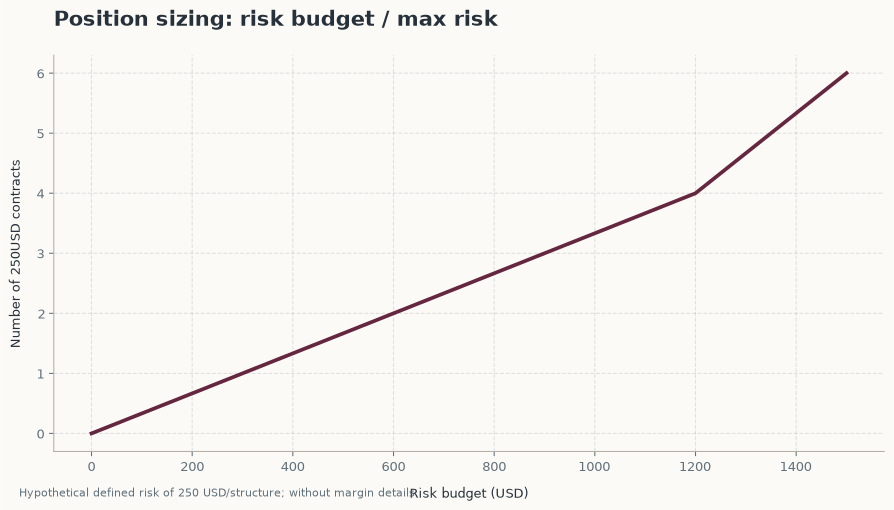
Position sizing means how many contracts to open so that a streak of losses does not knock you out of the market. We will look at why size is not set by the credit received or by margin, and how maximum or stress loss comes into it.
What we are dealing with
When you buy a stock, the risk is given by the number of shares and their price. With an option it is not so straightforward: you pay the premium, but the risk of a position can differ substantially from the amount paid. With a long option and a debit spread the maximum loss is defined; with uncovered short options it is not.
The practical question is: how many contracts may I open so that the maximum or stress loss stays within the budget I am willing to give to a single trade? The answer rests on two separate things — the maximum loss of the payoff and the margin or buying power that the broker holds.
Intuition
The size of a position is not determined by the credit received nor by how much your broker allows you. It is determined by the loss the position can bring in a reasonably adverse scenario. The credit received is only part of the price; margin is the minimum the broker reserves, and during an adverse move it can increase.
The difference between defined and open risk is fundamental. A long option and a debit spread have a maximum loss given by the structure. A short call can lose without any upper bound, because the stock price can rise without limit. A short put on a stock has its loss bounded below by zero, but even so it can be very large: strike price minus the premium received, times 100 per contract. The fact that the risk is bounded does not mean that it is small.
A simple example
Hypothetical account 100 000, risk budget 1 % per trade, i.e. 1 000, contract multiplier 100 as a simplification. For the sake of illustration we ignore fees and slippage.
| Structure | Max. loss per contract | Number of contracts |
|---|---|---|
| Long call, debit 2.00 | 200 | 5, risk 1 000 |
| Bull put spread, width 5, credit 2.00 | 300 | 3, risk 900 |
| Short call, K = 100, credit 2.00 | not bounded from above | cannot be determined from maximum loss |
For a spread the margin is broker-specific: the gross requirement can be read as the width times 100, i.e. 500, and some brokers deduct the credit received, so that the net requirement comes out at around 300. This is not a universal table, but an illustration of two possible assumptions.
The core lies in the last row. If the investor sized according to the credit received of 200 per contract, he could open five short calls. On a move of the underlying from 100 to 120 at expiration, the loss on one contract would be (20 minus 2) times 100, i.e. 1 800 — more than the entire risk budget. That is why with open risk the size is determined from a stress scenario, for example from a move of +20 % or +40 %, and from there the number of contracts is limited.
In practice
Sizing does not end with a single trade. Several small positions on the same underlying or on correlated stocks are not diversification: together they carry one common risk. With short options, gamma exposure is added to this, which determines how quickly the directional risk changes as the market moves. That is why exposures are added up across positions, typically as delta exposure in stock equivalent or via portfolio Greeks, and one watches how much capital is in a single theme.
Assignment and reserved cash are also part of the plan. A short put can end up as a stock position you did not plan, and that ties up capital. In addition, the broker may hold cash as collateral that cannot be used elsewhere. All of these are inputs into position size, not details to be dealt with after opening.
Common mistakes
- Sizing according to the credit received instead of according to the maximum or stress loss.
- Confusing margin with risk. Margin is the broker's requirement, not an estimate of loss.
- The assumption that defined risk means small risk; even width minus credit can be a large amount.
- Underestimating correlation: five small positions on the same underlying are not diversification.
- Ignoring fees, slippage and the risk of a jump overnight or after an event. A stress scenario should include a gap, not only a smooth move.
- Increasing size after a loss instead of re-evaluating the thesis.
For advanced readers
The Kelly criterion is a mathematical framework for bet size when the edge is known. It assumes that the edge is known and stable, that bets repeat independently, and it maximises long-term capital growth regardless of interim drawdowns. In real trading the edge is only an estimate, it changes, and positions are not usually independent. That is why Kelly is used as a reminder that size should be proportional to the edge and inversely proportional to risk, not as a recipe.
With options, Kelly is especially problematic for open risk: if a maximum loss cannot be defined, it makes no sense to compute an optimal size. First the risk must be limited by the structure or by hedging, and only then can sizing be addressed. For a practical decision, scenario analysis with adverse moves in price, time and volatility is more useful than a single number derived from an estimate of the edge.
Check before using in practice
For an experienced options trader, these two checks in particular are essential before deciding:
- Derive the number of contracts from the defined maximum or stress loss, not from the credit received.
- Take into account the correlation of positions on the same index and liquidity during an adverse move.
What to take away
- Position size determines whether you survive a streak of losses, not just how much you earn.
- Size by maximum loss for defined risk and by a stress scenario for open risk.
- Margin and buying power are the broker's requirements, not a measure of risk.
- A short call can lose without any upper bound; a short stock put is bounded below by zero, but even so it is large.
- Aggregate exposure across positions and allow for correlation, assignment and reserved cash.
Sources
- ODD Quick GuideOIC ODD Quick Guide: refers to the official OCC Characteristics and Risks; margin, assignment and the risks of short options in context; it is not a substitute for the full disclosure
- Characteristics and Risks of Standardized Options — OCCthe official OCC document on the risks of standardized options; the full text was not verified in this run, retained as an authoritative reference
- All StrategiesOIC overview of structures for the risk profiles of individual legs; the specific pages take precedence over the summary index
- Volatility & the GreeksOIC: local sensitivities and the limits of the model as context for aggregating exposures
- Portfolios and the Greeks — Rutgers Mathematical FinanceRutgers Mathematical Finance: portfolios and Greek exposure, delta neutrality; model examples are not a guarantee of results