
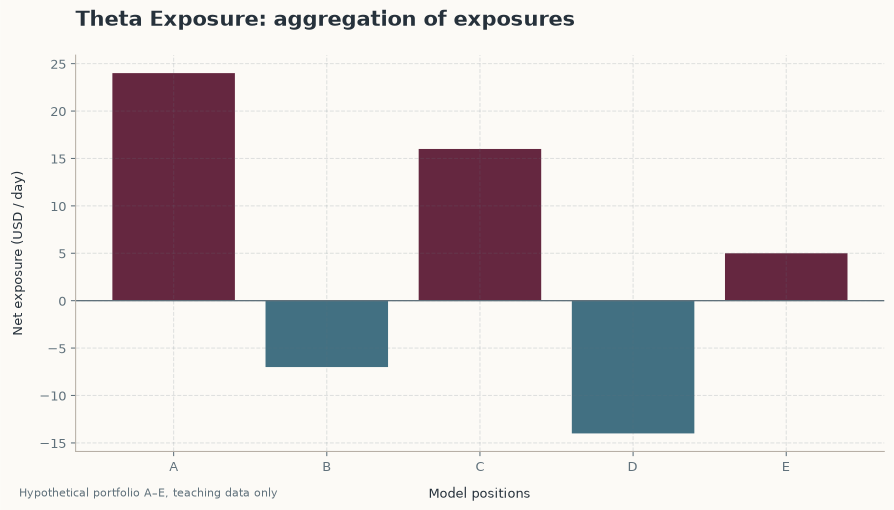
Theta exposure describes how the value of a position changes as time passes, if the price of the underlying and implied volatility do not change. We will look at why it is not a fixed daily income and how the unit, time convention and multiplier matter.
What we are addressing
When you hold a stock and nothing happens, it costs you nothing. Options behave differently, though: time value disappears as time passes, even with an unchanged stock price and volatility. How much that is, is described by theta, the change in the value of the position over a certain period of time, usually per day.
The practical question is: how much does waiting cost me, or how much does it bring me, and how will that change as expiration approaches? The answer is a model quantity, which is why a unit and a time convention must be stated for every number.
Intuition
Long options usually pay for time: they have negative theta, because their time value shrinks. Short options collect time: they have positive theta. In the aggregate exposure, each leg is counted with the sign of the position, the number of contracts, the theta of the option and the multiplier; stocks have zero theta.
The net theta of a spread or calendar can be positive or negative and changes over time. Collecting time is therefore not a stable income, but compensation for the risk you bear — for short options, especially gamma and vega risk.
A simple example
Hypothetical portfolio: underlying at 100, multiplier 100. You hold long 1 call with theta −0.05 per share per day and short 2 calls with the same theta −0.05 per share per day.
| Position | Contribution | Theta per day |
|---|---|---|
| Long 1 call, theta −0.05 | +1 times (−0.05) times 100 | −5 |
| Short 2 calls, theta −0.05 | −2 times (−0.05) times 100 | +10 |
| Total | — | +5 |
Net theta +5 means that with an unchanged price and IV the portfolio gains approximately 5 per day. But this holds only for the given spot and time. When the price moves or IV changes, theta changes, and in a range where the short options stop being at-the-money, net theta can even be negative.
In practice
Theta is largest for options near the money and grows as expiration approaches. For options far from the money, time value is small, so theta is small too; for options deep in the money, most of the value is intrinsic and theta is also relatively small. The fastest erosion occurs in ATM options in the last weeks and days.
Selling short ATM options looks like a high daily income, but it carries high gamma and the risk of a sharp loss on a move. Holding long ATM options, on the other hand, is the most expensive in time, because value disappears fastest exactly there. A calendar spread therefore seeks to combine positive theta with a different vega exposure, not just to maximize the daily number.
Common mistakes
- Treating theta as a constant daily income that will last until expiration.
- Confusing theta per share with theta per contract and forgetting the multiplier.
- Mixing theta per calendar day and per trading day; the value then differs, especially over the weekend.
- Ignoring that theta is largest for ATM options and near expiration.
- Overlooking that positive theta is offset by negative gamma and vega risk.
- Assuming that the theta of a spread never changes sign, or building a structure solely on the basis of high theta.
For advanced readers
With respect to the convention, one must be precise. Theta is stated either as the derivative with respect to the passing calendar time t, or with respect to the remaining time tau. For a long option, the value increases with increasing remaining time, so the derivative with respect to tau is positive, while the derivative with respect to passing calendar time is negative. When it is said that the theta of a long option is negative, the derivative with respect to calendar time is meant.
The difference between a calendar day and a trading day also shows up over the weekend: for a Monday expiration or for a position held over the weekend, the daily value on Friday and on Monday differs. Before comparing the theta of two structures, it is therefore necessary to verify the same convention, the same multiplier and the same time step.
Theta is only one component of the result. During a large move or a change in IV, delta, gamma and vega prevail over it. The complete picture is therefore assembled by portfolio Greeks together with scenarios, not by a single number per day.
Check before using in practice
For an experienced options trader, the following two checks are particularly important before a decision:
- Unify time units and contract multipliers for all legs and expirations.
- Supplement theta measurement with stress testing for spot moves, IV changes and gamma increases.
Key takeaways
- Theta exposure measures the change in portfolio value as time passes with an unchanged price and IV.
- Long options usually pay theta, short options collect it, but the net theta of a spread can change and even flip.
- Theta is largest for ATM options and before expiration.
- It is not a fixed daily income; it is compensation for gamma and vega risk.
- Always check the unit, the time convention and the multiplier.
Sources
- ThetaOIC: theta as time sensitivity, negative for long and positive for short options, the effect of moneyness and time to expiration
- GammaOIC: gamma and the change in delta as context for the compensation of positive theta by risk
- The Black-Scholes Model — Martin Haugh, Columbia UniversityHaugh (Columbia): Black-Scholes time derivatives and the model assumptions for theta
- Characteristics and Risks of Standardized Options — OCCofficial OCC document on the risks of standardized options; the full text was not verified in this run, retained as a link