
A diagonal spread is an options position that differs in both strike and expiration and resembles a covered call, but it is not the same as holding the stock. We will look at how it is built, how it behaves, and what it means for risk and the Greeks.
What we are addressing
You want bullish exposure to a stock, but you do not want to tie up the full purchase price, and at the same time you want to get something from selling an option to help finance it. Buying the stock and selling a covered call addresses this problem, but it ties up capital and cannot be scaled well. The diagonal spread takes a different path: by buying a longer call and selling a shorter call with a higher strike, it seeks to achieve similar exposure more cheaply.
This addresses one practical question: how to obtain close directional exposure, but with less capital, while understanding what substitutes for the stock and what does not.
What options you have
Various structures share a similar goal (bullish exposure with partial financing):
- Stock + covered call — full delta exposure, dividends, no expiration, but full capital.
- Long call — simpler, defined loss, but you pay the full theta.
- Calendar — the same strike and a purely time-based bet, with only a small directional component.
- Diagonal — different strike and expiration; both a directional and a time component at once.
Why the diagonal specifically
The diagonal saves capital compared with buying the stock, because instead of 100 shares you hold a long call option. In addition, selling the shorter call brings in premium that reduces the cost. That is both its main appeal and its main trap: a long option is not stock — it has an expiration, a different delta, a different sensitivity to volatility, and no dividends.
Moreover, from the broker's point of view, the short call may not be considered covered merely because you hold a long call with a different expiration; margin and buying power may correspond rather to an uncovered short position.
How it is built
| Leg | Position | Strike | Expiration |
|---|---|---|---|
| 1 | Long call | K1 (lower) | longer |
| 2 | Short call | K2 (higher) | shorter |
Because the short leg expires earlier, at its expiration the position still contains the long call. The value of the position is then the difference between the market price of the long call and the intrinsic value of the short leg; there is therefore no fixed payoff profile, but rather a model valuation with assumptions about IV and the remaining time.
How it behaves
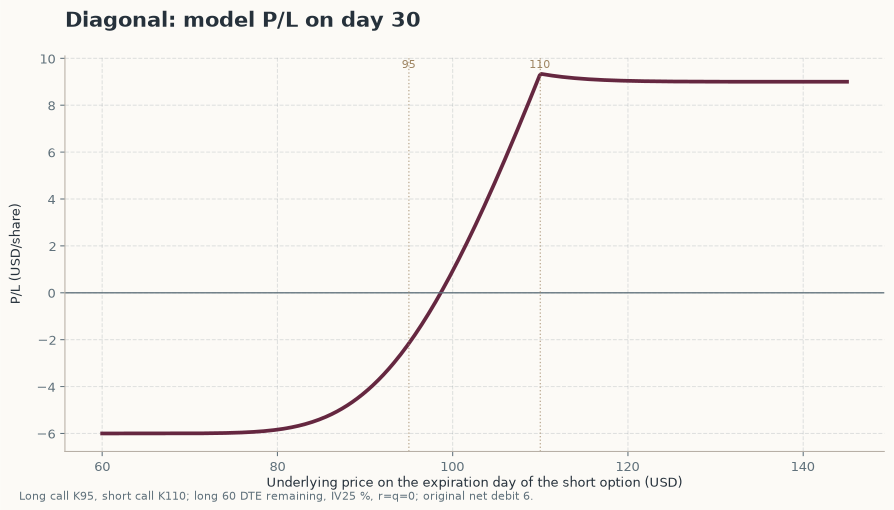
As long as the price is below the short strike, the diagonal behaves similarly to a long call — it rises with the price. As the price approaches the short strike, the short leg begins to slow the gains. Above it, the long leg rises only partially, because the short leg offsets it. On a decline, you do not lose the entire debit as long as the long option has time value — but that diminishes with time and a decline in IV.
It is neither "regular income" nor a fixed theta: the short leg usually erodes faster, but as its expiration approaches and its moneyness changes, theta can flip.
Compared with the stock and the covered call
The closest analogy is a covered call (stock + short call). The diagonal resembles it, but differs in essential respects:
| Characteristic | Stock + short call | Diagonal |
|---|---|---|
| Basis of exposure | 100 shares, full delta | long call, delta < 1 and changing |
| Capital | high (stock price) | lower (debit for the long option, margin on the short) |
| Dividends | you receive them | you do not receive them |
| Expiration | none (only the short option) | the long leg has its own expiration |
| Assignment risk | the short call may take away the shares | the short call may create a short stock position |
When the short call is assigned, a short stock position arises (you must deliver the shares), which must be managed together with the long call option. This is a different situation from the stock, where upon assignment you simply sell what you hold.
When it makes sense and when it does not
The diagonal makes sense when you have a moderately bullish thesis, do not want to tie up capital in the stock, and are willing to manage the position actively — to watch both legs, plan rolling, and be clear about what you will do upon assignment.
It is not suitable when you need dividends, when you want exposure without an expiration, or when you expect the position to "manage itself". Likewise, it is not suitable for accounts where the margin on the short leg could trigger a forced liquidation.
What can go wrong
- The short call may not be covered. A long call with a different strike and expiration may not meet the conditions of a covered position; the margin may correspond to an uncovered short call.
- Assignment of the short leg. With American options, the short call may be assigned before the ex-dividend date or while ITM, creating a short stock position.
- The long leg has its own risks. It has an expiration, is sensitive to IV, and cannot be treated like stock.
- No guaranteed theta income. The value at expiration of the short leg depends on the valuation of the long leg.
- A double spread and liquidity. Two expirations and two strikes mean higher costs and the risk of worse fills on the less liquid long leg.
Greeks and exposure
- Delta is the difference between the delta of the long leg and the short leg; in a bullish diagonal it is usually positive, but it changes with price and time, because the legs have different expirations.
- Gamma is usually negative near the short leg's strike — the shorter option has higher gamma, so delta flips quickly (gamma exposure requires management).
- Theta is not a constant "daily income"; it can flip and even be negative.
- Vega is a combination of two expirations: the longer leg usually has higher absolute vega, but the relative movement of IV between expirations (term structure) can change the picture.
The signs depend on the strikes, the spot, time, and the skew, not on the number of legs. Greeks are local sensitivities and do not describe behavior during a large price jump.
Practical example
The underlying is at 100. You buy a 90-day call with a strike of 95 for 8.00 and sell a 30-day call with a strike of 110 for 2.00. Net debit = 6.00 per share (600 USD for one complete structure; 2 option contracts, each with a multiplier of 100).
In 30 days the short leg expires. The table uses model values of a European call from the Black–Scholes model with the assumptions r = 0, q = 0, σ = 0.25, T = 60/365, no fees; C = S·N(d₁) − K·N(d₂), d₁ = [ln(S/K) + 0.5·σ²·T] / (σ·√T), d₂ = d₁ − σ·√T. The entry debit of 6.00 is a hypothetical quote, not a value computed by the same model.
| Underlying price | Short leg value | Long leg value (BS) | P/L per share |
|---|---|---|---|
| 85 | 0.00 | 0.63 | −5.37 |
| 95 | 0.00 | 3.84 | −2.16 |
| 100 | 0.00 | 6.93 | +0.93 |
| 110 | 0.00 | 15.34 | +9.34 |
| 120 | 10.00 | 25.04 | +9.04 |
The profile is neither symmetric nor strictly bounded. On a decline you lose, but not the entire debit, as long as the long call has time value; on a strong rise the short leg limits the profit. The table is a model illustration for European options; with American options the risk of early assignment is added, and the model includes neither dividends nor rates (r = 0, q = 0). If IV were to fall sharply, the value of the long leg would be lower and the result worse.
Checks before using it in practice
For an experienced options trader, the following two checks are particularly important before deciding:
- Establish a scenario at the moment of the nearer expiration as well as the later outcome of the remaining long leg.
- Check the underlying, the settlement, the IV term structure, and any delivery upon assignment.
Key takeaways
The diagonal is a hybrid: a directional component from different strikes and a time component from different expirations. It is neither guaranteed income nor a risk-free covered call — it requires a plan for assignment, for both expirations, and for changes in volatility.
Sources
- All Strategiesclassification of the structure and the terminology of long/short variants
- The Black-Scholes Model — Martin Haugh, Columbia Universitymodel values of a European call and the assumptions for the calculation table
- Understanding Options GreeksGreeks as local sensitivities and the limits of the model