
A broken-wing butterfly is an options structure with unequally wide wings that is often opened for a credit. We will look at where the one-sided loss arises in such a structure and why the credit alone does not mean small risk.
What we are addressing
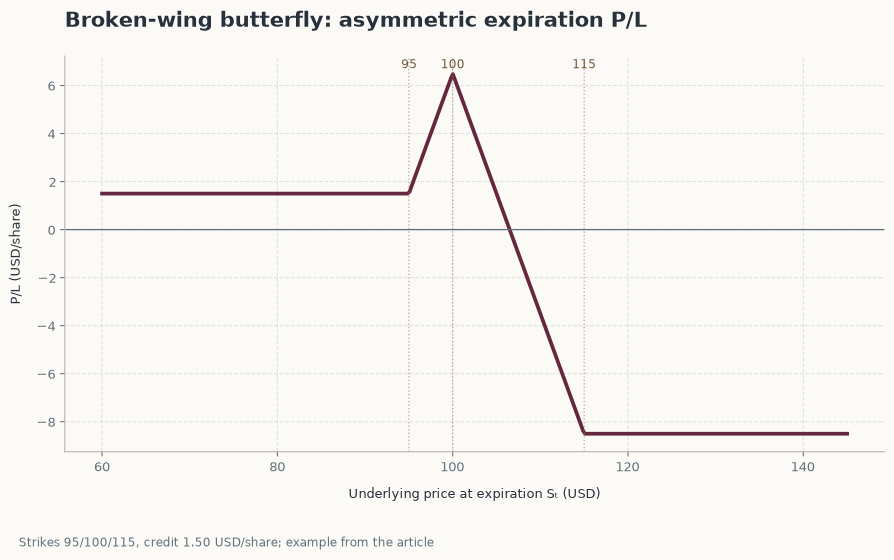
You want an outcome concentrated around the middle strike and you are considering an asymmetric structure for a credit. In the stated call BWB 95/100/115 with a credit of 1.50 per share, the maximum P/L is at K2 = 100, below K1 = 95 it remains +1.50 per share, above 106.50 a loss arises, and from K3 = 115 it amounts to −8.50 per share. This is therefore an example with risk on the upper side, not primarily a bet that the price will not fall below a certain level. A broken-wing butterfly (BWB) has unequally wide wings; the direction of the risk depends on the call/put variant, the widths and the entry debit/credit.
In doing so we address the question of how to express a mildly directional view and at the same time get paid, without overlooking that one leg of the payoff is significantly worse.
What choices you have
A mildly directional thesis with defined risk can be expressed in different ways:
- Credit vertical spread — simpler, defined risk on one side.
- Symmetric butterfly — symmetric risk, usually for a debit.
- Ratio spread — more short options than long options; the risk at the edge can be unlimited.
- BWB — ratio 1 : 2 : 1, defined risk but asymmetric.
Why specifically a broken-wing butterfly
The BWB preserves the basic structure of a butterfly (long 1× lower, short 2× middle, long 1× higher strike, same expiration), but the spacings K2 − K1 and K3 − K2 differ. Thanks to this, the structure can often be opened for a net credit and can express a mild directional tilt.
The price for this is one-sided risk: on the wider wing a larger, though still bounded, loss arises. A BWB is therefore not a “better butterfly” — it is a different, less symmetric bet.
How it is constructed
| Leg | Position | Strike | Quantity | Expiration |
|---|---|---|---|---|
| 1 | Long call | K1 (lower, near wing) | 1 contract | same |
| 2 | Short call | K2 (middle) | 2 contracts | same |
| 3 | Long call | K3 (higher, far wing) | 1 contract | same |
Because K3 − K2 > K2 − K1, the protection on the upper side is weaker. Above K3 the terminal payoff is fixed: all three option series (four contracts in total) are in the money, the net terminal delta is zero, and the P/L remains at the level of −[(K3 − K2) − (K2 − K1)] + credit. This is not open spot exposure but a fixed loss.
How it behaves
On one side of the range the outcome is small and firmly set (often precisely the credit received), on the other side a larger loss arises that is only stopped beyond the far strike. The greatest profit lies at the middle strike, just as with a symmetric butterfly.
The credit received by itself does not say whether the risk is small. With the same strikes, a higher credit reduces the maximum loss at expiration; with structures of differing widths the entire payoff must be recalculated. In this example the maximum loss is (15 − 5) − 1.50 = 8.50 USD per share. In the credit call example given, a breakeven exists only on the upper side; this is not a general rule for all BWBs.
Versus stock and a short position
A BWB is mildly directional, but with a completely different profile than stock or a short position:
| Characteristic | 100 shares | Broken-wing butterfly |
|---|---|---|
| Source of profit | price increase | price position near K2 |
| Maximum loss | large on a decline | on the wider wing (difference of widths − credit) |
| Maximum profit | unlimited | in the example +650 USD at K2 = 100; +150 USD at S ≤ K1 = 95 is the lower plateau, not the global maximum |
| Price increase | earns | above K3 it no longer increases the loss, but it does not earn |
A credit put spread can express the thesis “it will not go below this level”, but the credit call BWB stated has a different orientation: at expiration below 95 it does not lose, and the loss arises only above 106.50. The claim of loss on both sides therefore does not apply to this example. Before expiration, the ongoing mark-to-market P/L may be unfavourable even at a price within the terminally profitable range. Versus a short sale of shares, the risk is defined, but the profit is limited and concentrated in a range.
When it makes sense and when it does not
A BWB makes sense when you genuinely want to enter for a credit and you have a view on a range with a lean to one side. With physically settled options of American style, a plan for possible early assignment of the short middle option is necessary. With index options of European style, early assignment does not occur; the specific method of settlement must be verified according to the contract specification.
It is not suitable for a neutral view without a lean (there a symmetric butterfly or an iron condor is better), nor for situations where the far wing is illiquid — the protection depends precisely on it.
What can go wrong
- The one-sided risk is large even with an initial credit. A credit by itself does not mean low risk.
- Assignment of the short middle option. With physically settled equity call options of American style, early assignment of one or both short options can create a short stock position; the ex-dividend date and the small remaining time value of an ITM option may be relevant. Pin risk around K2 concerns the uncertainty of exercise at expiration and the resulting underlying position. With index options of European style, early assignment does not occur; cash-settled contracts do not create a stock position. The style and settlement are not specified in this hypothetical example.
- Little room for profit on one side. On the narrower side the P/L is fixed and relatively low.
- Ongoing mark-to-market and IV. Before expiration the value follows market pricing; a fall in IV or a price move can put the position into a loss sooner.
- Margin. Because of the larger one-sided risk, requirements may be higher than corresponds to the credit received.
Greeks and exposure
- Delta: a BWB has a directional lean depending on which side the far wing is on; with the spot it changes sign in the middle range.
- Gamma and vega: as with a symmetric butterfly, their sign changes according to the spot, the strikes and time. In a BWB the asymmetry is more pronounced, because the far wing has a different sensitivity than the near one. One cannot say that a BWB has positive gamma or vega merely on the basis of the ratio of legs.
- Theta: it can be positive near the middle (short ATM options) and negative elsewhere; it is not constant.
The terminal payoff shows how far the loss can go, but it does not describe the ongoing risks: before expiration the value changes with mark-to-market, IV, and with options of American style also with the possibility of early assignment, even when the terminal profile is favourable.
Practical example
Underlying at 100. Long 95 call at 8.00; short 2× 100 call at 5.00 each (10.00 in total); long 115 call at 0.50. Net payment = 8.00 − 10.00 + 0.50 = −1.50, i.e. a net credit of 1.50 per share; 150 USD for one complete structure, 4 option contracts in three strikes, multiplier 100 for each contract. Spacings: left wing 5, right wing 15.
The value at expiration per share is f(S) = max(S − 95, 0) − 2·max(S − 100, 0) + max(S − 115, 0); P/L = f(S) + 1.50.
| Price range at expiration | f(S) per share | P/L per share | P/L of the whole structure (USD) |
|---|---|---|---|
| S ≤ 95 | 0 | +1.50 (fixed maximum on this side) | +150 |
| 95 ≤ S ≤ 100 | S − 95 | S − 93.50 | e.g. S = 100: +650 |
| 100 ≤ S ≤ 115 | 105 − S | 106.50 − S | e.g. S = 105: +150; S = 115: −850 |
| S ≥ 115 | −10 | −8.50 (fixed maximum loss) | −850 |
At S = 100, f(S) = 5.00, P/L = +6.50 (maximum). At S = 115, f(S) = 20 − 30 + 0 = −10.00, P/L = −8.50, and likewise for any higher price. Maximum loss = (15 − 5) − 1.50 = 8.50 per share (850 USD for one complete structure (4 contracts; multiplier 100 for each contract)); the upper breakeven is S = 106.50. Below K1 the P/L is always +1.50, so there is no breakeven there. The risk-to-reward ratio is strongly asymmetric and depends on how far away the far wing is.
Checks before using it in practice
For an experienced options trader, the following two checks are particularly essential before deciding:
- Verify the widths of both wings and the net debit/credit; the asymmetry determines the worst side of the risk.
- Calculate the profile at expiration and also on early closing, and take into account the liquidity of the three strikes.
Key takeaways
In the credit call example given, there is a fixed positive outcome on the lower side, a maximum at the middle strike, and a pronounced but bounded risk on the upper side. For other call or put BWBs, the direction and extent of the losses must be derived from the specific payoff. The asymmetry of the wings may allow opening for a credit; whether that actually occurs depends on the prices of the individual options. The credit alone says nothing about the size of the risk.
Sources
- All Strategiesclassification of ratio structures and terminology
- Gammabehaviour of gamma according to moneyness and time (asymmetry of the wings)
- Understanding Options GreeksGreeks as local sensitivities and the limits of the model