
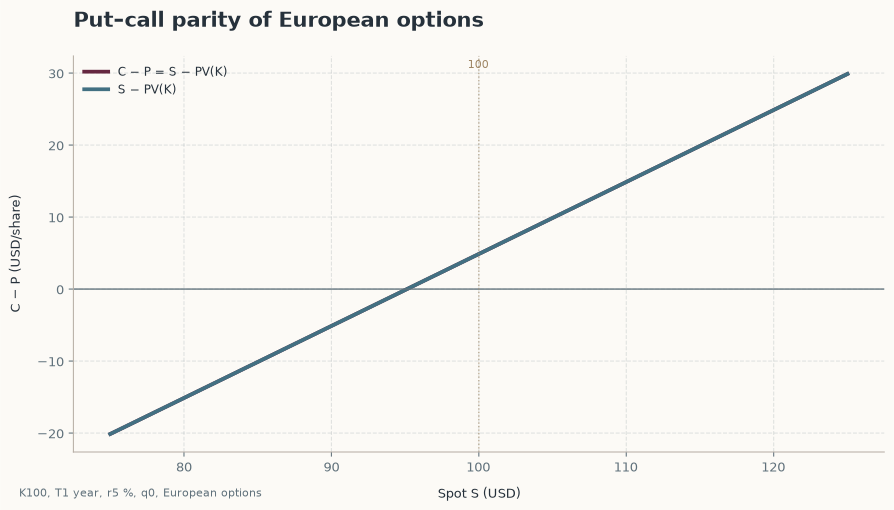
Put-call parity describes the relationship between the price of a European call, a European put and a forward on the same underlying, strike and expiration. We will show what follows from this relationship, how synthetic positions are used, and why it holds only with an adjustment or within bounds for American options and discrete dividends.
What we want to find out
If you compare a call and a put on the same underlying, strike and expiration, and with a comparable exercise style and settlement, the difference in their implied volatilities alone does not prove mispricing or a realizable arbitrage. Under the same European model convention, the same inputs and prices consistent with parity, a European call and put should have the same implied volatility only if the same inversion model is used; an observed difference may stem from non-synchronous quotes, bid/ask, dividends, borrow costs, model error or American exercise, for which parity does not hold in general. The basic check is the relationship between the call, the put and the forward. That relationship also explains why a higher nominal price of the call than of the put does not by itself mean that the call is more expensive or a worse purchase: they are different exposures, and the price reflects the forward and the strike.
Parity for European options
For European options on an underlying with a continuous dividend yield q, in a simple no-arbitrage model C − P = S·e−qT − K·e−rT = e−rT(F − K) holds, where F = S·e(r−q)T is the current market forward delivery price for maturity T (the price of a new forward with zero initial value), not the current mark-to-market value of an already existing forward. C and P are the prices of the call and the put, S the spot, K the strike, T the time in years, r the risk-free rate for the relevant tenor, and q the model's continuous dividend yield, which must be consistent with the spot S. The expression e−rT(F − K) is the present value of a long forward with delivery price K whose market forward price is F. The assumptions include European exercise, continuous q, and the ability to finance and sell short without transaction costs and restrictions; it is a no-arbitrage relationship under these assumptions, not an empirical law. Discounting and dividends must use the same time and currency convention.
Computed illustrative model example
For S = 100 USD, K = 100 USD, T = 1 year, r = 5 % p.a. with continuous compounding and q = 0, F = 100·e0.05 = 105.1271 USD and the difference comes out as C − P = 100 − 100·e−0.05 = 4.8771 USD per unit of the underlying. If the call had a chosen model price of 12.0000 USD, the corresponding put would, under the same convention and inputs, have to be 7.1229 USD. This is not a live quote and not a trading recommendation.
Synthetic positions
A long call and a short put with the same strike and expiration create a terminal payoff profile of a long forward with delivery price K: at expiration the payoff is ST − K, not actual ownership of the stock. The initial net premium C − P and its financing are not part of the payoff; if C − P > 0, it is a net debit and the profit at expiration is (ST − K) − (C − P)·erT; if C − P < 0, it is a net credit. The amounts stated are per unit of the underlying and exclude the multiplier and fees. A synthetic forward does not receive dividends or voting rights and may have different capital, margin and financing requirements than directly holding the stock, depending on the account and venue. The opposite combination provides a short forward profile.
When parity is not enough
For American equity options, early exercise may apply, and the simple European equality therefore does not hold in general; instead of equality, bounds must be used that depend on dividends and on whether early exercise is optimal, and assignment risk must be taken into account. For European options with known deterministic discrete cash dividends, the equality continues to hold, but S − PV(D) must be substituted for S·e−qT, where PV(D) is the exact present value of those known certain dividends up to expiration; for uncertain or merely expected dividends, PV(D) is only an estimate, and continuous q is only a model approximation. Quotes are further affected by the bid/ask, borrow costs, financing, dividend assumptions, fees and the unavailability of some legs. Even a theoretical difference that is found does not by itself constitute a realizable arbitrage.
Checklist before interpretation
- Same underlying, strike, expiration, exercise style, settlement and multiplier?
- Correct market forward price (not the mark-to-market of an existing forward), dividend and discount curve; for discrete dividends, PV(D)? Are S and q mutually consistent?
- Am I working with a genuinely executable bid/ask, not just the mid?
- Does any leg carry American exercise/assignment risk?
Sources
- Options Industry Council – Put/Call ParityPrimary explanation of synthetics and parity.
- Options Industry Council – Option Price BehaviorValuation assumptions and sensitivities.
- The Black-Scholes Model — Martin Haugh, Columbia UniversityEuropean put-call parity and discounting assumptions