
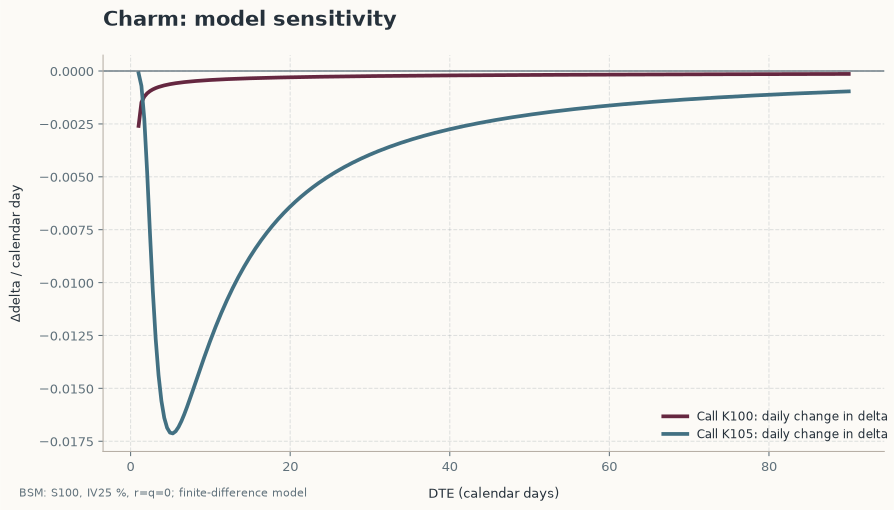
Charm describes how an option's directional sensitivity changes just because time passes. We will show why a hedged position can drift out of alignment even when the market barely moves, and when to watch for it.
What we are addressing
You manage a position that you hedged against directional risk. On Monday it sat right: delta was balanced. On Thursday the market has moved only minimally, and yet you hold a different directional exposure than you planned. No one changed the price of the underlying or the volatility — only time passed.
This drift is not a coincidence. An option's directional sensitivity, delta, changes on its own over time, because the moment when it is decided whether the option expires in the money is approaching. This change of delta over time is called charm. For a stock investor, it is a signal that hedging against direction is not a one-time action but ongoing maintenance — especially before expiration.
The practical question is therefore: by how many shares does my exposure shift per day when nothing else changes?
Intuition: delta makes up its mind over time
An option's delta is like the market's estimate of the weight with which the option behaves like a stock. As expiration approaches, the option gradually makes up its mind: an out-of-the-money call moves toward zero, an in-the-money call toward one. Delta migrates over time toward its final state, even if the price does not move.
It is different for an option near the money. As long as the price of the underlying is right at the strike, the outcome remains open like a coin in the air: delta stays near one half until the final moments. Only at expiration does it break — the payoff function has a kink at the strike, so its derivative from the left and from the right differs.
Charm therefore depends on where the strike lies. Far from the price of the underlying, delta barely changes over time. At the money and for short expirations the drift is fastest, similar to gamma and theta.
A simple example: a stock at 100
The stock trades at 100, volatility is 25 %, rates and dividends are zero for simplicity. We enter time in years as T = days/365. We track a call on which nothing changes except the passage of time.
First an at-the-money call, strike 100: delta falls from 0.5247 at 90 days to 0.5143 at 30 days and 0.5026 at one day. The drift is small but systematically negative; toward expiration delta stays around one half.
It is different for a call with a strike of 105. Delta and charm change substantially in the final days, but not constantly:
| Days to expiration | Delta | Charm / day |
|---|---|---|
| 30 | 0.2595 | −0.003870 |
| 7 | 0.0820 | −0.015429 |
| 2 | 0.0043 | −0.008367 |
| 1 | 0.0001 | −0.000731 |
Ten long contracts carry, at 7 days, exposure equivalent to 81.9696 shares (0.08196957 × 10 × 100). Over five calendar days, as we move from 7 days to 2 days, delta falls to 0.004304253, that is to 4.3043 shares. The change is −77.6653 shares over five days, which averages −15.5331 shares per calendar day. It is not a constant −0.0154 per day as at the start of the week, nor −0.0084 at the end: the average over the interval lies between the instantaneous values. And note, these are five calendar days, not five trading days — a week is shorter in trading days. A short position (short ten contracts) reverses the sign of the entire shift.
A call with a strike of 115 shows the opposite end of the spectrum. At 90 days delta is 0.143718 and charm is −0.001495, so even well before expiration it is not zero. Only as expiration approaches do the values drop: at 30 days delta is 0.0278 and charm −0.0021138, at 7 days 0.00002915 and −0.00003583. Toward expiration both delta and charm approach zero, but no universal acceleration takes place.
Where it most often goes wrong
The first trap is convention. Charm is quoted either with respect to calendar time (the derivative with respect to t, as time flows forward) or with respect to time to expiration τ. The two figures have opposite signs. Without the stated convention the value is incomprehensible, because the same position looks now positive and now negative.
The second trap is the claim that charm always accelerates toward the end. That holds for options near the money. For a strike clearly distant from the price of the underlying, delta is already nearly zero or one, and charm weakens to zero as expiration approaches. No general rule exists.
The third trap is the sign of the position. A short position reverses the direction of the drift relative to the same long position. Anyone who sold a call and hedged the delta must expect their hedge to shift in the opposite direction. In hedging basics it is therefore useful to plan the frequency of monitoring according to the distance to expiration and to the strike, not according to how calm the market was.
For advanced readers: the formula and conventions
Formally, charm is the derivative of delta with respect to calendar time: charm = ∂Δ/∂t = −∂Δ/∂τ, where τ is time to expiration. The notation via τ has the opposite sign, which is why the figures in the literature differ depending on the convention.
Model assumptions: the European Black-Scholes model with constant volatility and rate, continuous trading, and zero transaction costs. In the example above, r = q = 0 and we enter time in years as T = days/365; the value per calendar day is obtained as charm / 365.
For a European call with dividend yield q and delta Δ = e^(−qτ) N(d1) we obtain charm = e^(−qτ) [ q N(d1) + φ(d1) ( d2/(2τ) − (r−q)/(σ√τ) ) ]. The derivation rests on the fact that ∂d1/∂τ = −d2/(2τ) + (r−q)/(σ√τ). For zero rates and dividends the relation simplifies to charm = φ(d1) d2/(2τ); at the ATM point d2 is negative, so charm is negative and, as τ decreases, it grows in absolute value as 1/√τ.
That is precisely the difference from an option far from the money: there d2 is distinctly negative, but φ(d1) falls much faster, so charm heads toward zero. For an ATM option with zero rates, delta stays around 0.5 until expiration, because d1 = σ√τ/2 and N(d1) approaches 0.5. In the limit, delta just before expiration approaches 0.5, but at the exact instant of expiration the derivative of delta with respect to time at the strike is undefined: the payoff function has a kink at the strike, its derivative from the left is 0 and from the right is 1, so the value of delta is not unique. It therefore cannot be claimed that delta at the strike deterministically jumps to 0, or to 1. What happens to a real position is determined by the type of contract and the rules for exercise and delivery, not by a single limit.
In practice, charm is combined with gamma: both quantities are large for short expirations and at the money. They are complemented by vanna for changes in volatility and vomma for the second derivative with respect to volatility.
Check before using it in practice
For an experienced options trader, the following two checks are particularly important before making a decision:
- Record whether the derivative is taken with respect to calendar time or remaining time τ; the signs are opposite.
- Expect a change in delta due to the passage of time even without any movement in price and IV.
Key takeaways
- Charm measures how an option's delta changes when time passes and nothing else changes.
- For options near the money, delta migrates toward one half and charm grows before expiration; for a strike far from the price, charm weakens to zero.
- Without the stated convention (calendar time versus time to expiration) the sign has no meaning.
- A short position reverses the direction of the drift.
- For short expirations, check delta more often, even when the market is calm.
Sources
- Options Deltadirectional sensitivity and the conversion of an option into an equivalent number of shares, on which the example rests
- Thetathe intuition of the passage of time and the limitations of simple rules about the sign
- The Black-Scholes Model — Martin Haugh, Columbia UniversityBlack-Scholes (Haugh): delta e^(−qτ) N(d1) and the model structure from which charm is derived by taking one's own derivative
- Quantitative Finance, Lecture 6 — E. W. Farkas, ETH Zurichthe Black-Scholes PDE and the first Greeks as a basis for the time derivative; charm conventions are not cited here
- Vanna-Volga and the Greeksmodel and numerical instability of advanced Greeks in practice (FX context); not conventions for equity charm
- Characteristics and Risks of Standardized Options — OCCofficial document on the risks of standardized options; the full text was not verified in this run