
Options that expire during the trading day change risk not only with the underlying but also as hours pass. We show how gamma and delta exposure shift during the session and why the same delta does not mean the same exposure.
Why 0DTE is not just faster options
0DTE means that a given contract expires on the current trading day; it need not have been newly listed today. Near-ATM European vanilla options can have very concentrated gamma when the remaining time is short. Even a relatively small price move can change delta exposure substantially more than a trader expects.
The mathematical mechanism
For a small move in the underlying, the change in option delta can be locally approximated as Δdelta ≈ gamma × ΔS, provided that other influences remain approximately unchanged. Example: gamma = 0.025 per index point and an index move of 8 points leads to a local change in delta of about 0.20. This is a linearization that may be inaccurate for a larger move, a change in IV, or in the vicinity of the expiration moment.
Scenarios during the day
When the market moves toward the short strike, the need for hedging may grow; when it moves further away from the strike, delta and gamma values may quickly change in the opposite direction. At the same time, P/L is affected by theta, a change in IV, the bid/ask, and the possibility of an early exit. That is why daily theta cannot simply be divided by 24 and treated as a guaranteed hourly gain.
The nature of the risk and the end of trading
With cash-settled European SPXW there is no early assignment as with American equity options, but the risks of short-term P/L, liquidity, a gap move, margin, and settlement remain. Before adopting a strategy, it is necessary to verify the specific series type and the cutoff of the broker's risk control.
How to present gamma over time
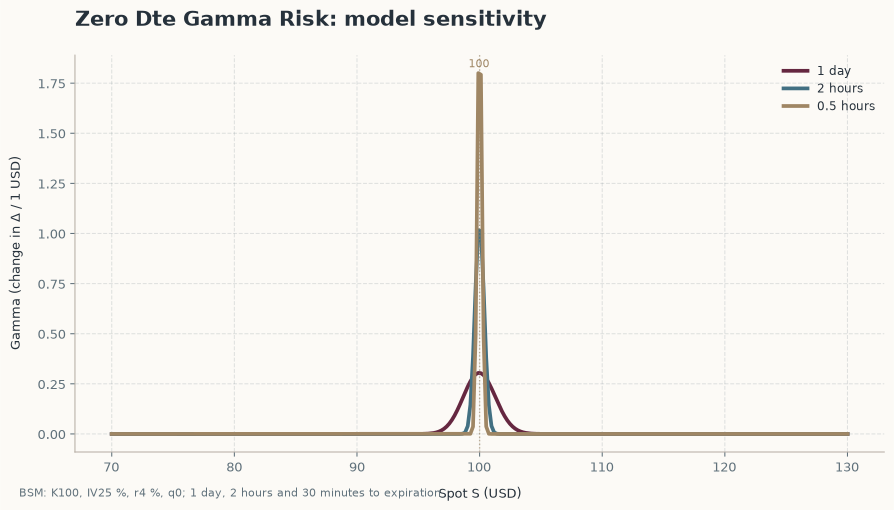
In a static chart we show gamma(S) for several short horizons, for example 1 day, 2 hours, and 30 minutes, with the same model IV and with an explicitly defined calendar time T > 0. We will not plot the infinite spike at T = 0. A secondary chart compares the scenario of a delta change at ±5/±10 points.
Before entry and during management
- Set a maximum monetary risk, not just a number of contracts.
- Check both delta and gamma near the relevant strikes.
- Distinguish mark-to-market, maximum loss at expiration, and the execution risk of exiting.
- Have an explicit plan for a move against the position and for closing before the cutoff.
Sources
- Cboe – 0DTE Trading ResourcesOfficial explanation of 0DTE and its risks.
- Cboe – S&P 500 Weeklys Options SpecificationsContract specifications for SPXW.
- Options Industry Council – Option Price BehaviorModel sensitivities.