
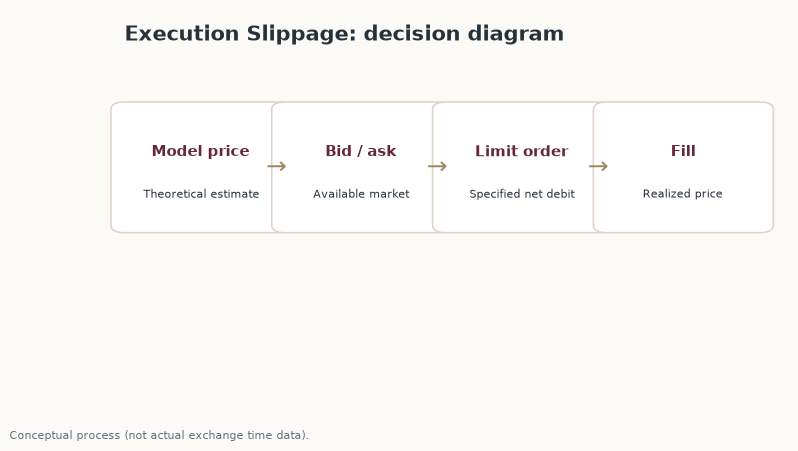
Execution and slippage describe the difference between the theoretical value of an option position and the price at which a trade actually fills. We will look at how to read the bid, ask and mid, and why multi-leg positions need real fills and limit prices taken into account.
From the model to realized P/L
The theoretical model value, the mid price between bid and ask, and the actual execution fill are three different quantities. With multiple legs, the pricing error can add up, and with illiquid series the entire displayed spread may be unexecutable. Especially with short expirations, the bid/ask changes faster than a manual order arrives.
Bid, ask, mid and limit
For a single leg with a bid of 2.00 USD and an ask of 2.10 USD, the mid is 2.05 USD. If the buyer pays the ask of 2.10, they pay 0.05 USD more than the mid, which with a multiplier of 100 means 5 USD per contract. Selling at the bid has an analogous deviation. The mid, however, is neither a guarantee of a fill nor an immediately attainable market price.
Four-leg structure – the cost of the spread
Purely illustratively: if on each of the four legs we cross from the mid to the unfavorable side of the spread by 0.05 USD, the total is 4 × 0.05 × 100 = 20 USD for one four-leg structure in a single execution cycle. The same modeled disadvantage on the exit means 40 USD in total for a round-trip, even before commissions. In a real complex order book, execution slippage need not be a simple sum of the individual spreads.
Multi-leg fill, slippage and partial fills
For a complex order, the total net debit/credit and the limit price of the combination are evaluated. The resulting price depends on the current liquidity of the combination and the available counterparties. If the trader sends the legs separately, they are exposed to legging risk – the risk of price movement and a change in exposure between the individual fills.
What to require from a backtest
A backtest must not automatically assume a perfect fill at the mid. It needs bid/ask snapshots from the same time, commissions, a realistic limit procedure, fill probability, rules for order rejection, and spread changes under stress. Missing historical quotes mean estimation uncertainty; we do not invent precision that the data do not have.
Before every entry
- Set the required net debit/credit as well as the maximum permissible slippage.
- Check the depth and spread of the least liquid leg.
- Define in advance the procedure for a non-fill and the exit plan.
- For P/L, distinguish between the model, the current quote and the actual fill.
Sources
- Options Industry Council – Put/Call ParityMarket frictions and bid/ask in option combinations.
- Options Industry Council – Option Price BehaviorInputs to option pricing.
- Characteristics and Risks of Standardized Options — OCCRisks of price execution, liquidity and transaction costs