
As we mentioned in the previous article, with options we can roll the strike or the time (or both). But what is it for?
In all examples we will work with two option chains:
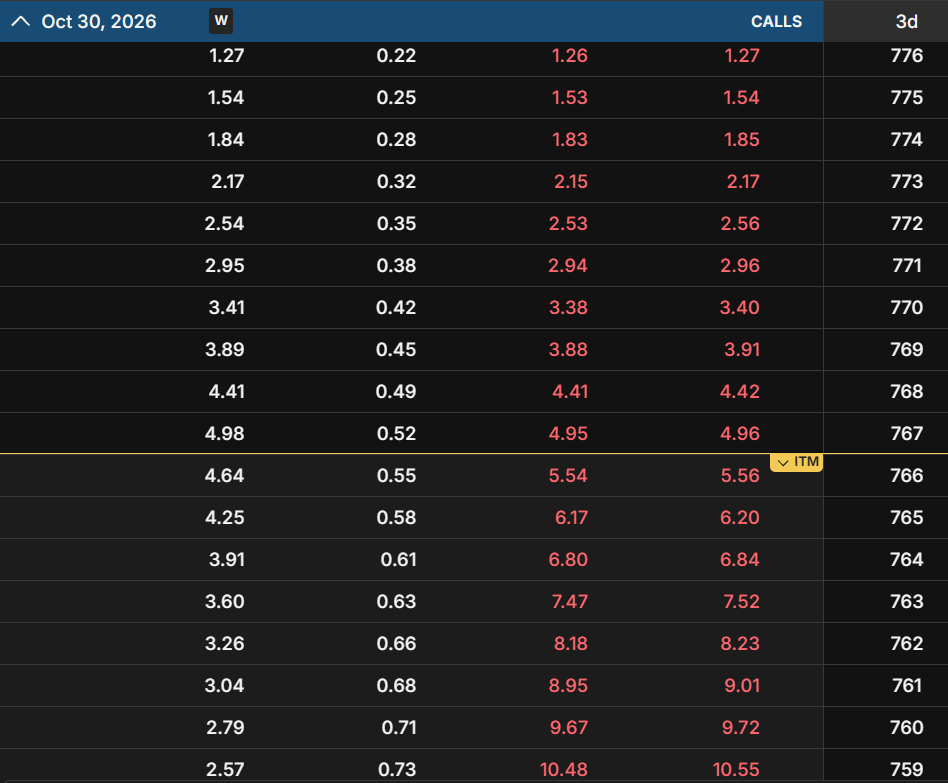
SPY - 3DTE (3 days to expiration)
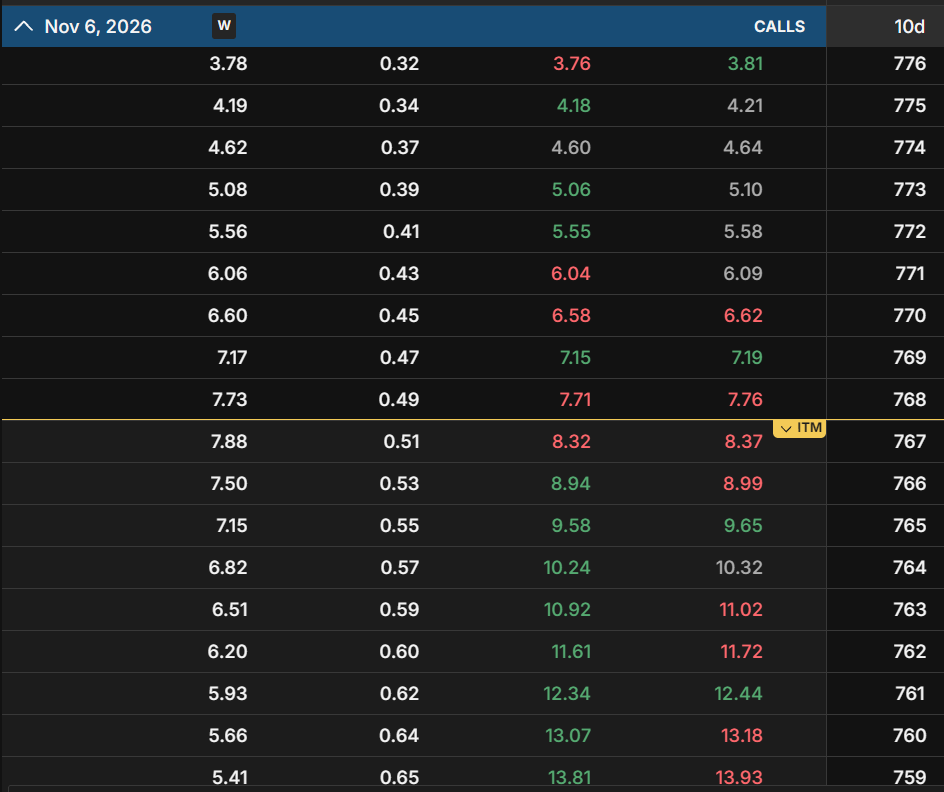
SPY - 10DTE (10 days to expiration)
Rolling in time (roll-out, roll-in)
Imagine that you have written (sold) a call option on SPY with a strike of 767 USD, which now has 3 days left to expiration (3 DTE). Looking at the first option chain, you find that if you want to buy this option back and thus close your position, you will pay 496 USD. However, if at the same time you write a new call option with the same strike of 767 USD but with an expiration in 10 days (10 DTE), according to the second option chain you can collect a premium of 771 USD. The result of these two transactions will be:
Buyback of the original option (3 DTE): −496 USD
Sale of the new option (10 DTE): +771 USD
Net credit from the roll: +275 USD
So for extending the option position by another 7 days you gain a net credit of 275 USD (the calculation assumes execution of the trades at the stated prices and does not include transaction fees).
Practical use – regular option writing
Rolling in time is often used in strategies based on repeatedly writing options and collecting option premiums.
Imagine, for example, that you write an OTM (out-of-the-money) put option whose strike lies below the current price of the underlying asset. You can choose, for example, a typical option with an absolute delta value between 0.10 and 0.30. For writing the option you collect a premium. Because the option is OTM, it has no intrinsic value. Its entire price consists of extrinsic value. One of the factors that reduce this value is time decay (theta decay). As the time to expiration decreases, the extrinsic value of the option, all else being equal, falls. This is advantageous for the writer: if the price of the underlying asset stays sufficiently high above the strike and there is no significant increase in implied volatility, the price of the written put option can gradually decline. You can then buy the option back at a lower price than you originally sold it for and realize a profit.
You do not have to wait until expiration.
If, for example, the value of the written option falls to 10–20 % of the originally collected premium, you can close the position and possibly write a new option with a later expiration. In this way, the time decay of options can be used repeatedly. However, it is important to realize that the price of an option does not fall automatically every day. Movement of the underlying asset or a change in implied volatility can outweigh the positive effect of time decay on the written position.
At the same time, it holds that the collected option premium is not risk-free income. If the price of the underlying asset falls significantly, the loss on the written put option can substantially exceed the premium received.
The opposite procedure – Roll-in (Roll-back)
We can also roll in the opposite direction, that is, move the option position to a nearer expiration date.
Imagine that we have written a call option on SPY with a strike of 767 USD and an expiration in 10 days. However, we decide to shorten the time for which we want to hold this position and move the expiration to 3 days. We therefore buy back the original option for 771 USD and at the same time write a new call option with the same strike but with an expiration in 3 days, for which we receive 496 USD. The result will be:
Buyback of the original option (10 DTE): −771 USD
Sale of the new option (3 DTE): +496 USD
Net debit from the roll: −275 USD
In this example, therefore, for moving the expiration 7 days closer we pay 275 USD (again without accounting for fees). Such a roll is called a roll-in, or alternatively a roll-back.
By shortening the expiration we do shorten the duration of the new option position, but at the same time we change its risk profile. Short-term options can, for example, be significantly more sensitive to rapid movements of the underlying asset (higher gamma). Therefore, even a roll-in does not automatically mean a safer position.
Summary
Rolling in time allows the trader to actively adjust the duration of the option exposure:
Roll-out (roll-forward) – moving to a later expiration, which for written options with the same strike usually brings an additional credit.
Roll-in (roll-back) – moving to a nearer expiration, which for written options with the same strike usually requires paying a debit.
In both cases, however, it holds that rolling represents closing the original position and opening a new one.
The goal of rolling is not automatically to create a profit, but to adapt the option position to the current trading strategy and the desired risk profile.