
In this article, we will look at the basic parameters of an option and their effect on its price. As a simple example, we will use a call option on SPY. When choosing an option, we decide primarily among these parameters – strike, expiration, and volatility.
Strike
Strike means the price at which an option can be exercised at expiration. A 760 call on SPY gives the right to buy 100 units of the ETF at 760 USD per unit, for a total of 76 000 USD before fees. If, at the time of purchase, the current price of the underlying is lower, for example 750 USD, it means that the option is out-of-the-money (OTM); if it is exactly at the price of the underlying, that is 760 USD, it is at-the-money (ATM); and if it is higher, for example 770 USD, it is in-the-money (ITM).
The price of an ITM option also includes, in addition to time value, so-called intrinsic value – because I can buy at 760 but immediately sell at 770. The more ITM the option is, the more expensive it is. All else being equal, the more OTM a call option is, the cheaper it is.
Example of an option chain: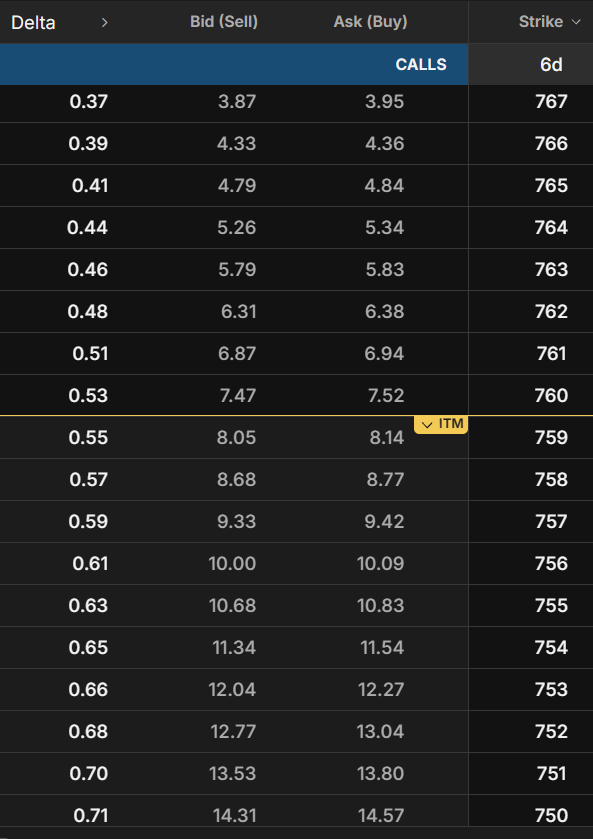
Expiration
An important parameter of an option's price is its length – since holding a long option means having a right, it is logical that the longer this right is (the possibility of exercising it), the more expensive it is. For example, an option for 1 day is, with otherwise identical parameters, cheaper than an option for 1 year.
It is important to realize that, for example, an option for 6 months is not automatically 6x more expensive than an option for 1 month. An example: a long call 760 on SPY for 6 days currently costs 749 USD, for 27 days 1459 USD, and for 158 days 3924 USD. This is used in more advanced structures, such as time spreads.
Volatility
The volatility of the underlying also significantly implies the price of an option. Imagine two stocks, A and B. The price of stock A moved over the last year in the range of 95 to 105 USD. The price of stock B moved over the last year in the range of 50 to 150 USD. For which of them will options be more expensive? The answer is, of course, hidden in probability. The 150 Call option on the stock has, given the history, a very small chance of getting into the money. In contrast, the 150 Call on stock B has a very solid chance of being in the money by the time of expiration. Therefore, the option on stock B will be (much) more expensive. In practice, we can see this difference, for example, in defensive stocks (e.g., KO, DUK, RSG, etc.) and technology stocks (such as TSLA, MU, etc.).
However, the volatility of the underlying changes over time – it is therefore good to monitor it and sell high and buy low 😊In addition to the implied volatility parameter, which denotes the expected movement of the underlying, there is another parameter, the so-called IV rank – as a rough guide, it can be used as follows: if the IV rank is below 20, the volatility of the underlying is generally considered low and buying options is recommended; if, conversely, the IV rank is above 40, selling options is considered appropriate.
These three parameters are the most basic ones that an options trader should consider – the specific structure and timing of entry into a position should be based on the technical analysis of the specific stock.
Sources
No external sources are listed for this article.